In reference
to Perry Mick's broken tension bolt...this was on an RX8?
He was only running at 4500 to 5000 rpm...perhaps
it might be even less reliable at a steady 6000 rpm?
I get the impression that nobody has had such a problem
with other 13Bs? Actually the 'fix' of drilling larger diameter
bolts could be problematic if it weakens the housing or
encroaches on cooling passages etc. Thoughts? Thanks.
Gene Kahn
No 13B.
This problems has been around for years and Mazda changed the
design of the bolts several times. If you put RTV on any
of them problem solved. Heck a few O-rings would work
if you could keep them in position. I think the latest
have a bit of heat shrink tubing located around the middle.
Could be on the RX8 bolts as I have yet to see one.
It happens when the sustained RPM hits the resonant frequency
of the bolt. That changes to a certain extent by how much you
torque it. Like tuning your violin. What works at 6000 might
not work at 4500.
No problem drilling these out to .500 inch from 10 mm (.3937").
There is plenty of room around the bolts now as they are
not used for locating anything. When drilled out
they do locate everything. Just like 17 dowel pins.
The frequency of the half inch bolts has been moved way up
above the max possible RPM of the engine. Not to mention
they are constrained from vibrating in the violin string mode
by the bolt bores.
They do add a little weight.
I want to make it perfectly clear these 1/2 inch bolts are not
necessary unless you are asking for over 350 HP from a two
rotor by boosting it.
Paul Lamar
I have recently seen a broken S4 tension bolt despite really good RTV
spiral beads...
Most of the standard extraction tricks have been tried, waiting for 12"
left hand drill bits to arrive.
The S5 and later bolts are heavier and have a section that is supposed
to deal with resonances.
I would go with several layers of heat shrink instead of RTV.
I've read of several problems with improperly doweled engines.
Cheers
Cary
He does not want to disassemble the engine? I assume it is not leaking
internally?
You mean left hand easy outs to get the broken part of
the bolt out of the front end housing? Why not just weld one up?
How are they improperly doweled?
Paul Lamar
Nope, he is avoiding a teardown - but it could have been rebuilt by now.
There is very minor coolant leakage, in theory you could seal the hole
and pretend it never happened :)
The bolt broke in the threads near the edge of the front iron, as I've
heard with similar, rare, tension bolt failures. There was a bit of a
barb left on the tension bolt - it provided enough contact area with 1
person pushing on the bolt and another person loosening to partly back
it out, but the broken portion in the front iron jammed.
Several short extractors and LH drill bits were tried with welded and
silver soldered extensions, mostly old tensions bolts.
See
www.icscuttingtools.com <
mailto:sales@icscuttingtools.com for 12"
left hand AC drill bits.
There were threads on doweled engine failures on rx7club.com years ago -
I seem to recall comments about improper alignment and cracked housings.
I wouldn't go to any corner garage for this mod.
Cheers
Cary
The root of a thread is a built in crack and putting this part
of a threaded bolt in bending is a big no no. That is where they always
fatigue and break in the rare cases that happen. Some early tension
bolts were necked down for this reason but I think Mazda stopped
doing it for cost reasons. The latter bolts had a couple of grooves
in the center to upset the resonant frequency. Then they added the
small section of heat shrink tubing. I believe that has made a broken
tension bolt even more rare.
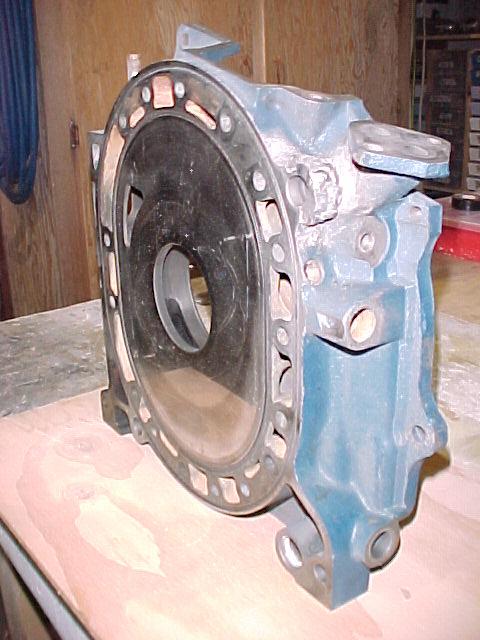
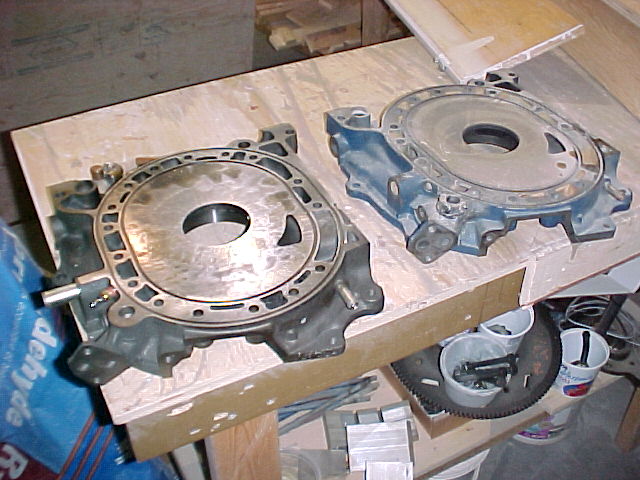
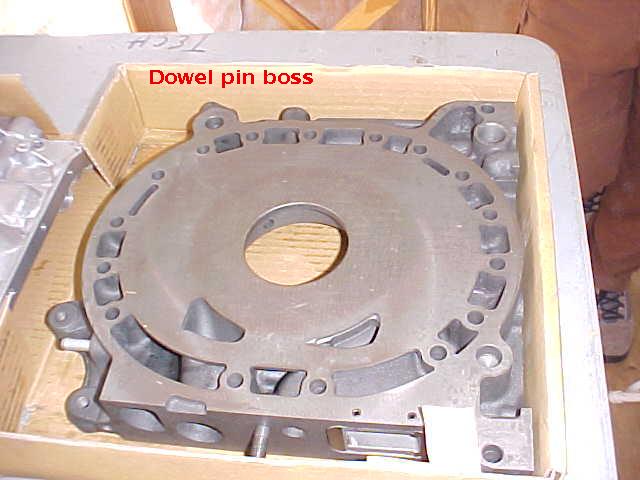
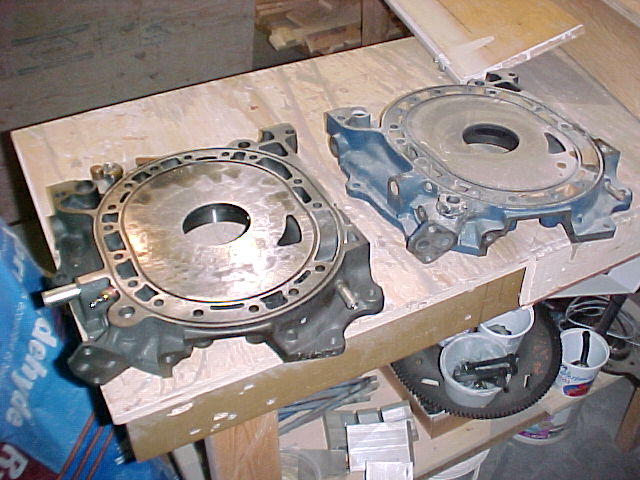
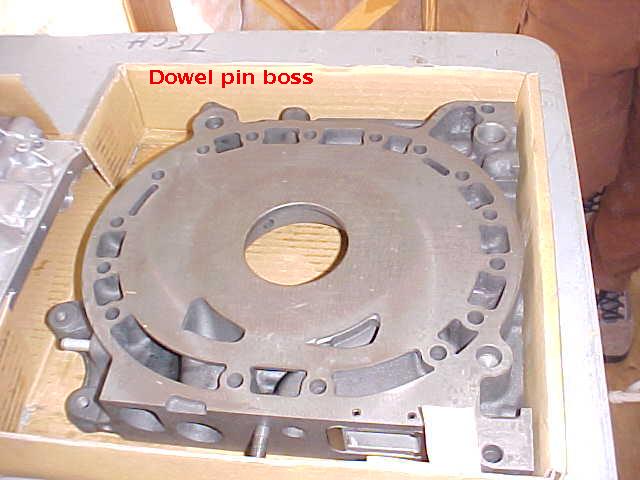
Prior to the 3rd gen engine, when they beefed up the rear housing
around the dowel pin, cracks happened on the upper dowel pin boss
on boosted turbo engines. The RX8 engines also have that feature.
The theory was the engine was detonating due to improper timing
or bad fuel. Rino Lacomb cracked one a few years ago on a normally
aspirated engine. He replaced it with a 3rd gen rear housing.
RX7 3rd gen engines were built between 1992 and 2004. Mostly in
the rest of the world and Japan.
I have seen that recently on a front housing that
was supercharged. Total HP was in the neighbor hood of 400 HP.
The torque generated by the front rotor goes through those two
dowel pins to find its way to the transmission.
It was fixed by going to 1/2 inch tension bolts from 10 mm.
That in effect added 17 dowel pins :)
The position
of the motor mounts is also a factor. Front motor mounts
on the original 12A are an example. Mazda has moved them around
at least three times. They went from the front cover to the
2nd gen center housing and then to the 3rd gen rear housing and
then back to the center housing on the RX8 engine :) We have
moved them up to Jeff's aircraft gear box adapter plate to take out
the 600 foot pound prop torque directly. It does not go
through the engine at all. Mistral passed this torque all the
way back to the front cover again by using a LYcoming dyno focal
type mount. Not a good idea.
We always hear about the problems and don't notice the 2 million
engines that have been built and successfully used for years? Yes
folks over 2 million rotary engines have been built by Mazda. My
guess is over 300,000 RX8 engines alone have been built since
2004.
Paul Lamar
--
The Rotary Engine NewsLetter. Powered by Linux.
ACRE NL web site.
http://www.rotaryeng.net
Youtube key word PaulLamar2
Copyright 1998-2011 All world wide rights reserved.