I am aware of the fragility of the oil lines used by Mazda from their
oil metering pump to the point of injection, but is that a good reason
to do away with the pump for aircraft use? I suppose if you're a belt
and braces (suspenders) person it might be a good idea to run the pump
and add oil to the fuel as well. I understand that some 2 stroke oils
remain mixed better than others so surely the pump could be more
reliable, particularly if the Antipodean habit of using 2 stroke oil in
the sump is followed. There seems to be some strange belief out there
that 2 stroke oils are in some way inferior to the usual heavily
advertised engine oils that leave all sorts of deposits when burnt.
John Evans
That is one good reason but another is mixing spreads the oil
better in the rotor housing. There is no doubt in my mind
that synthetic oils, and two stroke oils are in that category, are
better. If in doubt give it the 500 degree F oven test.
The apex seals run 500 F at full chat.
Paul
Our house is regularly inspected by the neighbor's cat, his name is
Diesel, but as I don't feed him I haven't any cat food tins. Furthermore
my courage fails me when I contemplate the oven test you recommend:).
I'm not sure of its relevance anyway.
Two stroke oil is designed to burn cleanly and leave minimal deposits,
some are better than others in this regard.
"Crankcase" oils on the other hand are not designed to be burnt in the
quantities required in a rotary so they do tend to leave deposits.
Antipodean experience shows that under racing (or for that matter road)
conditions 2 stroke oil is satisfactory in rotaries, and is apparently
generally used.
Of course there is the possibility that conditions are different in the
Southern Hemisphere, perhaps it's Coriolis effect? Seriously, there
remains the possibility that motor racing does not raise the tip seal
temps as high as aviation use, but then dyno tuning would be similar to
aircraft use, so why doesn't 2 stroke oil gum up the tip seals as in the
recommended oven test?
I know it's inconvenient to have someone asking these questions, but if
this site is to have any resemblance to using "scientific method" we
must be prepared to put up with this and enjoy the challenge of bouncing
stuff off each other.
John Evans
-------------------------------------------------------
It is not inconvenient to have someone asking these
questions. We are just not in the business of
developing oils. We are focused on making the
rotary engine easier to install in aircraft.
Our secondary goal is educating people on
the advantages of the rotary.
My test is what are we going to gain by taking a risk?
If it is not broken don't fix it.
It has been working for at least 30 years.
It is a well known fact that 2 stroke oil works
fine when mixed with the fuel to lube the apex seals.
It is also a well know fact that 2 stroke oil burns
cleanly. Mix half and half 2 stroke oil with
gasoline and burn it. That will confirm that fact
in few minutes. There are literally a thousand or
more Mazda rotary powered cars in the US racing.
65,000 RX8's have been sold here year after
year until recently when everything dropped dead.
I contacted Mazda engineering in Japan about their
recommendation or lack there of on synthetic oil.
This was no small achievement. It took me quite some
time. I also got a private tour through the rotary
engine assemble plant March 2004 in the bargain. The
guy standing to my left was (could be still be) the
chief engineer on the RX8.
Mazda claimed the reason they do not recommend Mobil 1
synthetic oil was simply because they have not tested
it. Idemitsu has formulated a special synthetic oil
especially for the rotary. That is now being sold
in the US. It is what I now use instead of Mobile 1.
I have owned at least three different rotary
powered cars since Mobile 1 has been available
and used it in these cars. I have owned six rotary
powered cars total since 1973. Some with over 300,000
US miles. I have other cars I also used it in.
Others have also used it with no problems. I do
know it stands up much better than all the half
dozen mineral oils I have tested at 500 F. There
are local hot spots in any engine under certain
circumstances so I am thinking why take chances
with something else?
I had a Dodge Caravan that had 200,000 miles on
it. Everything else failed except the engine.
It was fed Mobil 1 its entire life. The engine was
still running strong and passed California smog
inspection when I got rid of it.
The bottom line is what do you hope to gain by
using 2 cycle oil in the crankcase? How long
do you proposes to test it before you can conclude
it is OK let alone better?
Paul Lamar
Paul,I would like to suggest a particular brand of 2-stroke oil to
mix with gas. The motorcycle shop I worked at during college used this
in our own bikes and sold a lot of it to customers of other brands of
bikes. It is made by "blendzall" this is a very clean burning castor
based oil which does not tend to settle to the bottom of the tank if the
bike sits up for a week. We had been shaking up the bike before starting
to remix the outboard brands of oil but didn.t need to with the
blendzall. Some people mixed it as lean as the label recommendations
with no problems, however I mixed it more like 22 to 1.As an added
benefit it doesn't seem to reduce the octane of the gas prompting some
people to claim it is an octane booster. I don't know if that is true
but the performance seems better with it.Anyone interested in this
product can research it on the internet.
george grimes
Oh dear, I can feel a philosophical ramble coming on.
We are all, to a greater or lesser extent, products of not only our
genes, but very much, our environment. I'm not sure where my skeptical
streak came from, but I have to confess to being a great admirer of the
little boy at the parade who had the temerity to point out that far from
being dressed in his fabulous new clothes, the Emperor was wearing his
"Birthday suit". Nobody has told us of his fate, perhaps his obvious
mental aberration was dealt with by the popular treatment of the day.
We can laugh at this today, but in reality our unquestioning acceptance
of a lot of what passes for news and advertising copy today brands us as
somewhat uncritical.
What's this got to do with 2 stroke oil?
My adventures with various unfortunate motorcycles (2stroke of course)
gave me an enormous respect for what a little bit of it can do in those
bikes despite my modifications.
In my work as a Designated Aviation Medical Examiner, which apparently
qualified me to also perform fitness assessments on racing drivers, I
learned many interesting things. From multiple sources (including a
winner at Bathurst in an RX7) I learned that certain 2 stroke oils were
routinely used in rotaries for road and track. This has been going on
for many years now without any adverse effects that I am aware of. This
is not just an experiment, it is normal practice.
Contributors to this site with long memories may recall that some time
ago I posted the results of some tests my Engineer friend and I
performed on various oils. In keeping with proper scientific method I
invited attempts to confirm or debunk our findings. I was disappointed
at the lack of any attempt to confirm or debunk.
We undertook this research as I wanted to know whether or not the oil
film strength of the tested 2 stroke oils was sufficient for it to be
used in Tracey's PSRU, i.e. circulated from the oil pan. Such
information just isn't available, all I could find was a lot of
advertising copy and pontifical statements about the quality of various
oils.
Now look, I accept that the world's most popular lubricant is BULLSHIT.
I agree that it has its place, it makes the world run smoother. Where
would politicians be without a good supply? I don't believe we should
use it in rotaries without further testing.
John Evans
Ambition: To be a good observer.
-------------------------------------------------------------------
-------- Original Message --------
Subject: Oil film strength tests
Date: Sun, 11 Jul 2010 20:31:10 -0700
From: Rotary Engine
<rotaryeng@earthlink.net>
To: AAA Put this in the To box
<rotaryeng@earthlink.net>
G'Day Paul,
I would again like to subscribe to your Newsletter.
A few years ago I was a subscriber. At that time I posed a
question regarding oil film strength in relation to the
normal Australian practice of using two stroke oil in the
sump of rotary engines, including those used in competition
as I was proposing to use it and circulate it through one of
Tracey Crook's reduction drives. I was unable to find any
objective information to compare ATF and two stroke oil.
We built a fairly simple oil film strength testing device
giving us a reading on the load applied and the amount of
friction generated reading as amps. On being shown our results
recently Tracey remarked that the components of Mobil 1 were
responsible for a lot of apex seal problems. No such problems
appear to occur on two stroke oil here in Australia.
If you think your subscribers would find our results of
interest I would be happy to share them with you.
Let me know.
Regards
John Evans
Quote.
"On being shown our results recently Tracey remarked that the
components of Mobil 1 were responsible for a lot of apex seal
problems."
Whose apex seals? Tracy's apex seals? Stock Mazda apex seals?
Tracy is selling apex seals.
We have been running Mobil 1 for at least 25 years in our rotaries
with stock Mazda apex seals with no problems. We did a 500 F oil
bake test and Mobil 1 came out on top of all the oils we tested
except for turbine oil.
As far as I know, and some of the evidence would support that,
Tracy's apex seals are made from steel. We warned our readers 12 years
ago about making apex seals out of steel. Mazda apex seal history
also indicates that. Apparently and a lot of other info supports this,
cast iron is the best metal to make apex seals and piston rings
for that matter. Apparently it is porous on a microscopic level
and retains lubricant while steel does not. Mazda spent millions
coming up with this conclusion. The 13B apex seal environment is
severe with the seals running at over 500 F.
Does your film strength tester test at 500F?
Unless you are testing at 500 F you are not testing :)
What works best is Ianetti ceramic seals made from silicon nitride.
Silicon nitride is used in high speed ball bearings as it will
run over 1000 F while regular ball bearings start to have
problems at 500 F.
Read this
http://www.rotaryeng.net/seals.html
Paul Lamar
Thanks for your reply Paul, I don't know anything about
Tracey's seals, I showed him the results in relation
to his gearbox. We certainly didn't attempt to "bake " the
oil in our tests, so far as I know what we did was a valid
test for oil film strength in a gearbox. Both the air cooled
and water cooled two stroke oils we tested were very good.
Perhaps one of your subscribers would be interested in
replicating our tests to confirm/debunk our findings?
John Evans
I don't think running the engine oil in the gear box is
a good idea to begin with. You should use gear lube I suspect.
What do the Rotax guys do? Lots of two stroke Rotax's out
there with gear boxes.
Paul Lamar
_
John, I would like to see the some reference to the testing
protocol you are describing, for replication.
I work at the R&E Center for Ford Motor Company in
Dearborn MI. Having participated in numerous laboratory
and production automotive environments, it is clear that
he gathereing of data, and it's interpritation must be
clearly laid out, and of course repeatable.
I'm interested in replicating your testing protcol.
C. Smith
Strangely enough the person I work with is also C Smith! As I
mentioned in the original post it was a fairly simple device we
used consisting of a 1/4 hp electric motor with a mild steel
disc about 1/4" wide and 1" diameter. A pivoted lever with the
test piece mounted on it was pulled up by a large spring and
spring balance scale to measure the load. The length of the
lever multiplied the reading on the spring balance by a factor
of six. The oil to be tested is applied to the test piece after
carefully wiping off any previous oil, the load is progressively
increased in steps and applied with the motor already running
until oil film breakdown is evidenced by a sudden increase in
amperage reading, the motor slowing and smoke from the oil.
All this may seem fairly simple and even crude, but it did work
and was impressively repeatable.
Paul, as originally stated, the aim was to compare ATF and two
stroke oil as Tracey's reduction drive uses the planetary set
out of a Ford automatic - a C6 I think. As you know these are
designed to be lubricated by ATF. We wanted to get an
indication of their oil film strengths, but we did go on to
check a few other oils we had on hand.
As there seems to be some interest I'll dig the results out and
post them shortly.
John Evans
John, I don't want to ruffle any feathers, but a summary look at your
protocol only tells us relatively how long one could turn the starter before
damaging the bearings, if the oil pump failed immediately after 5 or 6 turns
of the crankshaft, in a relativistic way.
Kind of limited utility.
C. Smith
-------- Original Message --------
Subject: Oil Film strength
Date: Sun, 11 Jul 2010 03:54:43 -0700
From: Rotary Engine
<rotaryeng@earthlink.net>
To: AAA Put this in the To box
<rotaryeng@earthlink.net>
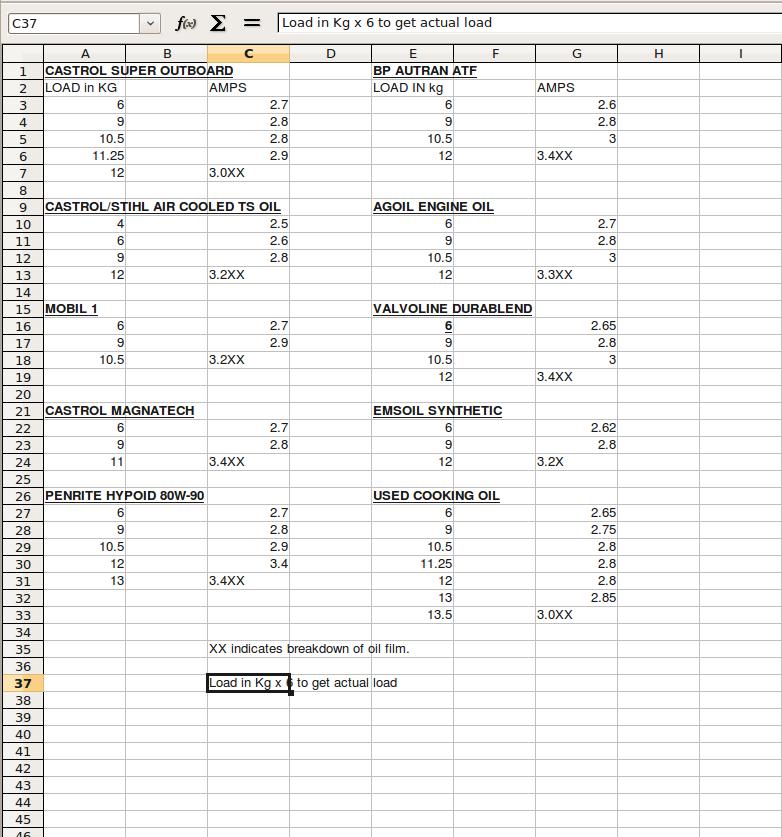
Test results attached, note that XX indicates breakdown,
the load indicated has to be multiplied by 6.
We did the used cooking for a laugh!! Please don't
accuse me of recommending its use as an engine
lubricant, although it is a great diesel fuel.
We found it necessary to do our own tests as I
could not access any information giving an objective
comparison. I guess some hackles will be raised by
the relatively poor performance of Mobil 1, perhaps
it has some other highly desirable qualities.
John Evans
I think we are missing something here. Probably oil
temperature. Used cooking oil looks as good as the
best synthetics :) Somehow I doubt that :)
Paul Lamar
--
The Rotary Engine NewsLetter. Powered by Linux.
ACRE NL web site.
http://www.rotaryeng.net
Youtube key word PaulLamar2
Copyright 1998-2010 All world wide rights reserved.