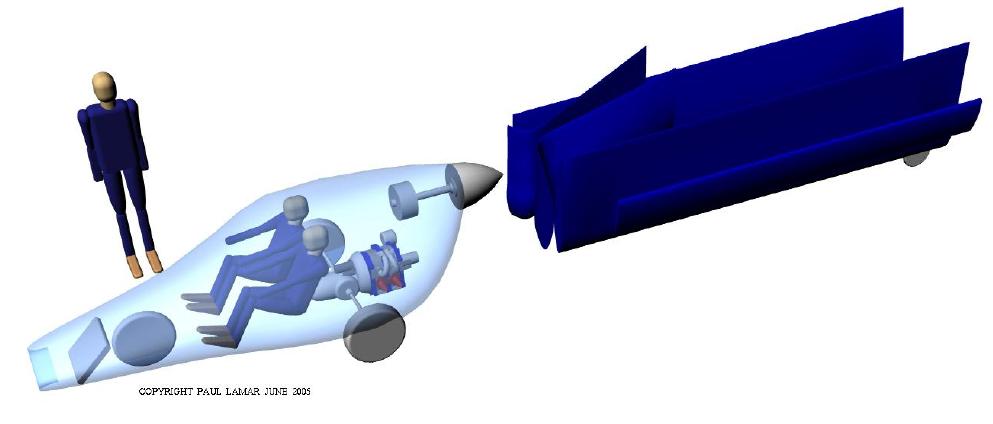
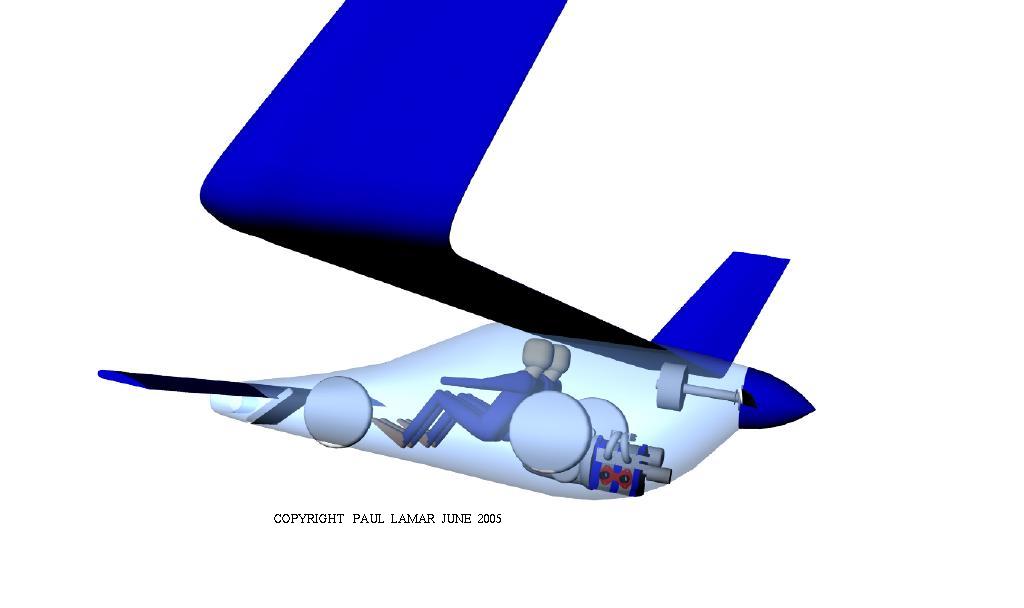
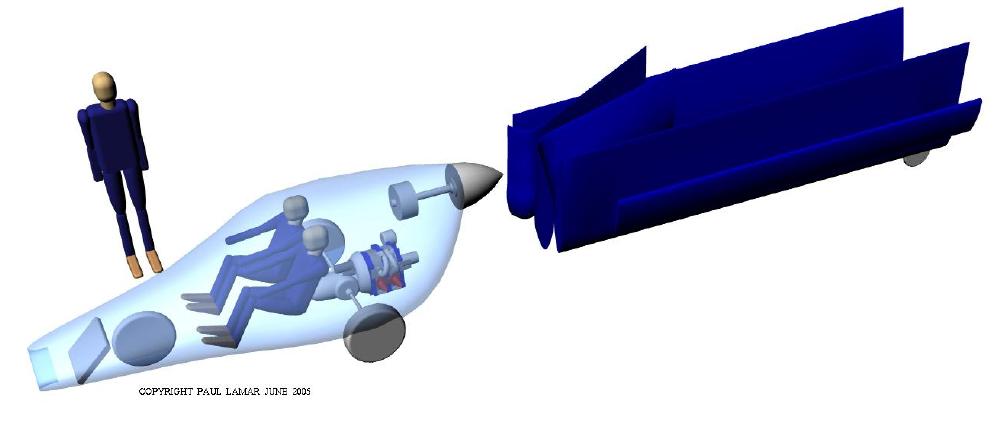
Wow! 240 mpg and on the road in 2012.
This car is almost ready for production. Probably on the road in
2012
http://www.psfk.com/2011/01/volkswagen-xl1-worlds-most-efficient-car.html
1 liter/100 km equals 240 miles/gallon
Marc Wiese
----------------------------------------------------------
This is water melon wacko environmental dishonest PR stunt.
It is easy to build a "car" that gets 200 MPG at 20 MPH. Use
hard low rolling resistance bicycle tires, carbon fiber and low
frontal area. Forget the ride, the speed, the cornering and
the acceleration or lack thereof. Forget going up hills.
A bicycle will go 20 MPH on only .5 HP. Why .5 HP? Well
that is how much a human can generate on a continuous
basis. The top speed record for a 2 human (1 HP) powered
streamlined vehicle is about 60 MPH. Brian Allen flew across
the English channel in 1979 on .5 HP or less.
http://en.wikipedia.org/wiki/Gossamer_Albatross
I consulted on the earlier Gossamer Condor.
With a model airplane sized .5 HP diesel engine with a BSFC
of .3 that is .15 pounds of fuel per hour. Fuel weighs 6.25
pounds per gallon so that is .15/6.25 or .024 gallons per hour.
20 miles divided by .024 gallons is 833 MPG!!!!
As a teen ager I had a 2 stroke model diesel engine
with variable compression ratio no less. The BSFC
was NOT .3 :)
Paul Lamar
Imagine all the effort in the wind tunnel, then Oncle Earny or Aunt Edna
buys one of those cars, only to find out that nothing of their stuff
will fit inside, so the first thing they do, is to mount a roof rack,
and bungee down a big ( blue) beer cooler.
Roger
That model aircraft engine will have a hell of a time with
the beer cooler :)
If I were Brian Allen I would have slipped a Nitto rotary
model aircraft engine in my pocket. After I got out of ear
shot over the channel I would have plugged it into the transmission.
started it up, sat back and enjoyed the ride :)
Paul Lamar
Off course a MPG figure is meaningless if not related to the mission
(payload, internal volume of the car, slope and speed pattern).
What has really been achieved by stock cars in standard offical mission
including highway at 130 km/h, small roads and city
is just under 100 grams of CO2 per kilometer, that corresponds to about
3.8 liters of diesel oil for 100 km or about 62 MPG
of course further marginal improvements are still possible, but I can't
see any technical breakthrough that can change that dramatically.
1l/100 km is just communication, propaganda or nonsense, depending or
the point of vue.
More interesting is the little Nitto Wankel engine.
20 cc is a bit small - I don't think we can get much more than 3 HP out
of it...
But on Nitto's website, there is very interesting news : a 80cc wankel
is being developed
From a 80cc Wankel engine I think we can expect 12 to 15 HP : That is
exactly what is needed to power a Cricket !
Philippe (France)
I think the Cricket is a brilliant design from a packaging point of view.
Two engines are ideal to power a fuselage just large enough to hold a human.
A Rutan Canard configuration with an all flying front wing
(pivoted around the 1/4 cord point) with the engines mounted
on the front wing might be better. One would get much more
control authority with vectored thrust than has been yet achieved
with the current Rutan design.
BTW Klaus built a short main wing span version of a Long EZ and it
was unable to take off. Does anybody know why? Hint: what happens to
the stall angle of attack as the aspect ratio is reduced?
Paul Lamar
--
The Rotary Engine NewsLetter. Powered by Linux.
ACRE NL web site.
http://www.rotaryeng.net
Youtube key word PaulLamar2
Copyright 1998-2011 All world wide rights reserved.