I am interested in using two small turbos to boost power on my
cozy 4 rx8 engine. It means I might be able to fit them rearward
towards the prop. keeping the heat away from all radiators. So I
looked at Aerocharger stuff again.
Aerocharger sells to our military and shows on their website an aircraft
rotary design using their turbo.
http://www.aerocharger.com/military_app.php
Possibly this is ground covered already, but I haven't seen this unit
discussed here over the past 10 months.
Ed Carver
That looks like a one rotor Midwest/Austro engine. That could also
be an LSA size rotary engine generating 100 HP if the rotor
cooling is adequate.
Clever idea cantilevering the turbo charger shaft.
Bearing heat and lubrication are always issues with
turbo chargers.
Also clever is using SS for the compressor/turbine wheel as it cuts
the heat transfer from the turbine to the compressor. The larger
inter cooler required removes the extra heat. I would think that
would be an advantage if one were trying to run diesel fuel in a
low compression rotary.
Looks like Pandora's box of possibilities.
http://www.aerocharger.com/kits_porsche_930.php
Thanks for uploading that Ed.
Paul Lamar
Hi Paul
Some of the Aerochargers claims appear to be significant.
Boost control, oil supply would seem to make implementation simpler.
I note that the 53 series is good for 340cfm and the 66 series for 540cfm.
Are you easily able to give us what a 13B consumes at a boost of say
14.7psi at sea level.
Cheers
Steve Izett
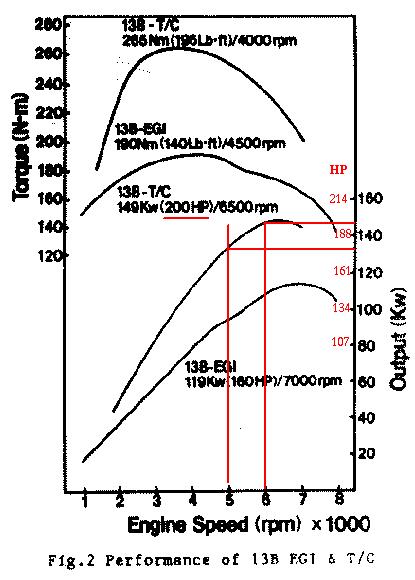
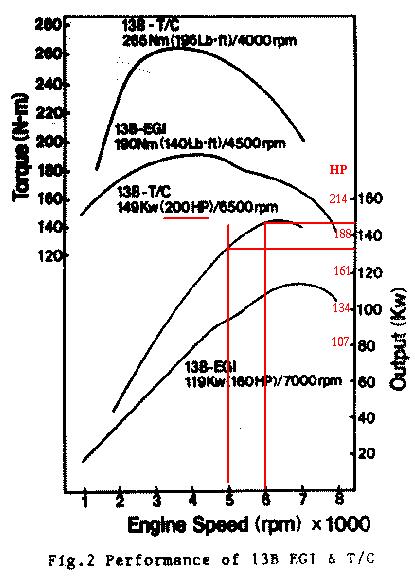
Sure. Here are some charts.
Paul Lamar
Paul,
What is the VE of side port 13B engines? 100%? I realize it will be affected
by the ports, whether street port, bridge port or stock.
The 350 draws 175 cubic inches per rev times the 0.8 VE. The chart looks right
at 405CFM. Now a rotary 13B will draw like you drew the lines for a 2.6L. But
the VE will be better than a recip engine. So if the street port is about 100%
VE, the CFM would be 125% of the chart. A p-port would be 150% of the chart.
Am I correct in my thinking?
Then you would use the above to calculate the airflow for the turbo install.
Dale Davies
Yes you are correct. A stock side port might not be exactly
at
100% but it is close. Many manifolds have been built that are less
than ideal so it is somewhat dependent on the design and manufacturing
quality of the manifold.
The tuned P-port is so simple and so easy to make the results are more
consistent at around 120% VE.
The turbo on the other hand is not so sensitive for the quality
of the plumbing. It mainly increases or decreases the back pressure and
therefore the BSFC. To a minor extent. Just jack up the boost a few psi.
You see the same effect in the exhaust. The exhaust tuning is always
less important than intake tuning.
Paul Lamar
Steve,
Scroll down to the bottom of the page on
http://www.aerocharger.com/aerochargers.php
and there is a calculator
13B acts like a 2600 cc piston engine so use 158 cu in the calculator
brian
Note the calculator does not take into consideration the actual VE.
The base VE used is 83% so adjust the size of the engine based
on that number increased to the correct effective displacement.
100% VE for side ports and 120% VE for p-ports.
100/83 * 158 = 190 cubic inches for a 2 rotor side port.
120/83 * 158 = 228 cubic inches for a 2 rotor p-port.
The side port at only 5 psi boost gives an optimistic
265 HP at 6000 RPM. While the stock 2nd gen Mazda Turbo II gets 205 HP.
Could there be a bit of marketing built into the calculator? :)
The intake design is pretty good on the 1990 Turbo II.
Either that or this company has better internal aerodynamics
than the Japanese turbo found in the Turbo II. I kind of doubt
that.
Paul Lamar
--
The Rotary Engine NewsLetter. Powered by Linux.
ACRE NL web site.
http://www.rotaryeng.net
Youtube key word PaulLamar2
Copyright 1998-2011 All world wide rights reserved.