Paul,
I realize that the intake and exhaust tubing diameter and lengths
will affect the torque (thus HP) curves. What would you attribute
the dip in the curves between 5000 and 6000 RPM? I also realize this
is only one dyno run.
I would expect economy cruise prop RPM between 2000 and 2100 RPM
which would be about 5600 to 6000 RPM engine. With that in mind, a
change in tuning of the intake and exhaust would seem to be indicated.
Dale Davies
There is a thing called "Q" The higher the Q the purer the tone
and the greater the effect. That narrows the torque peak.
It also generates dips in torque over the RPM range. We don't really
care what happens below 6000 RPM as that is an ideal cruise RPM
where the loads on the rotor bearings are lowest. It is also a low
point on the BSFC curve or fuel burn.
I am not sure how to change that. Perhaps the 180 degree bends in the
tube is already doing it because our results are broader than
the Le Manns engine and we are getting slightly less HP.
Here is the results Mazda got for the Le Manns engine. We tried
to copy that as closely as possible based on the gear box ratio
we had to work with.
http://www.rotaryeng.net/fund-of-intake.html
http://www.rotaryeng.net/Mazda_R26B_US.pdf
Paul Lamar
Hi Paul,
After reading your reply, I make note.
In the Fundamentals of Intake Design you state "with a CS prop ... slow the
engine to 4500RPM to 5000RPM reducing engine friction and improving BSFC."
On the dyno charts for the 13B p-port;
with 24.5" intake runners, about 225HP at 6000RPM and 190HP at 5500RPM.
with 28.0" intake runners, about 225HP at 6000RPM and 210HP at 5500RPM.
At 6000RPM the prop is rotating at 2105RPM. At 5500RPM the prop is rotating at
1930RPM.
At 5500RPM the prop is turning slower in the air and should have less drag
thus more efficient. With the longer intake you also have about 20 more HP
available, which should increase the air speed a bit.
Reducing the RPM from the 6000RPM which is the least bearing load to 5500RPM
will not change the bearing loads drastically. It should help the fuel burn
some though.
After reading the Mistral information a while ago, they were stating a cruise
at 2000RPM prop for economy. Their intake is also long which suggests a tune
for lower RPM.
Now the dyno of the Renesis with 19" intake would look different with longer
intake runners. The side exhaust will affect the tune also. It may provide a
better BSFC with the right exhaust and intake tuning due to less fresh air and
fuel going out the exhaust: less overlap. A bit of exhaust may be carried into
the intake charge which will act like an EGR and slightly improve detonation
resistance.
Dale Davies
The Le Mmans P-port engine had the lowest BSFC of any rotary
ever built by anyone including all the side port configurations. Pumping losses
are lower with p-ports and pumping loses are a significant factor in BSFC.
I'll have to go over that article and correct any errors.
You might note Tracy has changed the common PSRU ratio
from 2.17:1 to 2.85:1. The Mistral ratio was 2.8:1 as I recall.
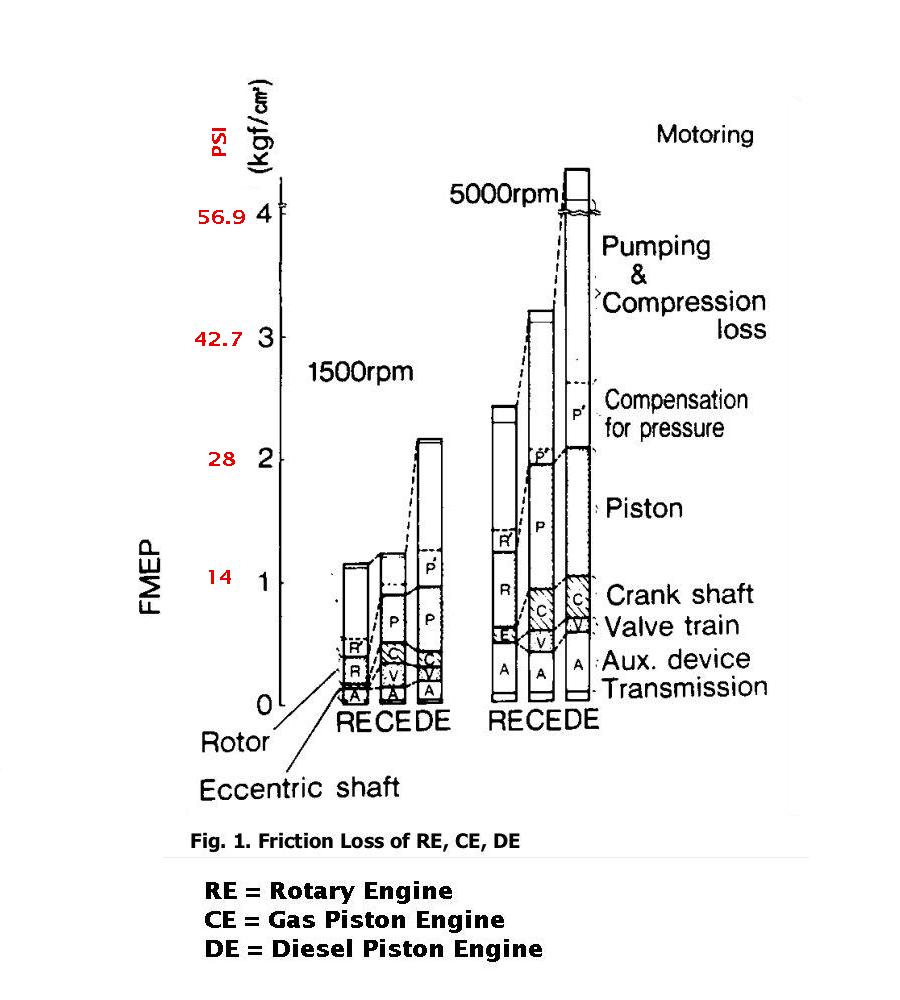
Engine friction is a minor effect in the rotary. Engine
friction is lower than a piston engine.
Here are a few numbers on that.
Paul Lamar
--
The Rotary Engine NewsLetter. Powered by Linux.
ACRE NL web site.
http://www.rotaryeng.net
Youtube key word PaulLamar2
Copyright 1998-2011 All world wide rights reserved.