I just found out that the first RX7 turbo in 1988 had a 5 psi
waste gate opening at about 6000 RPM. It gave 185 HP.
The 1991 Turbo II model had 200 HP at 8 psi.
8 psi is only 46 inches of HG. Same engine more or less.
That is 5 HP per psi so if you want more HP leave
the waste gate closed. It would not surprised me
if this engine would generate as much as 225 HP
with the waste gate closed and a boost of around 13 psi.
That should give a much better power to weight ratio
than a C182 with about the same HP. KIS cruiser gross weight is only
2300 pounds while the C182 is 3100 pounds. Both have a payload
of 1100 pounds. That is the advantage of composite construction with
carbon fiber spar caps. However the C182 has the advantage of
a constant speed prop.
Mistral claimed 230 HP, 6200 RPM and a ceiling of 25,000 feet.
Critical altitude (where full power starts to drop off)
was 20,000 feet.
Hopefully Dave Leonard will tell us what boost
he is seeing at 6000 RPM with the waste gate opened
and closed. Dave has had his 13B turbo RV6 up to 17,000 feet.
Paul Lamar
-- I too will be very interested in what Dave L reports and, of course, what you
determine Paul.
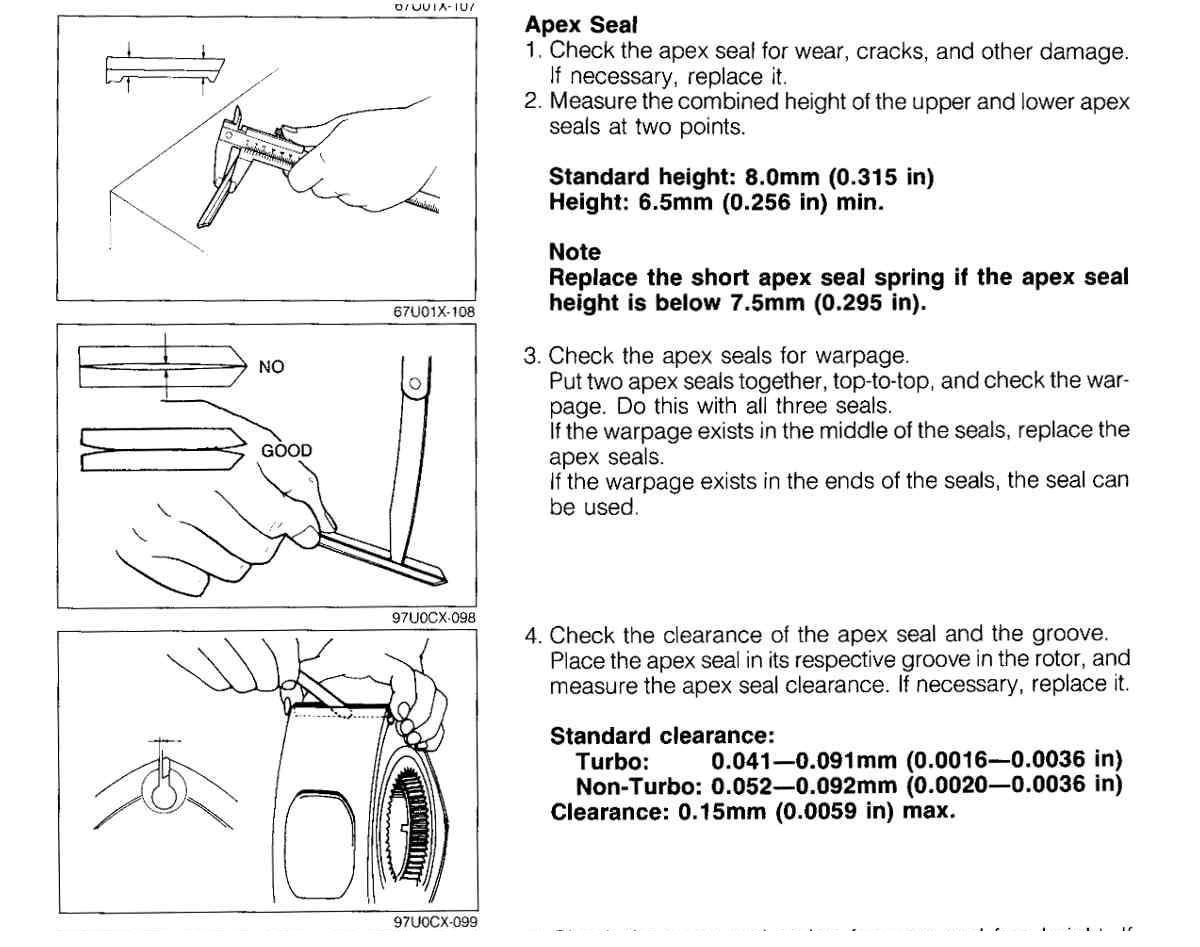
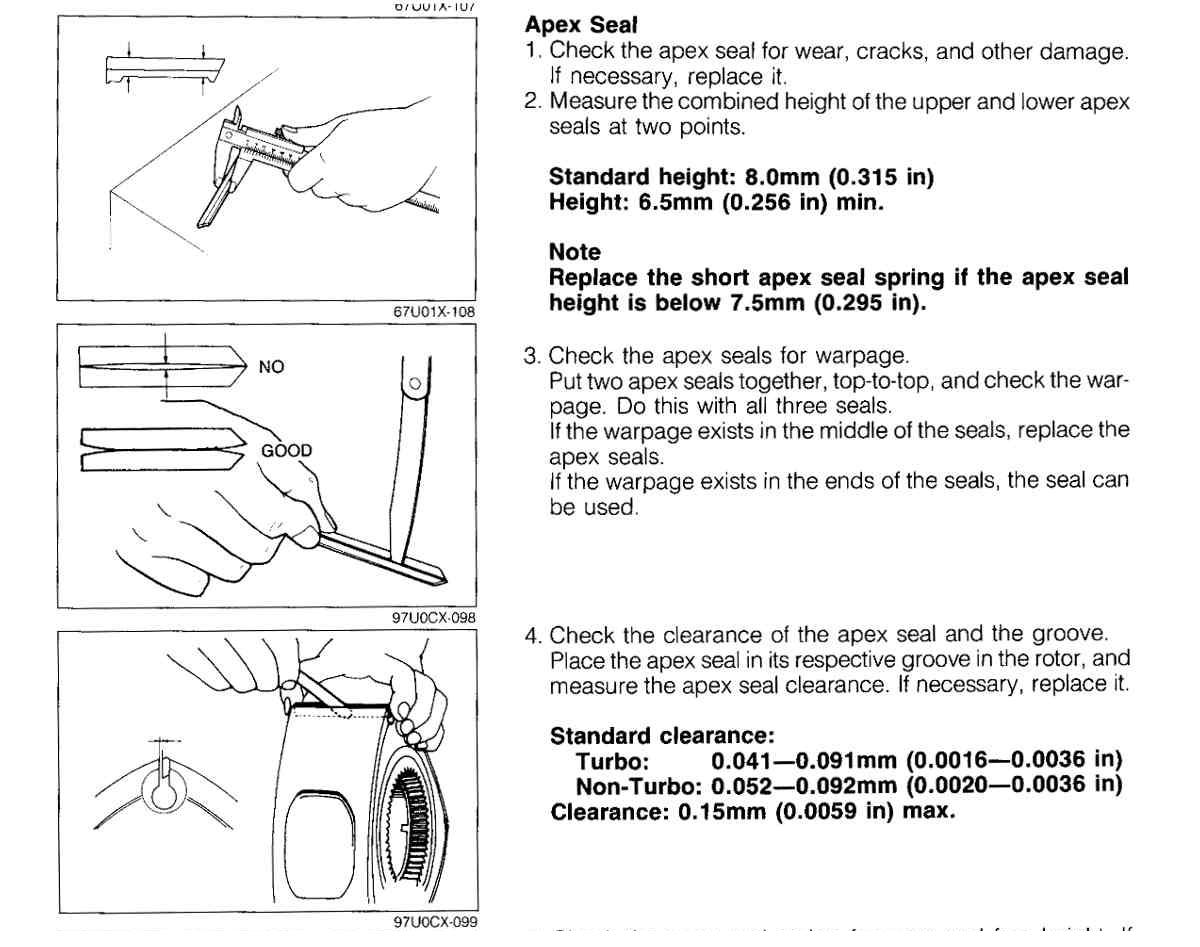
I just rebuilt my engine this last weekend due to me bending my apex seals. My
compression dropped and I was having a terrible time starting. The engine then
started running rough at the low end when it would start. So I bit the bullet
and pulled the engine and replaced the seals (also found one broken side seal)
checked everything for damage, luckily found non (it is my understanding that
some apex seals shatter, the ones I had/have did not, but you could see they
were bent when held together back to back). In the past I would have dickered
around with everything else before I would have allowed myself to just
acknowledge the core problem (so to speak) and pull the engine and repair
internal parts. Not really a problem anymore. As I have mentioned in other
places, I am no longer afraid to "let the magic out" by cracking her open.
I started the engine yesterday and it has never started so easy or run so
smoothly (at least so far....). Of course this is my fourth time to rebuild it.
It is getting much easier ;-). The first time was really another engine that
was assembled from three cores a buddy and I got online. My ignorance and low
learning curve killed this engine with heat and bad sensors (the O-rings failed
and coolant was in the chambers). I bought new end iron and rotor chambers,
however, a the brand new Mazda center iron failed at the lower water galley.
So another build. Then, a couple of months ago, fighting hard starts and
finally finding low compression in what I thought was just the rear rotor, I
just pulled the rear rotor chamber open, replaced those seals then following it
being back together determined the front compression was low too and too far
from the psi on the newly rebuilt rear chamber. (yeah, so much for short cuts).
Anyway, the rebuild only took the weekend this time. I have all my ancillary
systems in place (and the ancillary/cooling etc seem to be working well) so it
was an easy removal and then just reinstall (ok, a bit more, but it is now
methodical).
All this goes to the fact that my installation is turbo charged too. I was only
running 3lb spring when I bent the apex seals (the waste gate can be adjustable,
but currently I have a static boost with a spring...figure I should walk before
a run). I have now replaced the 3 lb spring with a 1.5 lb spring, thus very low
boost. Speculation in online commentary was that I over boosted and/or the
charge was too hot, the timing was off, the octane too low and/or the mixture
was too lean. I do not think any ONE of these is the case, however, I will
start low and increase if/when I prove it all in flight....if that ever happens.
I do have the factory intercooler, but with no airflow on the ground it does
little good.
I believe I got into a circular diagnostic mode. I would try to treat a symptom
and as I would do that I would screw something else up and eventually I got too
much timing advance, on lower octane fuel (doh, 93 is not that much more
expensive and still cheaper than Avgas) etc etc etc eventually leading to my
detonation. Of course not thinking it through I figured I would hear the
detonation like in a car...wrong, the engine, while MUCH quieter with the turbo,
is still loud AND has a prop punching the air to boot.
Anyway, as of yesterday, the engine is starting up like I have always wanted. I
am keeping the rpm's low for now (just under 4500 which is around the 22 map
that is suggested to adjust Mode 3). I hope to baby it this time until I am
secure in the process.
Yeah, it may appear that I am a complete screw up, perhaps I am, but the me of a
few years ago would sure be impressed with the me of today.
I am curious as to the "correct" PSI as to get around 200 hp without toasting
another ingine. The smaller Velocity, the SE model is rated for a I-320 (160 hp)
so everything over this is gravy.....but I want the GRAVY dang it!!!!!! :-)
(yeah, I know Paul, I should have P-porte <wink>) This is an engine with a
Mistral intake and a medium street port porting by Mazdatrix), built by your
local failure mode finder.....FWIW.
Go ahead; discuss. My flame suit is all burned up...I am now pretty
impervious...well, maybe not.
Chris
Houston
Velocity SE N17010
Chris, I have bad news. They are supposed to be "bent".
It is called "crown".
The 1991 shop manual and entire web site is required reading. Same tech as the 3
rotor.
http://foxed.ca/foxed/index.php?page=rx7manual
There will be an exam. Anybody failing the exam will be suspended :)
Anybody passing the exam will receive a Phd :)
This is one way to identify most cheap after market apex seals. They are
not "bent" or no crown :) Don't use them.
http://www.rotaryeng.net/seals.html
A cracked side seal is unlikely to be noticed when the engine is running.
Some stock 3 piece seals from around 89 up would shatter if the engine detonated
at high boost. Mazda recommends retrofitting the latest stock 2 piece seals.
Iannette ceramic seals, according to Mistral, are near impossible to shatter
despite deliberately causing the engine to detonate. Apparently the resonent
frequency is too high to cause them to shatter.
Paul Lamar
The Rotary Engine NewsLetter. Powered by Linux.
ACRE NL web site.
http://www.rotaryeng.net
Youtube key word PaulLamar2
Copyright 1998-2011 All world wide rights reserved.