Paul,
I'm looking into the possibility of using the '89-'92 year 9.7:1 rotors on
the P.P test engine.
Do you happen to know the redline for these rotors?
T.O. will be at 8300, but I would like the engine redline to be 9,000 which
is less than the Renesis engine I believe.
I may have to have the 9.7:1 rotors lightened a bit.
http://www.mazdatrix.com/faq/rotorwgt.htm
I was going to go with Renesis rotors for the 110 grams reduction
in weight and the slight increase in compression ratio, but to use
them in a 13B engine I would have to incorporate lots of the Renesis
engine parts. E-shaft, stationary gears, counter weights etc.
The biggest issue is the durability of the stock apex seals going
over the P-ports. The Renesis rotors would have to be machined both
to accept a deeper 2mm apex seals, and fix side clearance issues
encountered when used with 13B housings.
Doug in Japan
It is the rotor bearing that is the limit. As I recall the "windowed"
version of the rotor bearing is good to 11,000 RPM with just about
all stock cast iron rotors. The RX8 rotors are just a little bit lighter.
Racing Beat uses a 3D NC mill to get a few ounces out of the stock rotors
at great expense. M V squared over R.
The 13B intake p-port, if anything, is better than 13B side input port as the
apex seals are cooled better. The worst effect on the apex seals
comes from the p-port exhaust. Not the p-port intakes. RX8 side exhaust are
easier on the apex seals. The P-port RX8 engine IMHO is the best of all worlds.
If money is no object why fool around? Go with Iannette silicon nitride
apex seals. Guaranteed to last for ever and be unbreakable.
Dave Lemon at Mazdatrix melted a steel rotor housing liner by running the engine
long after all the coolant blew out. He took the Iannette seals
out and is still running them to this day in new engines.
Paul Lamar
That is good news. Thanks. I believe these are what you are referring to.
http://www.racingbeat.com/RX8/Engine-Internal.html
As I understand it the Racing Beat 9.7:1 lightened rotors are even lighter than
the Renesis lightened ones.
These come at a hefty price though and include a snap ring retainer for the
rotor gear. Note according to R.B. they must be used with a Renesis e-shaft.
http://www.racingbeat.com/RX7-1986-1992/Rotors/10007.html
Lighter is always better for less bearing stress but the at the rpms we run them
out I think it is a waste of funds. Ceramic seals, I agree, would be the
better investment. Next . aluminum side housings.
What happened to your P-ported Renesis engine? For turbo compound that may be
the most efficient engine to use.
Ditto the 16X, IF we will every see it.
Doug in Japan
To summarize: The car racers are looking for
as much as 350 HP normally aspirated at 11,000 RPM and 500 to 600
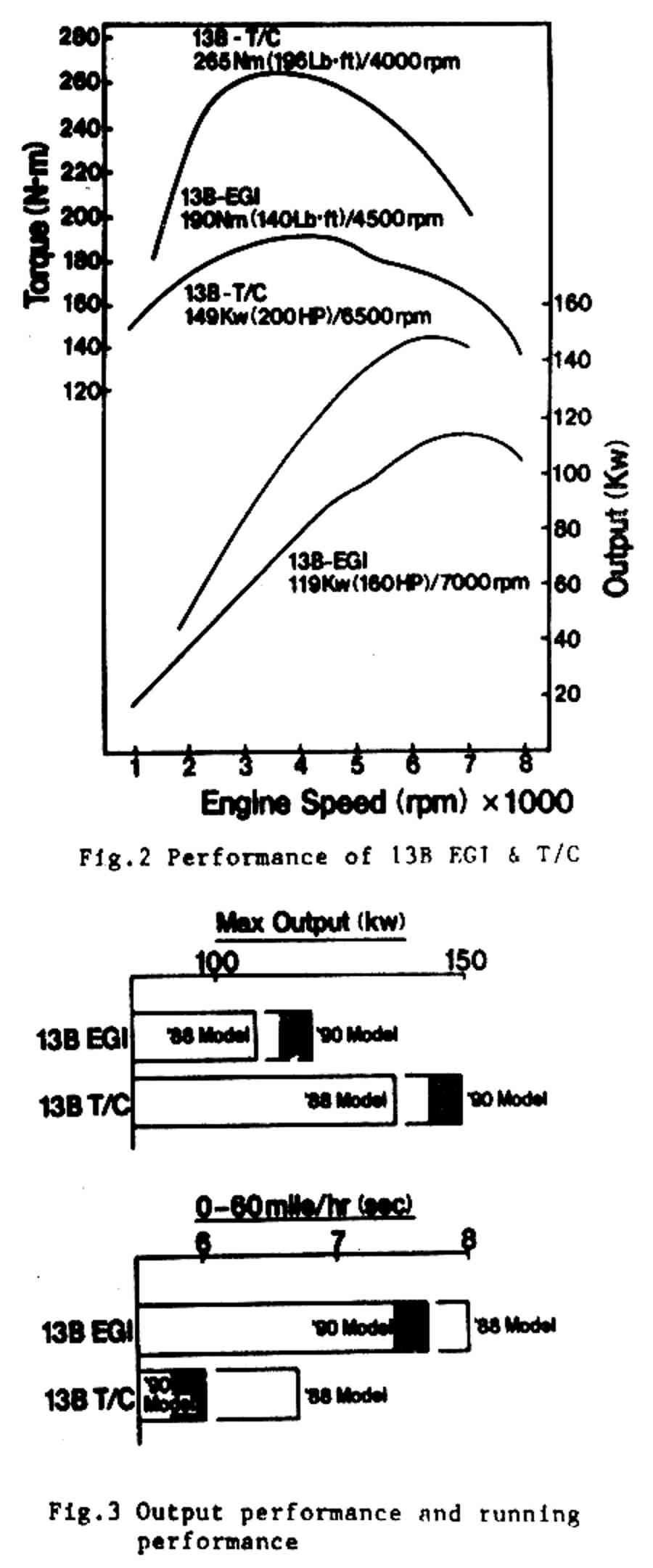
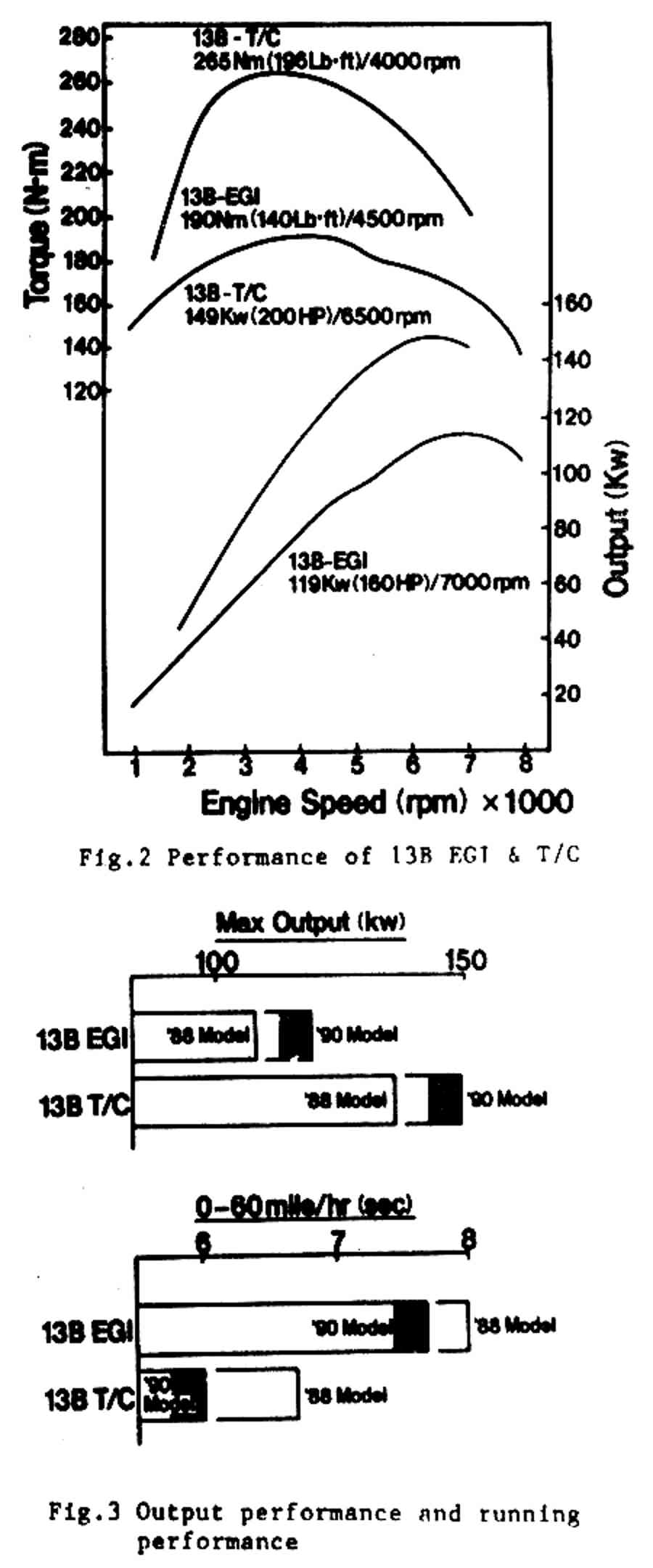
HP turbo charged at 11,000 RPM or more. The stock 13B 3rd gen turbo was 280
HP and the stock 2nd gen turbo was 200 HP. The stock RX8 was 250 HP normally
aspirated at 8,500 RPM.
The the p-port intake in all cases gives slightly lower fuel burn and a lot
more power at the RPM's we use. Namely 5000 to 7500 RPM. IMHO the stock engine
in all cases is up to it with out structural modifications. These kinds of
structural mods are not worth it nor needed for aircraft use.
IMHO anytime you make the slightest change there are unintended consequences.
Other than the stock intake which does not fit the average cowl I would only
enlarge the oil pan to increase oil volume. My O-470 230 HP Continental has
12 quarts for a reason. First and foremost important it delays oil heating
on take off, and second, it insures you never run out of oil on four
and five hour x countries. However the rotary does not burn oil if you mix 2 cyc
oil with the fuel.
My 250 HP at 7500 RPM p-port RX8 engine is going in Mike Will's RV4 along with a
new 2.85:1 PSRU.
Paul Lamar
--
Paul,
What made the 80 hp difference between the 3rd gen turbo at 280 and the 2nd gen
turbo at 200. While I have understood the 3rd gen to be a bit more refined, as
is the 2nd gen over the 1st gen, 80 hp seems like a lot. Is it the fact that it
had two turbo's pumping air in? Higher compression rotors? I know John Slade
used higher compression rotors from the N/A engine in his 3rd gen turbo,
however, I kept the stock lower compression rotors in my 2nd gen turbo fearing
detonation...which I got anyway....DOH! (but that was likely much more due to my
learning ignorance that rotor compression choice)
I feel I have a decent understanding, but would be interested in the reasoning.
No, I do not plan to try to achieve 280 hp in my 2nd gen, but 200+ ish hp
would be pretty sweet in my Velo.
Thanks,
Chris
The 1990 second gen was a big compromise for low RPM torque.
Peak torque occurred at 3000 to 4000 RPM. Not exactly
what you need for an aircraft engine. That is not to say
the engine will every see that load with a fixed pitch
prop. Car people are too dumb to shift:) IMHO a mechanical,
fast shifting auto tx as used in F1 cars would be perfect
for a rotary. The RX8 does not need a bigger 16B. What
it needs is a good modern tranny to take advantage of
the extrodinary high RPM power.
The third gen merely added another sequential turbo for high
RPM power.
Probably the only such configuration in the world to this day
other than the stock 3 rotor.
Paul Lamar
The Rotary Engine NewsLetter. Powered by Linux.
ACRE NL web site.
http://www.rotaryeng.net
Youtube key word PaulLamar2
Copyright 1998-2011 All world wide rights reserved.