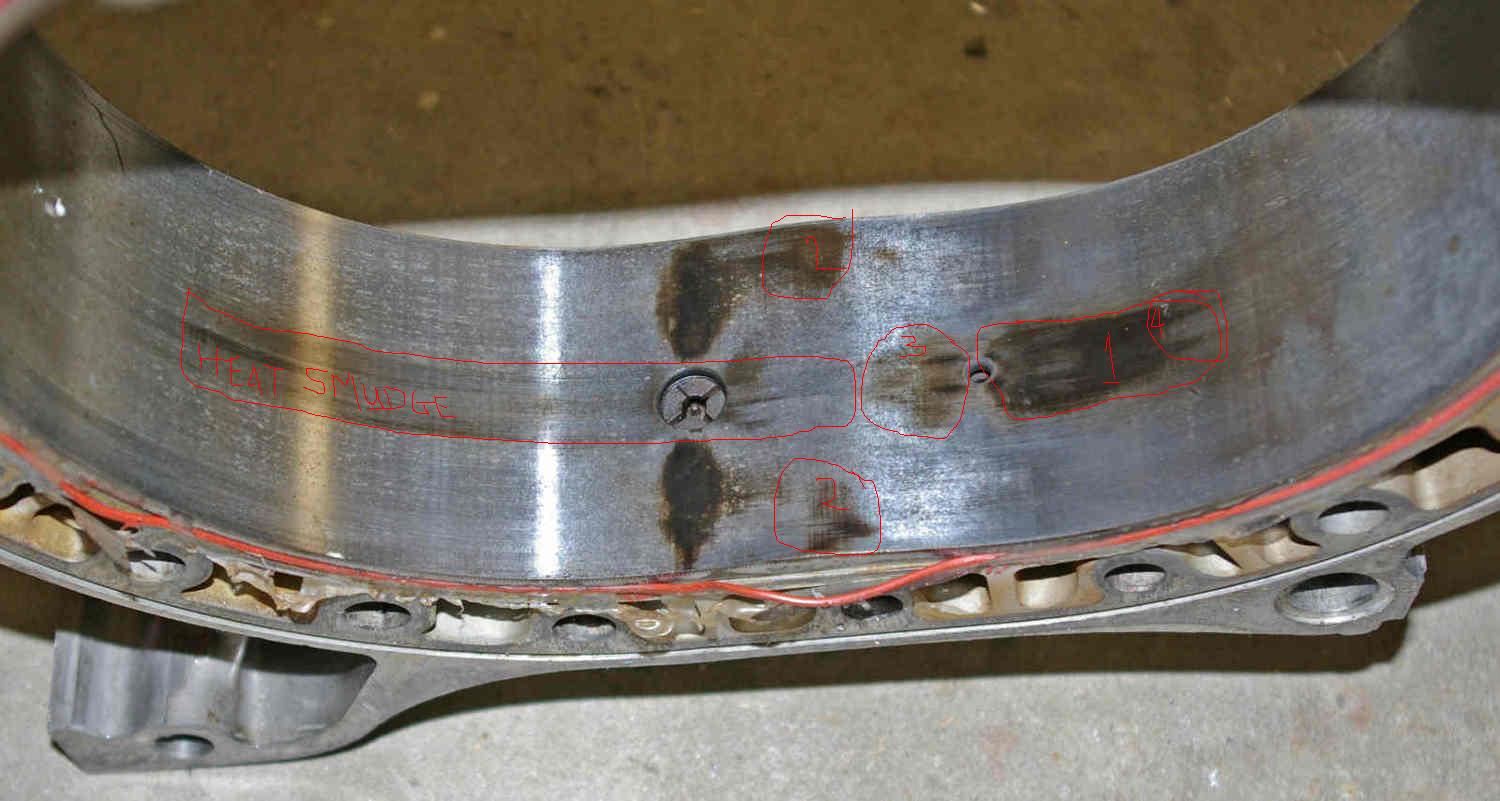
The attached picture is from my single rotor PP engine after
about 10hrs running time. Most of the time was running at WOT and
6000RPM. fuelflow was around 8gph.If this an indicator of
mixture distribution at ignition, what does itmean? if anything.
Has that been observed by anyone else?
Richard Sohn
N2071U
You got me. I have never seen anything like that.
What kind of oil are you mixing?
Paul Lamar
I am using 1.25oz/gal ECHO two stroke oil.
Richard SohnN2071U
It looks to me like there is silicone partly blocking the coolant
passage to the left of the leading plug. There is a difference in
the marking of the housing to the left of the plug. Almost as if
there is damage to the apex seals as they cross the leading plug.
Also of note is the burn mark before the trailing plug. Could this
be blow by past damage to the apex seals? There is also a curious
line across the housing just before the trailing plug. It also looks
like the apex seals were not following the rotor housing after the minor
axis indicated by the burn discoloration. How is the coolant flow
with the new end housings? I would put a thermocouple in as per
Paul's description to monitor the metal temp on further runs.
Dale Davies
Good call Dale. Richard is building his own end housings so that area
may not be getting as much water as it needs. Could also be your
water pump is not up to it Richard. As I recall the 2 rotor needs
about 30 gallons per minute.
Here is the picture from my book How to Cool Your Wankel.
"installing a "cylinder head temperature" gage. This can be done by
drilling a small hole in the rotor housing in the place shown and
installing a thermal couple."
BTW Mario called me from Germany this morning and took me to task
for the careless use of the word "Wankel" since he now owns the
copyrights.
It is like copy and Zerox.
Paul Lamar
Richard,
Could the spark plug be kinda bottoming in the threads and
distorting the rotor housing? It is polished right at the sides of
the plug hole, but burnt farther out.
Dale Davies
--
Hi Richard;
The centerline smudge running left from both plugs is a sign of heat.
Were the smudges there previously?
It might be blow by, grooved surface, apex clearance?
Have you checked the rotor housing surface and apex seals with a ruler
and back lighting for flatness?
Those orings also appear to be too large.
Cheers
Cary
Richard,
Attached is a picture of a rotor housing that was severely overheated.
It has a similar pattern that you're seeing. I think the residue
is from burnt coolant. From the looks of the TES o-ring, it
appears the teflon got very hot, possibly compromising the seal.
Has the engine been overheated? What EGT do you see at WOT?
Mark S.
Thanks for all the excellent responses.
After doing some more checking on all the parts and indicators, it
appears
to me now that high temperature in the plug area is the most likely
culprit.
The EGT at my test runs was pretty constant 1600 to 1650F , and coolant
temperature never went above 180F. One thing could have caused a
local overheat is the fact that I run all these tests at a
atmospheric coolant pressure. There was leak I could not find, so I
started with the testing anyway. However, when I disassembled the
engine, there was a damaged stud o-ring, which very likely was the
reason for the leak. --
Richard Sohn
N2071U
I would still install the thermocouple near the lower spark plug.
You may have local film boiling in that area which is allowing the
metal to go higher than 500 F coking the apex seal oil. You cannot
always rely on the pressure in the cooling system to reduce the local
film boiling.
I would also measure the coolant flow through the block with a flow
meter set up just to be sure you are getting enough water flow. I'll
loan you my flow meter set up if you send me your shipping address.
Paul Lamar
Richard,
What is the clear or opaque stuff by the seal? It looks like clear
silicone.
You state you test at atmospheric pressure and a damaged seal may have
caused
the leak leading to over heat. In my experience, leaving the rad cap
loose
will slow a leak. It would have had to be quite low in coolant to
allow it to
get that hot. The water pump is less efficient at atmospheric which could
reduce the coolant flow. Monitoring flow with Paul's meter would be
highly
recommended, especially considering the changes made. In conjunction
with a
thermocouple any problems should be shown up before it gets expensive
again.
I would try testing flow with and without pressure to see what happens.
Dale Davies
Hi Richard;
As mentioned, a pressurized system (and other mods) will help with local
boiling near the spark plugs, although your temps sounded normal.
Paul's question about how much 2-stroke oil ash deposits are left behind
is a good question.
I have heard of people using a lot of different oils - they all seem to
work as long as they make it to the engine ;)
Lower ash is better - a 6k rev a day keeps the rebuild away :)
Were the outer layers of your TES orings melted?
Were the orings diameters bigger than when you installed them?
inner oring (thickness) OD? 0.093"?
What, if any, damage or problems did you find?
Comments on the oil/coolant coking? deposits near the less cooled
housing metal in the attached pic:
One thought was that there were deposits well ahead of the trailing plug
(#1 in photo).
There were also deposits #2 just below (left) the rotor housing
centerline (these are rare)
The odd #3 and #4 deposits look like 2 lines above and below the edges
of a recess or groove.
One thought was that your timing advance was too early. This might
prematurely squish the flame front. Horizontal centerline groove? areas
may have continued to burn but were extinguished at the edge of the
groove in cooler areas of #3/#4 resulting in the horizontal lines in the
pic.
This might also explain some of the possible heat issues.
What advance were you using?
leading/trailing split?
dizzy/ignition system/FI ECU?
If there was no damage, pretend I never made these alcohol induced comments.
Cheers
Cary
--
The Rotary Engine NewsLetter. Powered by Linux.
ACRE NL web site.
http://www.rotaryeng.net
Youtube key word PaulLamar2
Copyright 1998-2011 All world wide rights reserved.