Group,
looking to fit a prop to my P ported renesis and need to
know what actual HP it will generate and not an enthusiastic guess.
Would I be safe in aiming for 230 HP? Apparently if the prop is
too big
nothing works, so smaller seems to be the aim. Any suggestions ?? It
will be a fixed catto prop, and as usual craig Catto has been caught
many times before with HP in engines. Actual HP not guesses required.
Neil.
What gear ratio is your gear box?
If it is a 2.85 the prop will turn about 2600 and the engine
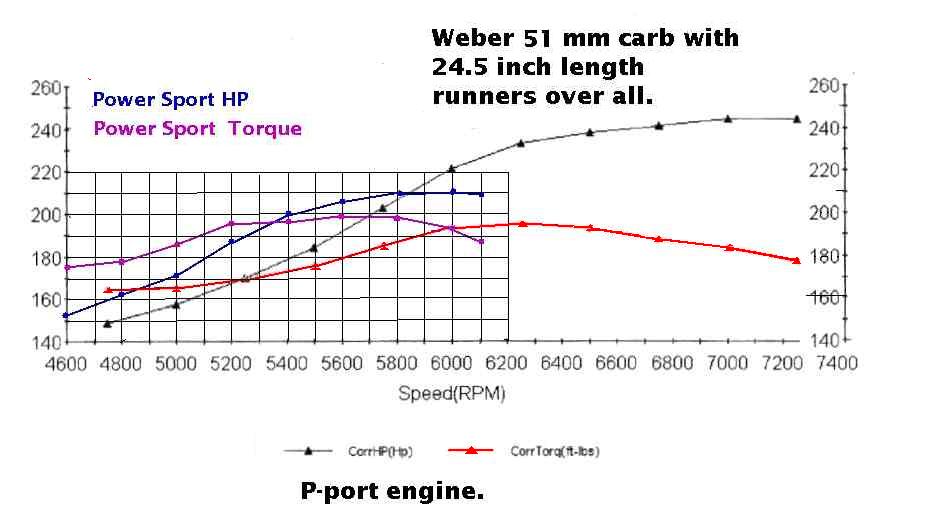
will turn about 7400 and make 250 HP plus or minus 10.
We need to get a group buy together and find somebody to make ground
adjustable blades for a Warp Drive type hub. That way you can fine tune
the pitch without buying a new prop.
Paul Lamar
Aren't there other factors that have to be right to get 250hp? Intake,
exhaust.. Can't go too big on the pipes, smooth transitions, no big
restrictions, etc. A bit of time on a dyno with the complete
firewall setup
from the airplane might be money well spent. Compared to swapping
props.
As for the prop, if pitch or diameter are wrong, it's a bigger
project to
add material to the prop than it is to take it away. At least for wood
props, it can be relatively easy to cut the diameter down, or even
reduce
the pitch to some extent. Catto props are composite covered, so it's
probably a bigger hassle to modify than for a straight wood prop.
How about buy or borrow another prop to try before committing to one in
particular. If you could find a fixed pitch prop from a local Pitts
or RV
or Skybolt, you'll have something to use for a baseline. Many/most
of those
airplanes have 180hp engines.
Another thought is to do prototyping with a wood prop of your own
construction. If you have gone to the effort of building a whole
airplane,
including the powerplant, building a prop may turn out to be that
difficult,
by comparison. There were ads in Sport Aviation for doing this. And
online.
Matt-
I am assuming (possibly incorrectly) that Neil is doing the p-port
at least as well as I am doing it and he is using a 2.85:1 gear box.
IMHO the best thing about a welded p-port it is hard to screw up but
possible.
I have taken the position that only a ground adjustable prop is worth
fooling with provided you are not using a constant speed or in the air
adjustable. I have come to the conclusion there are too many
variations in aircraft drag to recommend anything else. The Warp
Drive type adjustable
pitch hub is becoming an industry standard as even Sensenich is
supporting it.
Unfortunately Sensenich does not yet have a blade suitable for our use.
Randy told me today that Warp drive now has three different all
carbon blade designs. Ultra Light, LSA and high power. One of them
is called Constant Speed Blade Platform.
http://www.warpdriveprops.com/
However I am not yet convinced the WD blade plan-form and twist is yet
optimum for the lower drag AC designs. That I why I would like to
see some
other companies get in the biz of ground adjustable.
The high power to weight ratio of rotary powered aircraft and the
excess length
of most runways is why I think constant speed props are not worth
the money.
Set the pitch for best cruise and let the take off performance be
what it is.
We are mostly not building C182's here or cargo aircraft.
IMHO pure wood props will always have less performance than a metal prop
due to the lower modulus of elasticity wood. The high modulus of
elasticity in
carbon has yet to be taken advantage of. In other word when the tips
are in
the transonic range you want a thin blade as the drag of the tips
becomes
a significant consumer of HP. Therefor a stiff thin tip is an
advantage.
Paul Lamar
I agree with Matt. You should be much more conservative with your HP
estimate for the prop maker. Powersport was only claiming 210 h.p. and
I think that is more in line with what the average p-port builder can
expect. In aircraft we are seldom able to achieve the same optimum
numbers produced in dynos and on cars. Largely that is due to our fixed
gear ratio an also by imperfections in the design and fabrication of the
intake and exhaust manifolds, like Matt mentioned.
With reguard to props, I am still mostly an advocate of fixed pitch
composite props for our application. The MT electric c/s is heavy (like
a lot), expensive (like a REAL LOT), and comes with an RPM limitation
that you would not want to have to live with (can't remember the number
off the top of my head). The IVO is, well, the IVO... search the
archives. And Whirlwind, as of the time I called them asking about a
prop 7 years ago, would not make one that turned in reverse direction or
with custom blades. (even in ground adjustable form). Warp Drive and
Whirlwind both do not make hubs and blades big enough for our application.
So that pretty much leaves fixed pitch. I disagree that metal props are
always faster. If this is true, then why are all the top finishers,
indeed most of the fields in the Formula One, Biplane, and Sport classes
at Reno using composite props? Kevin Eldridge was the odds on favorite
to win the 2010 Super Sport class in his Nemisis NXT when an oil line
blew and overspead his prop causing it to quickly depart the aircraft.
He credits the fact that he had a composite prop and not a metal prop
with saving his life because a metal prop would have taken the engine
with it. But that's not why he was using a composite prop, he was using
one because it was fast - and he was doing more than 400mph.
If there is a difference in modulus that disadvantages composite props,
then it is so small that it does not overcome the other advantages that
composite props offer in terms of efficiency. Not to mention ease and
cost of production
Although the Catto has an epoxy layer, it is not difficult to re-pitch.
Craig took a few degrees out of mine in just a couple of days for
minimal cost. Matt is right, Craig said that it is easier to remove
pitch than to add it. But still, go with about 210 hp. when having your
prop made. Getting a loaner would be nice if you can find one.Or,
maybe start with a used prop that you can re-sell for about the same
price that you paid once you get some performance numbers.
--
David Leonard
Turbo Rotary RV-6 N4VY
http://N4VY.RotaryRoster.net
http://RotaryRoster.net
A P-port intake manifold is one simple bent tube
so it is entirely smooth from intake to port. There are
no parts that mismatch. That is one reason I advocate p-ports.
The manifold is easy to make and hard to screw up.
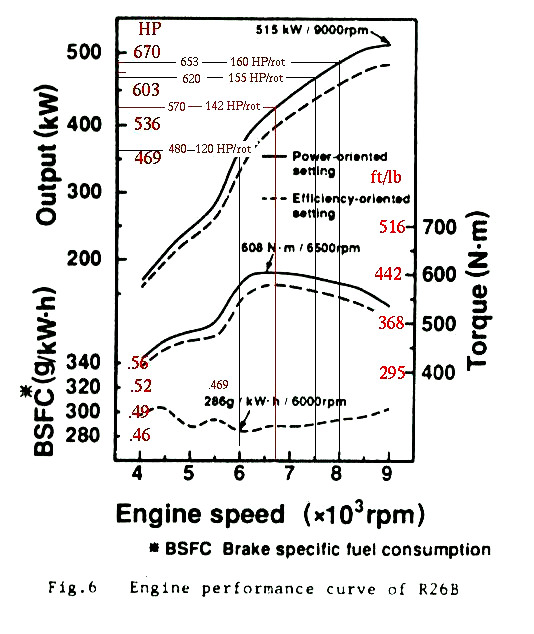
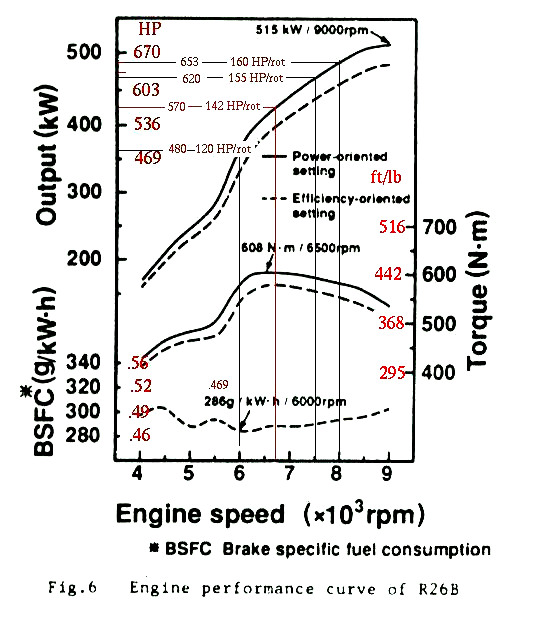
The design is an exact copy (port timing and tubes size) of the P-port
Mazda used to win Le Mans. That engine had 620 HP
at 7500 RPM. That is 155 HP per rotor or 310 HP for a 2 rotor
so if anything I am being widely conservative by claiming
only 250 HP at 7500 RPM.
The Power Sport p-ports had smaller diameter tubes and the power
was 215 HP (and not 210 HP) at only 6000 RPM and not at 7500 RPM.
Power is torque times RPM and torque in a p-port rotary is nearly
constant.
Mazda 2 rotor p-port road racing engines have been generating over
300 HP since the late 1970's.
The vast majority of people going for p-ports are using a
2.85:1 gear box that rotates in the right direction.
The modulus of elasticity of carbon is 3 times higher than aluminum
so in theory it should be better.
What I said about that was:
"IMHO pure wood props will always have less performance than a metal prop
due to the lower modulus of elasticity wood. The high modulus of
elasticity in carbon has yet to be taken advantage of."
Perhaps I was wrong about carbon not yet being taken advantage of.
I said nothing about the modulus of elasticity of composites being lower
that metal. Tracy Saylor, who demonstrated the fastest RV6 in the world
at 238 MPH in the Sun 100 race told me his CS metal prop was 15 to 20 MPH faster
than a so called composite CS MT prop which he tried and which is mostly wood.
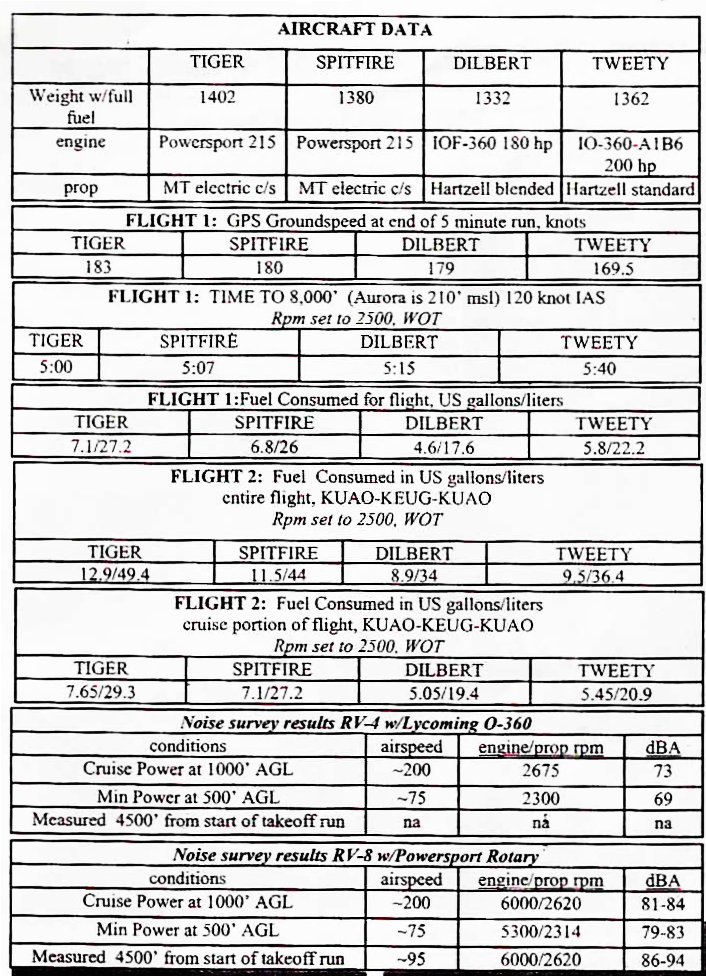
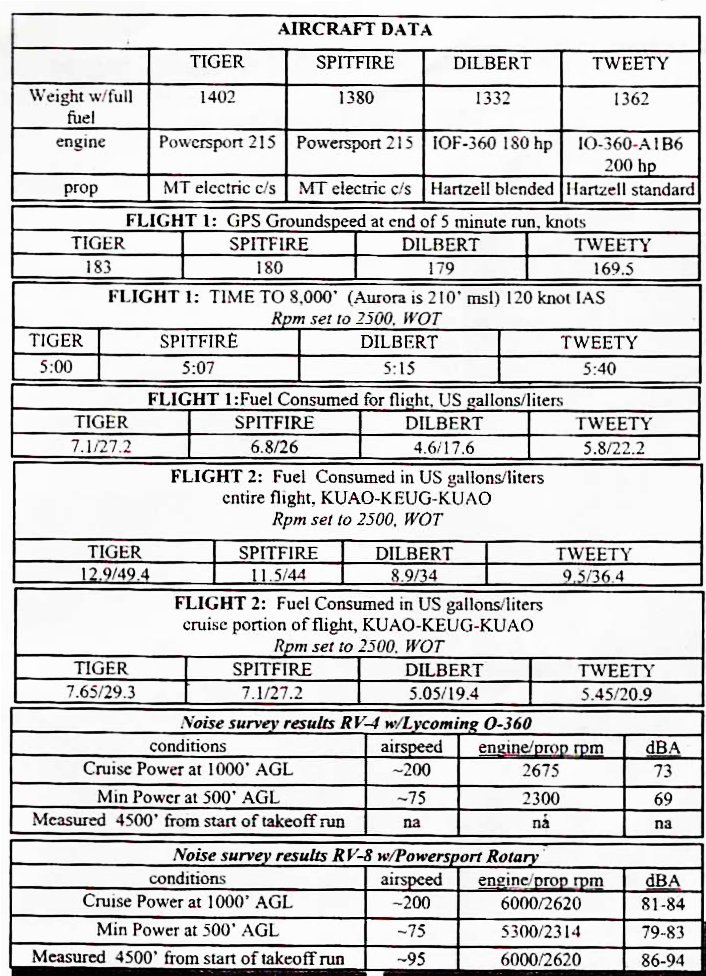
Despite running MT props the twin Power Sport RV8's were faster than
a 200 HP IO-360 owned by Van's at a comprehensive performance test done back
in 2007. See the last attachment. The fuel burn test was rigged showing
the Power Sport engines to burn far more fuel than they really do.
I have an RX8 P-port sitting in my hangar ready to go into Mike Wills RV4.
I will be building a new gear box that rotates in the right direction
for it.
We are now leaving Sunday to pick it up.
Do you want to race? :) You should beat me hands down with a turbo :)
Paul Lamar
--
The Rotary Engine NewsLetter. Powered by Linux.
ACRE NL web site.
http://www.rotaryeng.net
Youtube key word PaulLamar2
Copyright 1998-2011 All world wide rights reserved.