Paul,
Any chance you will be able to stop by tomorrow afternoon? I still
haven't been able to get the engine started but think I've got a couple
of things to try.
Thanks
Randy
I'll will be there about 1PM.
Have you checked for top dead center?
You can get a rough indication by putting a screw
driver in the lower spark plug hole and turning the
engine over slowly by hand.
A better way is modify an old spark plug and attach
a clear plastic tube about 3 feet long orientated vertically.
Than fill the chamber with thin oil and watch the oil go up and down
in the tube as the engine is rotated by hand.
The timing should be about 22 BTDC. Mark this on the ring
gear with white paint.
Paul Lamar
I would think you want to use the oil like you would a piston stop when
degreeing a cam. When you get the chamber full at approximate TDC,
rock it
back and forth by hand slowly to watch the oil rise and fall. When
it reaches
the highest level, stop and mark the flywheel or pulley. Then
continue in the
same direction for 10 or 20 degrees as the level falls. Then reverse
direction
and stop again when the level just reaches the highest again. Put
another
mark. The difference between them is actual TDC. Repeat to verify.
Then with a
degree wheel it is easy to mark the 22 BTDC.
Before starting, crank it with the plugs out to get the oil out so
you do not
hydraulic lock it.
Dale Davies
We got it running in just a few minutes. The number 4 wires from the
battery
in the aft fuselage were too small for the starter current. Too much
voltage drop. We jumped the starter directly from a car battery and
it kicked right off.
There is something wrong with the Ellison carb as you have to keep
priming it to keep it running. More on this later.
Paul Lamar
Contaminants in the Ellison? Is there a good fuel filter? How
about fuel pressure?
This is a pretty clever setup. I do wonder how hot the Ellison is
going to get when heat soaking after shutdown. Will it melt internal
plastic/rubber parts?
Matt-
It is on the cool side of the turbo.
We rigged up a temporary header tank so there was only about one foot of
head on the Ellison. I think the pin holes may be plugged as it sat
around
for ten years with oil in the fuel.
Paul Lamar
That was the good news, after switching carbs to a back up Ellison I
was able to get the engine started and keep it running. It was running
very rough though so I played with the throttle and the mixture to see
if it would make a difference. A quick check of the gages showed 1500 -
2000 rpm but no oil pressure, then the engine stopped as if it had
seized. This was all in the course of about 1 to 1 1/2 minutes. There
was oil in the gas and 5 quarts in the pan. The engine will not crank,
I can turn it over with a plug out and a breaker bar but it is very hard
to turn. I pulled the re-drive to make sure that wasn't the problem and
I'll pull the alternator belt tomorrow but I have a feeling a bearing
may have stuck. This engine has been sitting for around 20+ years so I
may have to do a tear down. Very depressing as it looked like it was
ready to go.
Thanks for your help today Paul.
Randy
Darn. We should have checked the oil pressure. Don't turn it over
any more. Obviously the rotor and main bearings are damaged.
You will have to take it apart and swap out the bearing shells.
The apex and sided seals are probably OK. It is not as bad as it seems.
It has happened to Finn Lassen except the throttle was stuck wide open
with no prop. The engine buzzed to 10,000 RPM and then seized. He
chiseled it apart, put new bearings in and flew it for 600 hours
before crashing in the trees on an unlighted dirt strip at night
while trying to land. The guy lived a charmed life as he survived
unhurt :)
Make a compartmented box identifying all three corners of the
marked rotor
to store the seals. Put them back in where they came from.
Let me know when you get it apart and I will try to get over
there to inspect the e-shaft. I'll be gone next week and
the newsletter will be shut down during that time.
Paul Lamar
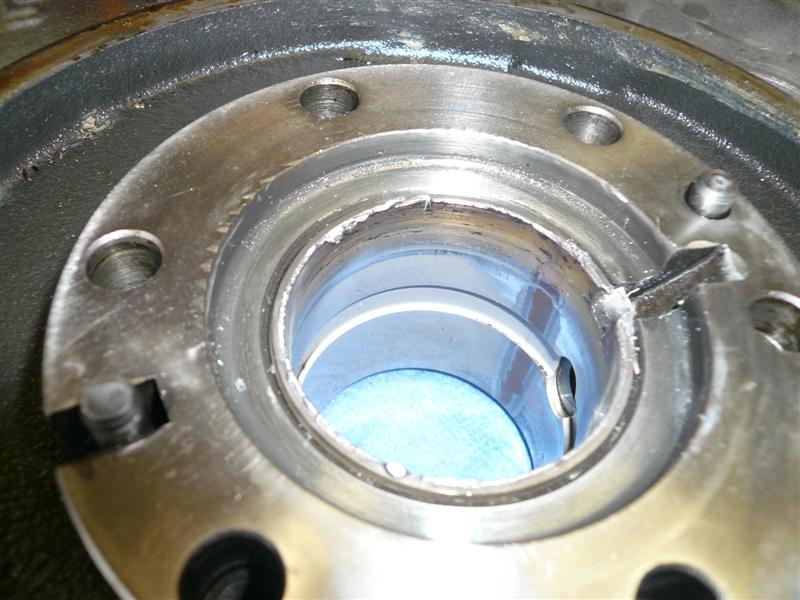
Here are some shots of that bearing and turbo mount.
Randy
Randy and I took the engine apart today. There was relatively little
damage from the lack of oil pressure. Rear main and rotor bearings
appeared to be OK. The front main had some very strange damage but
I am not sure it was caused by lack of oil pressure. Randy was not
sure it had no oil pressure to begin with as the engine stopped so
quickly.
Has anybody ever seen anything like this? It looks like a poorly
machined e-shaft to me. Another possibility is incorrect end play.
We will stick the e-shaft in the lathe tomorrow and check it
for run out.
BTW the bare block as you see it here weighs only 116 pounds.
This is a 12A based one rotor.
Paul Lamar
Paul, Regarding the bearing failure. It appears that the shaft was not
machined on a taper due to the localized damage. If the E-shaft lobe
had run against it there would not be melted bits of tin on the end of
the bearing shell. It looks to me that the bearing shell was staked
with a punch to keep it aligned with the oil feed port. Most likely IMHO
is the punch was held too vertical and along with forcing the material
into the lock groove it also pushed down enough to crush material
towards the bore. This would leave no clearance and wipe the oil
completely from that area. The tin would then melt off the shell and
spread in both directions increasing the length of damage in the bore
and off the outer end of the bearing. As for oil pressure being low one
place to ook is where the stock oil bypass would be located in the end
of the E-shaft.
This is a re manufactured E-shaft which allows for an
error where the bypass seats. Provided the drive chain was on the pump
the next place to look is where the oil transfers from the front side
housing to the rotor housing hollow dowel oil gallery. Might be someone
put a solid dowel in the hole or one hollow but too short dowel
through all
three pieces, Lastly is there a working oil filter relief valve or is
the oil all just going thru the filter back to the pan as the path of
least resistance. You might put it together again with the front
accessory cover and oil pump drive chain off. Turn it with a 3/8"
electric drill and see if it builds pressure.
george grimes
We are still trying to figure it out. That end was stock so it had
the stock 12A taper. We had it in the lathe today checking for run out.
Supposedly it had run before for 14 hours.
It could be an end play problem.
Paul Lamar
Bent eshaft or unbalanced CW on that end would be my first WAG. Check
bearing clearance and eshaft run out.
That front bearing is protruding a bit, it may have been pressed too
far or squished out by the eshaft.
Any pics and weights for the front and rear counter weights.
How is the oil routed to the bearings?
There are also some interesting triangular wear marks at the 9-11oclock
position on the back of the front stat gear.
Cheers
Cary
--
The Rotary Engine NewsLetter. Powered by Linux.
ACRE NL web site.
http://www.rotaryeng.net
Youtube key word PaulLamar2
Copyright 1998-2011 All world wide rights reserved.