14 CFR Part 91: General Aviation
Accident occurred Saturday, May 07, 2011 in Conroe, TX
Aircraft: WOODWARD HAROLD L RAVIN 500, registration: N913RA
Injuries: 2 Fatal.
This is preliminary information, subject to change, and may contain errors.
Any errors in this report will be corrected when the final report has been
completed.
On May 7, 2011, approximately 0855 central daylight time, a Woodward Ravin
500 experimental amateur built airplane, N913RA, impacted forested terrain
shortly after takeoff from Lone Star Executive Airport (CXO), Conroe, Texas.
Visual meteorological conditions prevailed at the time of the accident. The
personal flight was being conducted under the provisions of 14 Code of
Federal Regulations Part 91. The pilot and student pilot rated passenger
were fatally injured. The flight was originating at the time of the accident
and was en route to Temple, Texas, for the airplane to be displayed at an
aviation event.
According to CXO tower personnel, the pilot was cleared to depart runway 14
with a right turn on course. The airplane departed and as the pilot began
his initial right turn he reported smoke in the cockpit. The pilot was
cleared to land on any runway and giving the wind as being from 160 degrees
at 8 knots. The airplane was observed to perform an approximate 240 degree
right turn and crossed back over the departure runway before entering the
left downwind leg for runway 14. While on the downwind leg of the traffic
pattern the airplane was observed flying, â<80><9C>slowâ<80><9D>, wings
level, at an estimated altitude of 700 to 800 feet above the ground. While
approximately 4,500 feet along the downwind leg the landing gear was
extended. Shortly thereafter, the airplane started a descending left turn
towards the closer runway 19. The airplane overshot the extended centerline
to runway 19 and the airplaneâ<80><99>s bank angle increased. The airplane
continued in the descending left turn toward the runway until approximately
300 feet above the ground. At which point the airplane appeared to
â<80><9C>stallâ<80><9D> and impacted into forested terrain. A post impact
fire ensued. Tower personnel reported that during the event they did not
observe any smoke or flames coming from the airplane until impact.
A pilot rated eyewitness located near the crash site reported hearing what
he described as an engine that was â<80><9C>screamingâ<80><9D> and varying
in RPM. When he saw the airplane it was flying â<80><9C>very slowâ<80><9D>
at an estimated altitude of 300 to 500 feet above the ground. As the
airplane made a high bank angle turn back towards the airport the witness
observed the nose and left wing drop before the airplane went out of sight.
Seconds later he heard it impact trees followed by an explosion.
The airplane came to rest in an upright position about 1,600 feet out on the
extended center line from the approach end of runway 19. The measured impact
heading was 200 degrees magnetic.
------------------------------------------------------------
Sounds like they will never know what happened.
I am guessing. One possible scenario is the automotive clutch Bud used started
slipping causing the smoke and the âscreamingâ engine. The clutch disk
could wear rather rapidly due to normal high torque fluctuations
at high continuous power.
IMHO the TBO on an automotive V8 in aircraft use should be 300 hours.
Any piston engine can develop a crack in the critical parts leading to
a hand grenade failure without warning. The main purpose of the TBO is to
magnaflux the critical parts to detect cracks early before the engine
explodes. Through years and millions upon millions of hours of experience
and detail refinement the TBO on aircraft engines has increased to 2000 hours.
The TBO on my C182 engine was 1500 hours. By adding another torsional damper
on the crankshaft the TBO was increased to 2000 hours. However unlike a piston
engine in a car the aircraft crank and rods are made of the finest material
possible. Only the best methods of manufacturing and finishing are used.
Parts in an automotive V8 are made as cheaply as possible as the average
required power is only about 40 HP despite a 400 HP rating.
We are so lucky the Wankel rotary does not see the same kinds of reverse loading
on the e-shaft and the rotor that are seen on a piston engine cranksaft and rods.
Fatigue failures of the e-shaft and rotor are unheard of.
Paul Lamar
It sounds like the pilot might have stopped flying the airplane, but instead was
trying to save it. My training was that in case of fire, you get the airplane on
the ground immediately, as you really don't know what's burning. I can
understand the smoke could have been incapacitating, so that might have been the
issue, but if it was the clutch burning, it seems unlikely somehow.
Matt-
I agree but people that build airplanes have so much invested in them
(more than money alone) they appear to be reluctant to crash land straight ahead
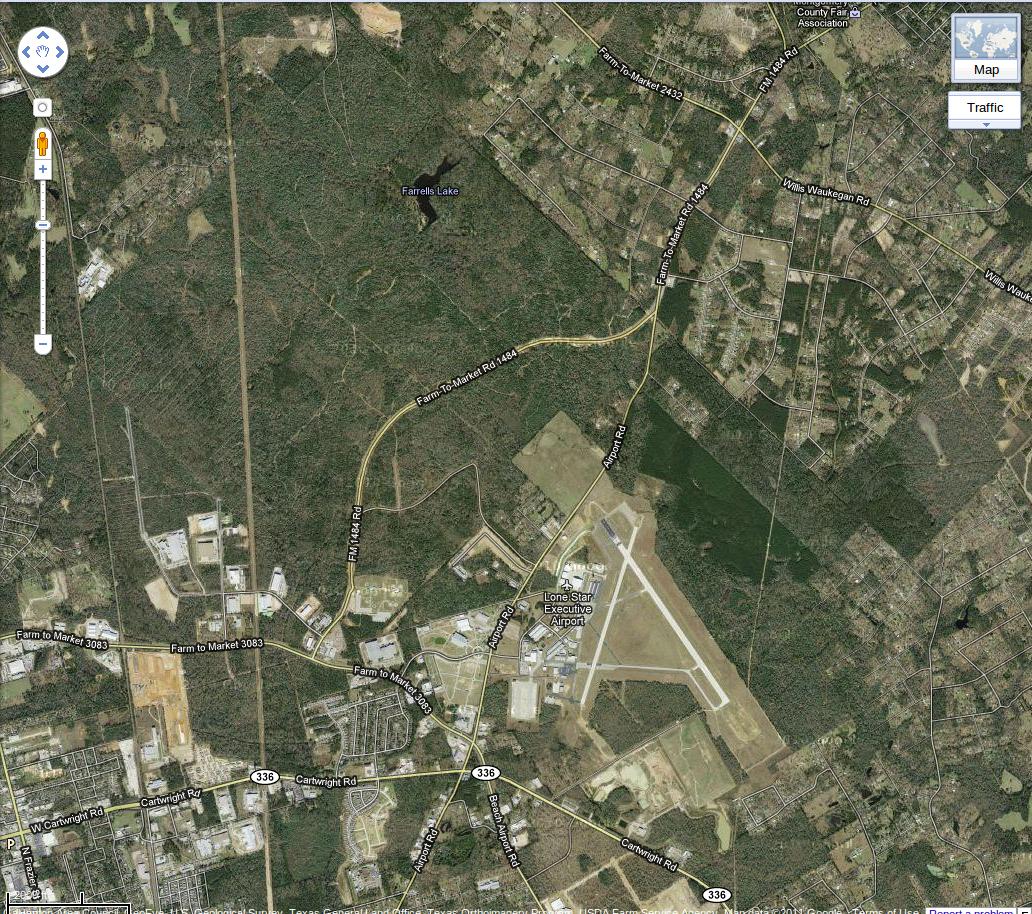
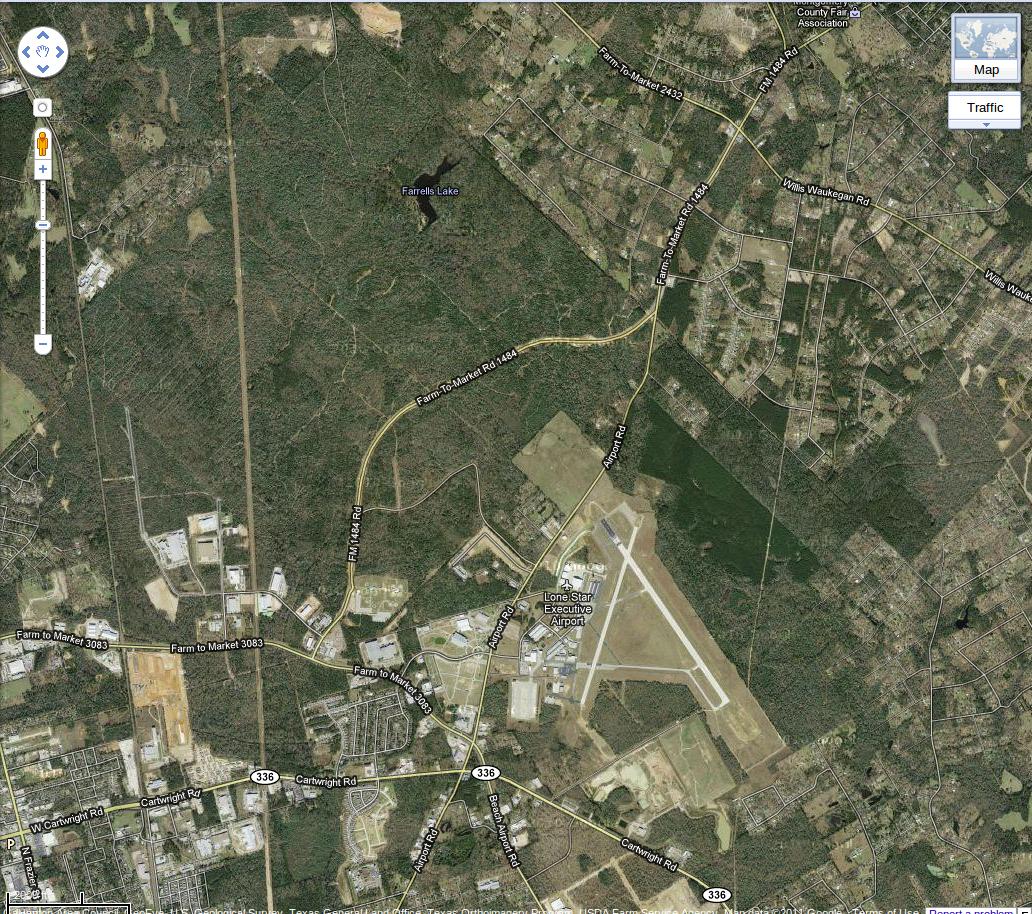
as we were all told to do in case of engine failure on take off. Here is a map
of the area and there does not appear to be many clear fields other than on
the airport itself. In the case of rotary crashes at least two fatals
were caused by the pilots attempting to turn back. In both cases there
were suitable fields straight ahead. One rotary crash was caused by engine
seizure after the loss of all oil pressure due to a split cheap oil cooler and
the other an interruption in the fuel supply due to a poorly designed
fuel plumbing system.
IMHO there is another more subtle factor. One is naturally reluctant to do a 180
and land downwind on a controled airport or busy airport. We had an incident
at SZP where a pilot had an engine failure in a Bonanza and successfully made
a 180 and landed down wind. He slammed it in so hard on the 2500 foot runway it
bent the spar and broke the motor mounts totaling the airplane but he was not
hurt. He skillfully ground looped it when it looked like he was going to
run out of runway at thew other end. I was standing 50 feet from the point of
impact.
I think people should practice 180's at altitude with the engine at
idle. Just to get a feel of what the airplane will do. Note the loss
of altitude.
Paul Lamar
--
The Rotary Engine NewsLetter. Powered by Linux.
ACRE NL web site.
http://www.rotaryeng.net
Youtube key word PaulLamar2
Copyright 1998-2011 All world wide rights reserved.