14 CRT Part 91: General Aviation
Accident occurred Saturday, May 07, 2011 in Con roe, TX
Aircraft: WOOD WARD HAROLD L RAVIN 500, registration: N913RA
Injuries: 2 Fatal.
This is preliminary information, subject to change, and may contain
errors.
Any errors in this report will be corrected when the final report
has been completed.
On May 7, 2011, approximately 0855 central daylight time, a Wood ward
Ravin 500 experimental amateur built airplane, N913RA, impacted
forested terrain shortly after takeoff from Lone Star Executive
Airport (CO), Con roe, Texas. Visual meteorological conditions
prevailed at the time of the accident. The personal flight was being
conducted under the provisions of 14 Code of Federal Regulations
Part 91. The pilot and student pilot rated passenger were fatally
injured. The flight was originating at the time of the accident and
was en route to Temple, Texas, for the airplane to be displayed at
an aviation event.
According to CO tower personnel, the pilot was cleared to depart
runway 14 with a right turn on course. The airplane departed and as
the pilot began his initial right turn he reported smoke in the
cockpit. The pilot was cleared to land on any runway and giving the
wind as being from 160 degrees at 8 knots. The airplane was observed
to perform an approximate 240 degree right turn and crossed back
over the departure runway before entering the left downwind leg for
runway 14. While on the downwind leg of the traffic pattern the
airplane was observed flying, a?a˘<80<9CslowĂ?¢<80<9D, wings level,
at an estimated altitude of 700 to 800 feet above the ground. While
approximately 4,500 feet along the downwind leg the landing gear was
extended. Shortly thereafter, the airplane started a descending left
turn towards the closer runway 19. The airplane overshot the
extended centerline to runway 19 and the airplaneĂ?a˘<80<99s bank
angle increased. The airplane continued in the descending left turn
toward the runway until approximately 300 feet above the ground. At
which point the airplane appeared to a?a˘<80<9CstallĂ?¢<80<9Dand
impacted into forested terrain. A post impact fire ensued. Tower
personnel reported that during the event they did not observe any
smoke or flames coming from the airplane until impact.
A pilot rated eyewitness located near the crash site reported
hearing what he described as an engine that was
a?a˘<80<9CscreamingĂ?¢<80<9Dand varying in RPM. When he saw the
airplane it was flying a?a˘<80<9Cvery slowĂ?¢<80<9Dat an estimated
altitude of 300 to 500 feet above the ground. As the airplane made a
high bank angle turn back towards the airport the witness observed
the nose and left wing drop before the airplane went out of sight.
Seconds later he heard it impact trees followed by an explosion.
The airplane came to rest in an upright position about 1,600 feet
out on the extended center line from the approach end of runway 19.
The measured impact heading was 200 degrees magnetic.
------------------------------------------------------------
Sounds like they will never know what happened.
I am guessing. One possible scenario is the automotive clutch Bud
used started slipping causing the smoke and the
[WINDOWS-1252?]a?a˘a˘?a¬a??screamingĂ?a˘a˘?a¬a? engine. The clutch
disk could wear
rather
rapidly due to normal high torque fluctuations at high continuous power.
IMO the TB on an automotive V8 in aircraft use should be 300 hours.
Any piston engine can develop a crack in the critical parts leading
to a hand grenade failure without warning. The main purpose of the
TB is to magna flux the critical parts to detect cracks early before
the engine explodes. Through years and millions upon millions of
hours of experience and detail refinement the TB on aircraft
engines has increased to 2000 hours.
The TB on my C182 engine was 1500 hours. By adding another
torsional damper on the crankshaft the TB was increased to 2000
hours. However unlike a piston engine in a car the aircraft crank
and rods are made of the finest material possible. Only the best
methods of manufacturing and finishing are used.
Parts in an automotive V8 are made as cheaply as possible as the
average required power is only about 40 HP despite a 400 HP rating.
We are so lucky the Wankel rotary does not see the same kinds of
reverse loading on the e-shaft and the rotor that are seen on a
piston engine crankshaft and rods. Fatigue failures of the e-shaft
and rotor are unheard of.
Paul La mar
It sounds like the pilot might have stopped flying the airplane, but
instead was trying to save it. My training was that in case of fire,
you get the airplane on the ground immediately, as you really don't
know what's burning. I can understand the smoke could have been
incapacitating, so that might have been the issue, but if it was the
clutch burning, it seems unlikely somehow.
Matt-
Re: Matt's comment about clutch burning unlikely. Yes unlikely, but
possible. Hi-way haul trucks have got the brakes on fire coming down
long
hills. I worked on a Ford 1/2 ton that had stopped on the side of the
road. Questioning the driver/owner he said it slowed and stopped going.
The engine ran fine. The fellow said when he looked under the truck
there
was fire underneath. When I removed the clutch cover, a couple of
handfuls
of clutch fiber came out. The flywheel, pressure plate, Trans input
shaft
and the back of the crankshaft were blue from the heat of the slipping
clutch. The Trans input and the crank just had small spots. The fire
was
the release fork boot burning from the radiated heat. Surfaced the
flywheel and put new clutch in. I also had to replace the Trans input
bearing as this fellow would shift into OD at 40MPH. Ford dealer had
replaced the noisy berg 3 times previous. Only 45K miles on the truck.
He
came back two weeks later to see if I had the clutch core. Said he was
talking to his insurance agent and they figured the fire burnt the
clutch
out. There we go with the only thing more dangerous than a dumbly, is a
dumbly that thinks he is smart.
Dale Davies
Burning brakes happened to me when I was driving a semi as a teenager.
Paul La mar
Bud claimed the clutch damped the torsional pulses which implied it
had to slip.
Paul La mar
The clutch was set up as a centrifugal. Torsional resonance is
usually at
low revs so the idea is to have the engine engage at higher than
critical
rpm. Some of the gearboxes for the small engines have a centrifugal
clutches for the two strokes where there are other benefits. The faster
the clutch turns, the harder the lock up. If the engine was running away
it would indicating a loss connection and power to the prop.
Murry I. Rozansky
If anybody went to Buds website you would see that the system uses a
standard disk clutch plate. (Friction) The configuration is a
bob weighted centrifugal clutch. The faster the engine turns the more
locked up the system is. The clutch should only slip at low rpm, taxi
and below run-up. For the engine to over speed, if that is what actually
happened, likely required a major mechanical failure.
Bill Jepson
http://www.geareddrives.com/
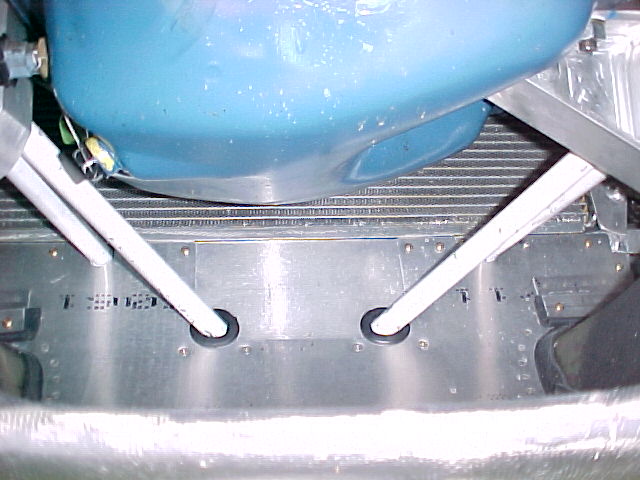
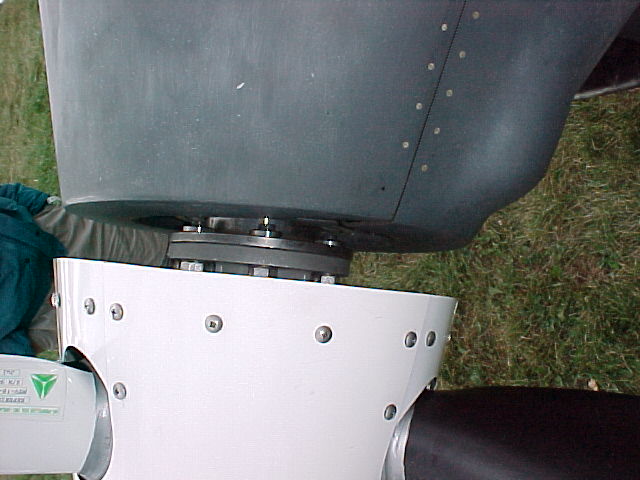
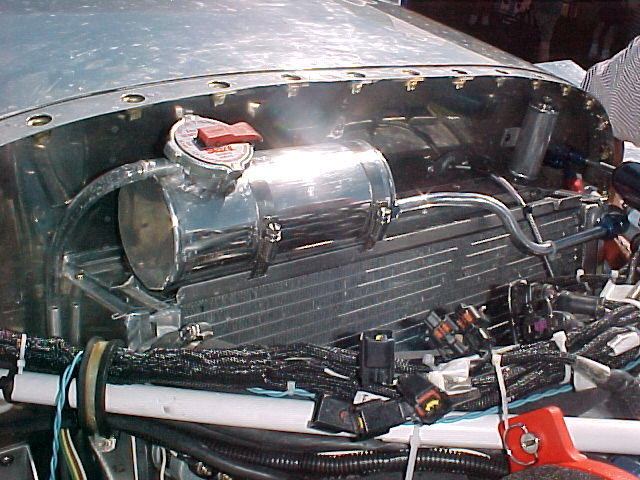
Here are a couple of pictures from one of Buds creations here at ESP.
Legendary_P51.
It is hard to tell from looking at these picture just exactly how
the "clutch" works. There is no through out lever of course.
The mechanic says the prop turns at engine idle. I'll keep my eye
on the project and see if I can get a picture of it when the gear box is
removed.
No lightest was wasted :)
http://www.geareddrives.com/FWF_Legendary_P51.html
As far as I can tell the brad behind the engine is the only brad.
I offered to help if it proved hard to cool.
Paul Lamar
Hi Paul, I haven't seen that one. From your photos it looks like the
radiator outlet just dumps out the bottom of the cowl. No proper ducting
in or out limiting delta P and pre-heating the air. And it looks like all
the engine's air needs; cooling radiator, block and induction have to come
from the small chin scoop that feeds only induction air in a real Mustang.
Dumping hot air in front of the belly scoop where the radiator belongs
would limit its usefulness as a place for an additional heat exchanger.
The air dump will be draggy in any case. If it can pull TO power on the
ground for 15 min., I would be surprised. If it can't it should not be
flown. Having an engine overheating on a first flight is too often deadly.
Has it flown?
Murry I. Rozansky
Not yet.
The New Power Sport spent a few years trying to make this configuration work.
Each year they would show up at OSH with a different configuration.
Here is what they eventually came up with. They completely ducted the air under
the engine and then up to the rad and let if find its way out anywhere it could
:) The major problem with this approach the cowl must be completely sealed which
is very difficult to do indeed. Imagine pumping dynamic pressure into a large
balloon :) The cooling drag must be horrendous.
It also needs a large cowl flap.
Paul Lamar
--
The Rotary Engine NewsLetter. Powered by Linux.
ACRE NL web site.
http://www.rotaryeng.net
Youtube key word PaulLamar2
Copyright 1998-2011 All world wide rights reserved.