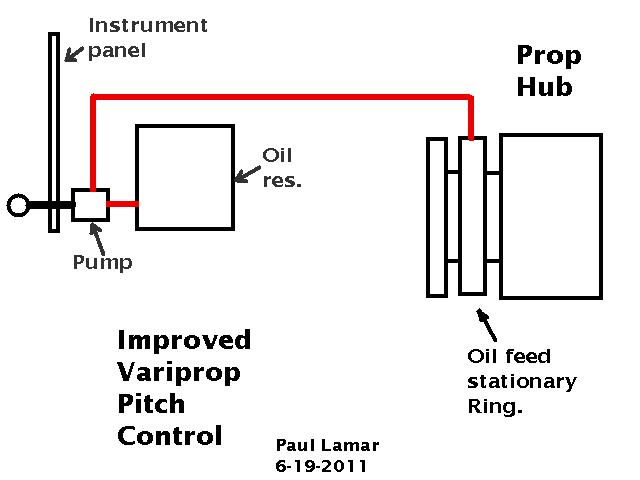
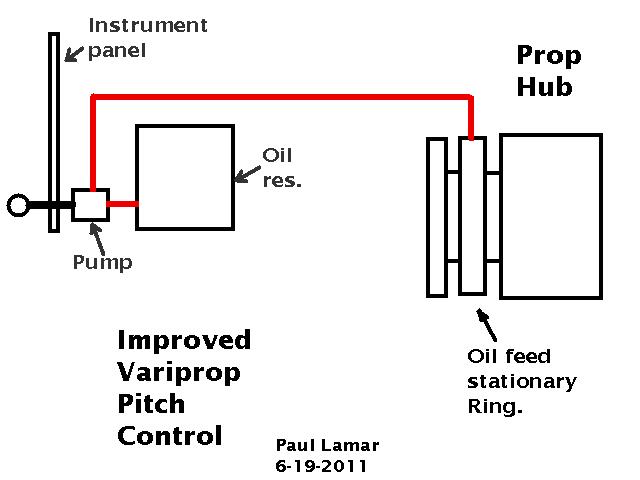
I had an idea to simplify the Vari- prop.
Replace the pump with a long control cylinder with
an attached knob that looks like the pitch control
knob in a 182.
Here is the old message.
--------------------------------------------------------------------------
The blade travel force depends on the axis of rotation position
relative to
the blade cord so I don't have a blade drawing to go on. For example
if the
blade rotation axis is on the 1/4 cord point of the blade the force to
rotate the blade will be a minimum. The force and travel is also a
function
of the distance of the pin from the axis.
Again I don't have a dwg to determine that.
The force available from the control cylinder mounted behind the
instrument
panel depends on the diameter of the piston used. My guess is 100 psi is
needed to change the pitch on most hydraulic props. If the average
person
can push 20 pounds the area of the control piston would have to be .2
square
inches. .2 square inches / 3.1416 = the radius squared or .0638 inches.
The square root of which is 0.252. Therefor the control piston would
only
need to be about .5 inches in diameter. The travel or distance needed
has
been discussed above. The mechanical advantage is five to one so a five
inch change in the master cylinder or control knob will move the
spool one
inch which should be more than enough to change the pitch throughout the
entire range.
-----------------------------------------------------------------------
snips....
This was shot down by the designer Larry Morgan as not having enough
force
to over come the spring.
Here is an improvement on the idea.
Since one could sense the blade angle quite easily one could use a small
hydraulic hand pump to pump up the pitch angle to what one wanted. Then
when
fine pitch is needed press a button to release pressure. This would work
like a
common hydraulic jack and cut the weight by doing away with the motor
and the control.
--------------------------------------------------------------------------
A few years ago a few of us teamed up to build an electrically
adjustable
constant speed prop. It was called the LAEV prop. Butch did the final
hub design and build, Bill Freeman did the blade design, Perry Mick
built the carbon blades and yours truly did some of the early concepts.
Butch disappeared for secret reasons along with the prop. If I knew and
told you I would have to kill you.
One of the revolutionary ideas was how the blades were retained by ball
bearings
in a one piece hub design. The balls were fed in one at a time through a
access
holes closed by a threaded plug. This saved pounds of weight. We looked
into
getting a patent but nothing came to fruition.
The one piece hub was welded 4130 steel and the balls were also steel.
If you make the hub from anodized aluminum light weight Torlon balls are
used just like the balls used in racing sail boat winches. No steel
races required
This design combines the rotating oil pressure ring of the Variprop and
the Torlon ball trick to cut the cost and weight. A hand pump like a
garage
jack is used to change the pitch.
It also uses off the shelf Warp Drive or Sensenich hollow carbon fiber
RV blades. This is done by using split clamps specifically contoured for
each type
of blade. A 3 blade version is possible.
No attempt to cut weight was done yet as this is a concept 3D.
Knocked out
in an over night session using Rhino 3D.
Paul Lamar
Hey Paul,
This is a really nice design. How much testing has it survived?
I'm not clear on the operating mechanism. I would like to know how much
work would be involved to modify the assembly so that the pitch could be
adjusted and locked on the ground using a screw arrangement maybe?
Mark LaPierre
Just a spring loaded piston with a groove that fits the pitch change
pins.
Not drawn so far. If you want to build one let me know and
I will work on it some more.
No testing so far.
Paul Lamar
Here is what the piston looks like. Just a couple of simple slots
that engage the pitch change pins. Shown in high pitch with
the spring fully compressed. When pressure is release the piston
moves back bringing the blades into low pitch.
As far as locking it into a position other than
full fine pitch I can see no simple way of doing that.
Why would you want to do that when you can get a ground
adjustable hub for way less money?
Paul Lamar
I may have the bull by the tail, but, if one was to vary the pitch
wouldn't you push IN the pitch control? normally ie convention has it
that pushing in the pitch control the pitch goes to fine, 20 pounds of
pull on the control/ pump would feel as if one was pulling the
dash/panel into ones lap.
John Burey
So if it won't take 20 pounds it is too weak :)
That is for the original one stroke method.
The latest method is many strokes of low force
(say 2 pounds). Each stroke increases the pitch by
a SMALL amount. Just like a hydraulic garage jack.
The prop starts out in fine pitch for take off as does
the C182. Also if the oil is lost the spring forces
the prop into fine pitch. There is a separate oil
supply for the prop control. It does not use engine oil.
Paul Lamar
--
The Rotary Engine NewsLetter. Powered by Linux.
ACRE NL web site.
http://www.rotaryeng.net
Youtube key word PaulLamar2
Copyright 1998-2011 All world wide rights reserved.