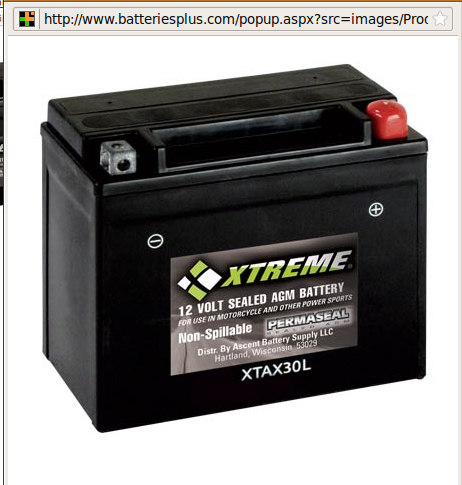
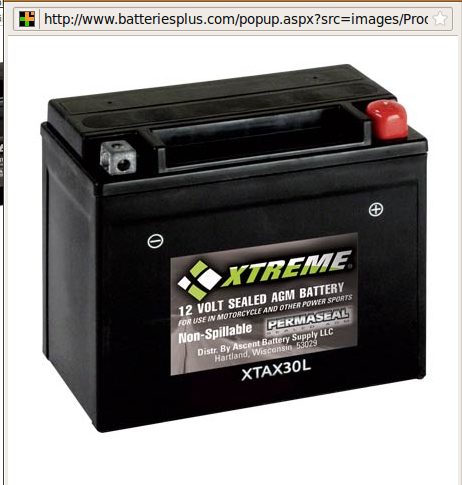
Use these in airplanes to save some weight?
We usually use two independently switchable batteries (at least I do)
so the self-protection low voltage feature may not be a problem.
http://eetweb.com/power-****supplies/lithium_batteries_****3411/<
http://eetweb.com/power-**supplies/lithium_batteries_**3411/
<
http://eetweb.com/power-**supplies/lithium_batteries_**3411/<
http://eetweb.com/power-supplies/lithium_batteries_3411/
http://4xspower.com/products/
Perry Mick
That is the way Mike set up the RV4. Is 28 AmpHr (both batts.)
enough for starting?
Paul Lamar
I currently use two Panasonic sealed lead-acid batteries. Just ordered
replacements as the existing have been in place for many years. Digikey
part number P049-ND, 28 AH each. I can independently switch in either or
both, but I always start and run on both. I think I did start it long
ago on one battery. Invoice from Digikey says 46 lbs. shipping wt. for
the two batteries.
Perry Mick
I used a single 16 AH SLA for starting just fine. But with Li Ion it would
depend on the "C" rating of the cells; If you figure about 100A for
starting with your 28 AH pack, the C rating of the cells should be 4C or
greater. Otherwise you risk fire and very quickly degrading the pack.
You can save some weight with Li ion, but the charging scheme that we use
for lead acids is unacceptable for li Ions and they will catch fire. And
with a pack that big, it will be a big fire. So you would have to isolate
the battery pack and use a proper computer to charge it and regulate
inflow
and outflow current and analize each individual cell etc..
Also, a 28 AH pack will cost over $200, sometimes WELL over that.
I put the equivalent of a 48 AH pack into my skate board. Great range and
low weight. But you have to be careful with those things! ALWAYS use a
controlling circuit board.
-- David Leonard
Turbo Rotary RV-6 N4VY
http://N4VY.RotaryRoster.net
http://RotaryRoster.net
I have a sense that these LiOn cells would be rejected by your DAR as
airworthy. They are highly regulated items for just transport on aircraft,
let alone an integrated part of necessary systems. David makes very good
points about their different characteristics.
Your results may vary.
C. Smith
Always had good results with NiCad batteries in RC cars. There are some
U-tube videos of NiCad putting out very high levels of power. The
charging requirements are not finniky like Lithium.
Dan F
On an experimental, the DAR is not going to probably even know what kind of
battery you use, nor is it his responsibility. That inspection is more of a
paperwork drill. You may use Li Ion if you want as well.
Ni Cads could not be hooked up to an aircraft electrical system and charged
like an SLA either. The charging algorithm for NiCads and Ni Metal Hyd is
the most difficult of all. Li Ions are actually easy in terms of the
computer knowing the state of charge... state of charge is directly related
to voltage. They wont work in a 12V system mostly because you must limit
the charging current. NiCad is the same, but at least they wont catch fire
if you dont do it right. With NiCads, the charge state is not represented
by the voltage. The charging computer must use a complex algorithm that
looks at how current has changed with voltage (and preferably temperature)
over time to figure out the charge state. NiCad also has problems with
memory.
Li Ion are still much better energy/weight than NiCad too.
But just use an SLA with your 12V system. Even the Nissan Leaf has a 12V
SLA that takes care of the 12V systems leaving the Ni Cads for go-power.
Nothing beats the price/current and ease of use of the Lead Acids..