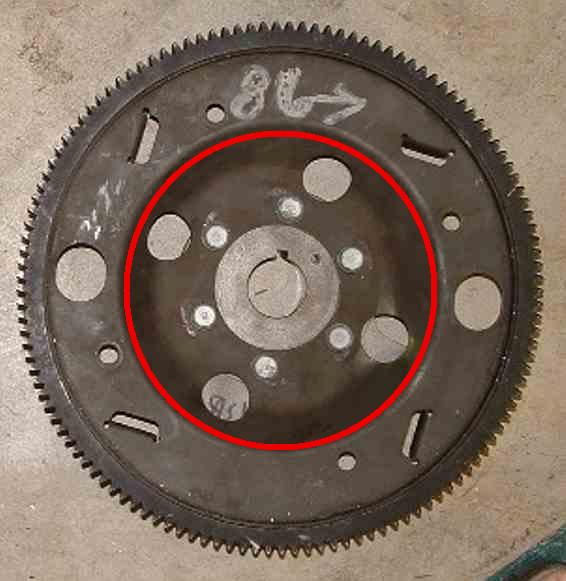
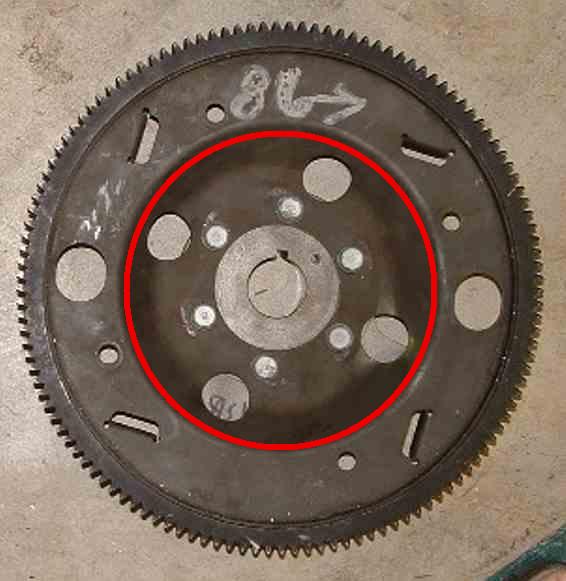
I finally got into the gear box today and found another issue. In
addition
to the sun gear pin failure inside the gear box, the flex plate came
apart.
I found a piece of it in my cowl as a litte hint of what I was about to
find..
Here are some pictures. The plate was pretty badly broken up and was only
being held together by Tracys aluminum damper plate and the steel bolt
ring.
Pin in sun gear was also broken. No apparent serious damage, just what I
assume is cosmetic galling of the input shaft, adapter plate, and bell
housing from the loose pin floating around.
Thinking back, I had an early sign of it at the Reno Pylon School. After
one of the races I noticed that my home made cover over the flywheel had
been marred by the flywheel but was not in contact with it. I attributed
it
to the high air speeds (205 Kts Indicated coming down "The Chute") somehow
pushing my cover down onto the flywheel. I put some creases into the
cover
to make it stiffer which seemed to solve the problem, but perhaps the flex
plate had broken at that time. With a mis-tracking flex plate it is easy
to
see that sun gear pins would be undergoing additional stress. So I am
calling the underlying cause of both issues the flex plate failure.
The large washers that covers the rubber dampers between the dampers and
the
flex plate have made a significant groove into the aluminum of the
attachment plate. I have never noticed that before, possibly was a
function
of the twisting flex plate. Question is, does it need to be replaced?
My rubber dampers are noticeably worn and soft and need to be replaced. I
am getting quite a significant amount of oil coming past either my rear
oil
seal or the oil seal on the gear drive. That oil may have done in the
rubber dampers, that got too sloppy and stressed the flex plate that
eventually fatigued and broke, which further lead to the pin failure.
So I am undecided on what to do about the flex plate replacement. I agree
that the iorn flywheel is not the answer. The machine work would have to
be
quite extensive, because the aluminum plate rides inside the ring. After
all that machining, it would have to be re-balanced but that would be
difficult because it has the rear counter weight built in.
Using one of the aftermarket aluminum flywheels might work. It would
still
have to be machined to make space for the damper plate, but at least it
would be aluminum (easy to machine) and could then be balanced
symmetrically
(perhaps even with the damper plate installed so it is all nicely
balanced.
That would not be a low cost solution, however!
Paul, if I were to get an aluminum flywheel like this one:
http://www.racingbeat.com/RX7-**1986-1992/Flywheels/11465.html<
http://www.racingbeat.com/RX7-1986-1992/Flywheels/11465.html
do you think that you could put it on your milling machine and mill in the
resesses for tracys damper plate? Then would you have any suggestion on
where I could get it balanced?
I am also wondering if I have any business trying to make that much HP. I
was about to install a water/methanol injection system to be able to use
more boost at Reno. But it seems I may not be able to safely use the HP
that I already have...
-
--
David Leonard
Turbo Rotary RV-6 N4VY
http://N4VY.RotaryRoster.net <
http://n4vy.rotaryroster.net/
http://RotaryRoster.net <
http://rotaryroster.net/
Wow Dave that is a game changer.
I have a guy up here in SZP with a really big lathe that can make
a new "flex plate" . As I recall the subject of flex plate run
out came up recently. Perhaps your plate was warped. Everybody
should check their plates for run out. Any run out puts a bending
stress on the plate due to dynamic imbalance. All parts of the
plate want to revolve in the same plane. If the plate does
not track it will introduce a bending stress in the material.
Also the alignment of the input shaft to the box must be
perfectly in line with the e-shaft axis. This is not easy to
check. Perhaps a low cost laser can be inserted into an empty
gear box starting at the prop bearing end and see where the light
spot falls on the counter weight. A holder for the laser can be made
and checked in a lathe for an aligned axis. If you UPS your empty box,
spacers and adapter plate up I'll put Jim Poole on the job.
One quick and dirty way is to assemble Tracy's damper on the
input shaft with out bolting it to the flex plate. In fact
leave the flex plate out and off for the moment. Use the engine block
as an anchor for a dial indicator and check for damper plate run out.
Then measure the distance from the block to all four quadrants
of the damper plate.
Paul Lamar
Dave if you look on the RX-8 flywheel as been redesign by Mazda and those 4
holes 1" dia plus are located further apart as the center of the flywheel
and close to the ring gear It looks to me Masda had similar fatigue problem
with the RX-7 flywheel.The problem we can not fit the Tracy damper plate
because it does not fit the attaching holes and are to close of the ring
gear unless someone have an other solution
Jean Prudhomme
Yes, it is becoming pretty clear that any option other than the auto-tran
flex plate is going to take considerable extra work to get it addopted. I
think the aluminum fly wheels are my first choice of alternative at this
time, but I may just put in the flex plate and stop trying to make a lot of
HP.
--
David Leonard
Turbo Rotary RV-6 N4VY
http://N4VY.RotaryRoster.net
http://RotaryRoster.net
I would not use aluminum Dave. IMHO a better way is use fatigue resistant
.065" thick 4130 sheet reinforcement tig welded in the center diameter. I'll
build you one out of a spare plate I have if you will work on finding
a replacement.
Paul Lamar
--
The Rotary Engine NewsLetter. Powered by Linux.
ACRE NL web site.
http://www.rotaryeng.net
Youtube key word PaulLamar2
Copyright 1998-2011 All world wide rights reserved.