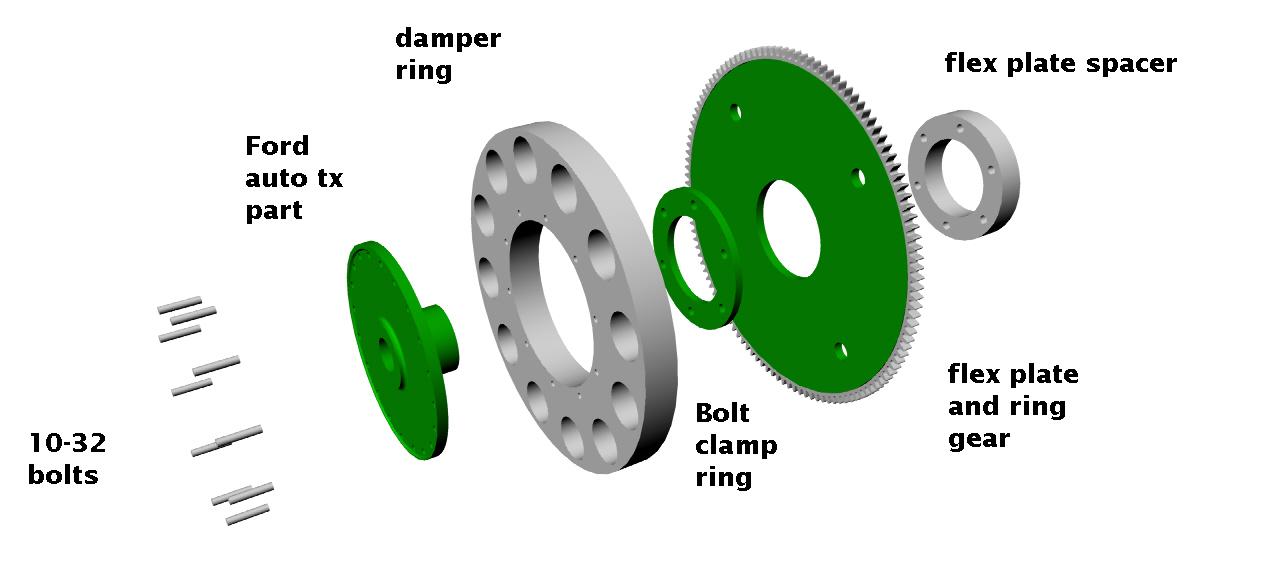
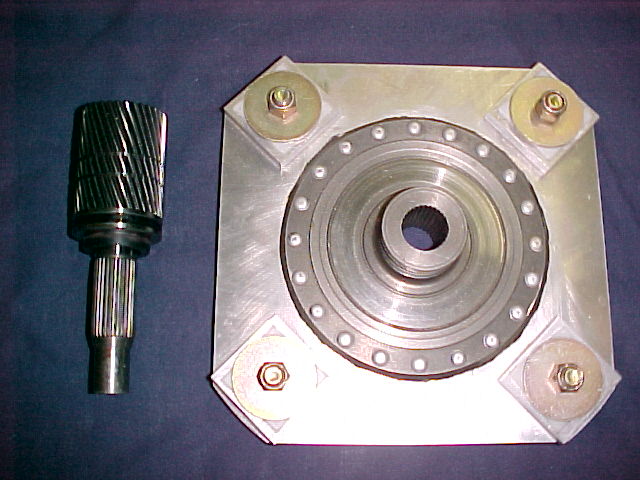
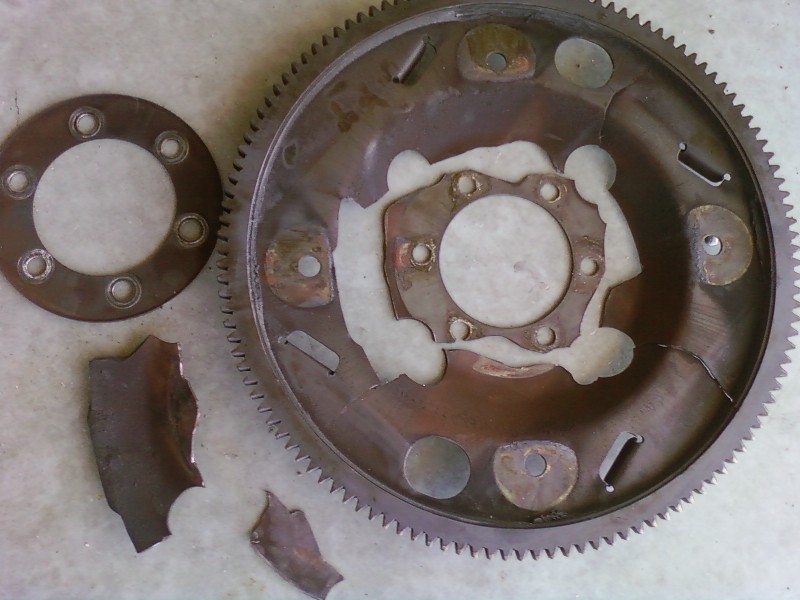
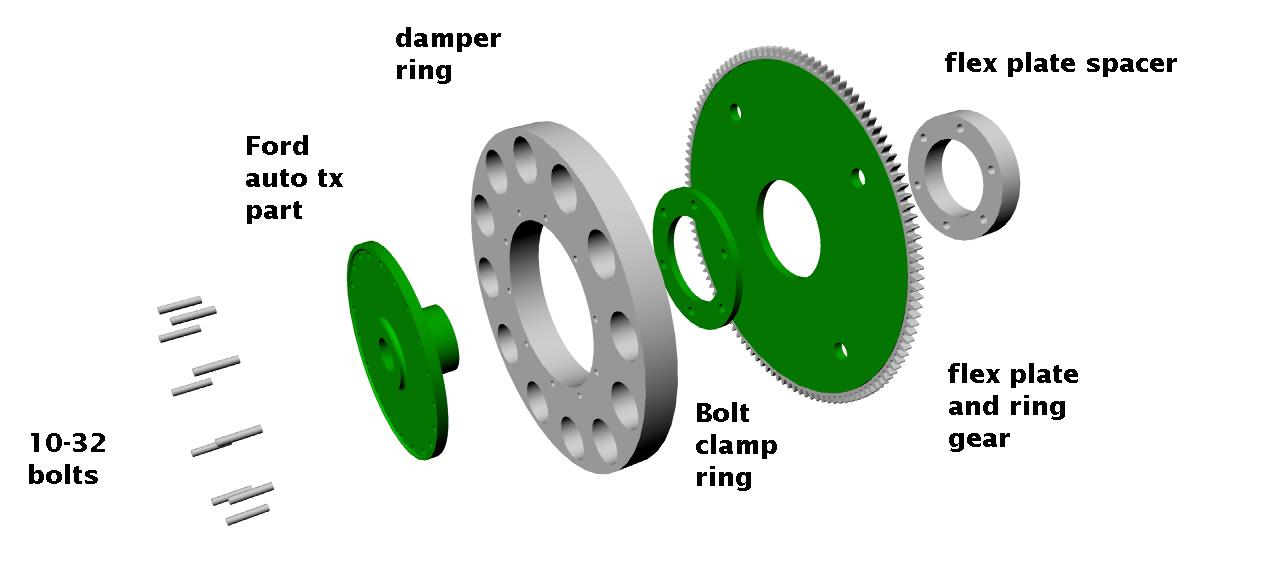
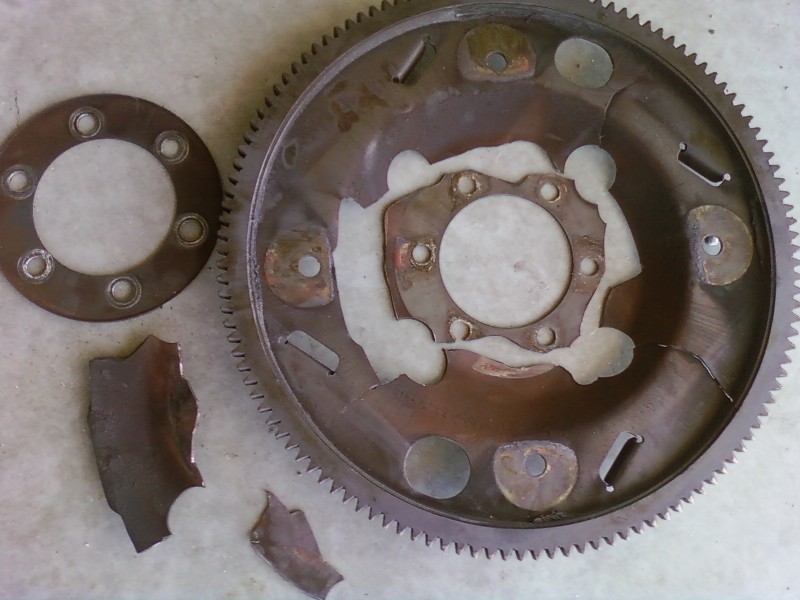
This reduces the number of parts.
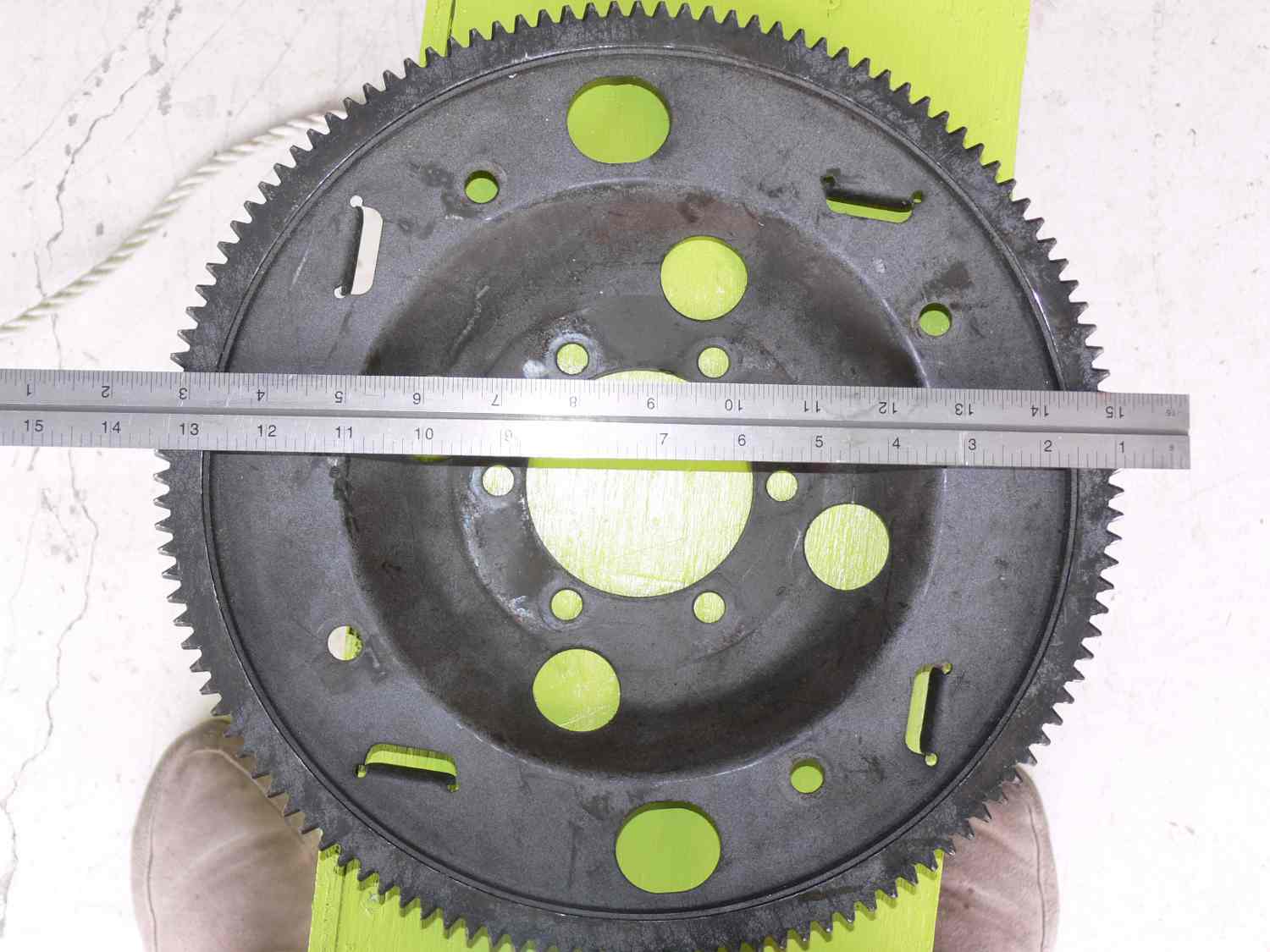
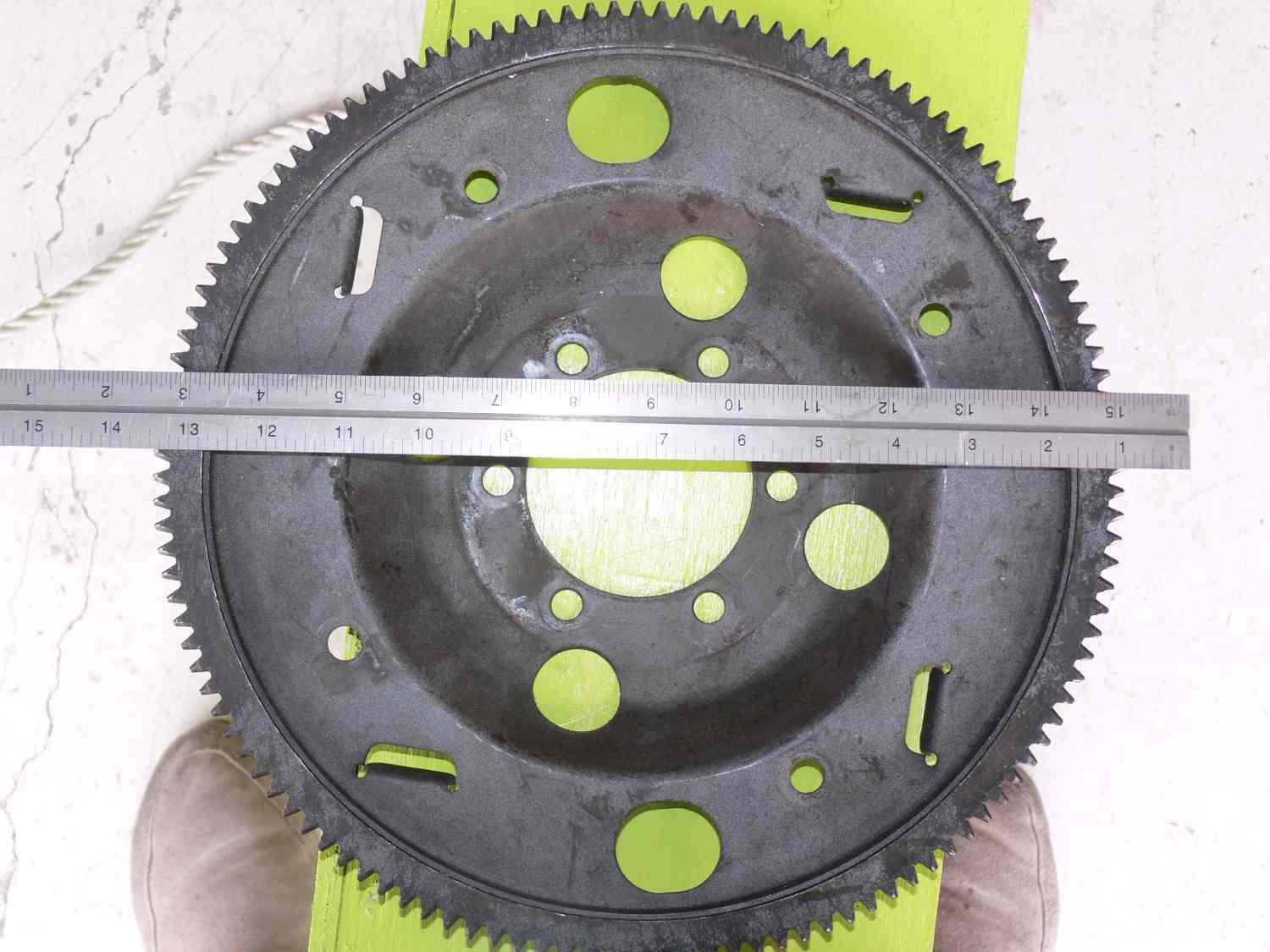
The flex plate can be .090" thick 4130 or anything up to 1/4 inch.
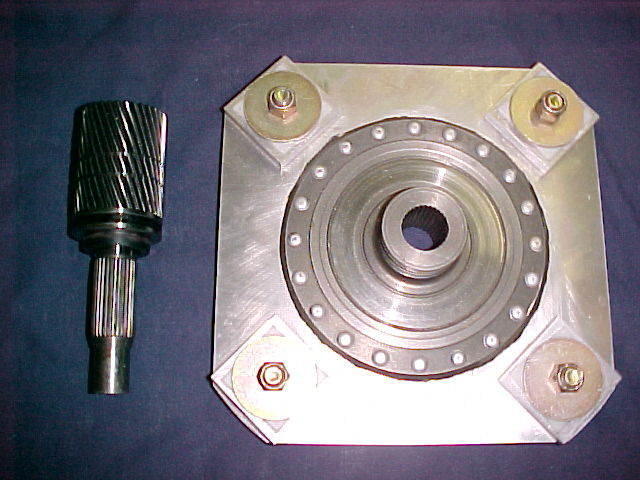
The damper plate has been reduced to one ring part instead of
a large thick Al plate four Al blocks and 16 rivets.
A large ring with twelve 1.375 inch holes easily
drilled on an NC machine. Only four of which are
used fro the rubber bushings. The rest are there to save
weight.
The Ford auto TX part is turned around 180 degrees
to nest inside the flex plate. Only 10 steel
10-32 screws are used to bolt it to the damper ring
instead of 20 rivets.
The rubber bushings and washers are the same.
No need to move the starter or change the damper
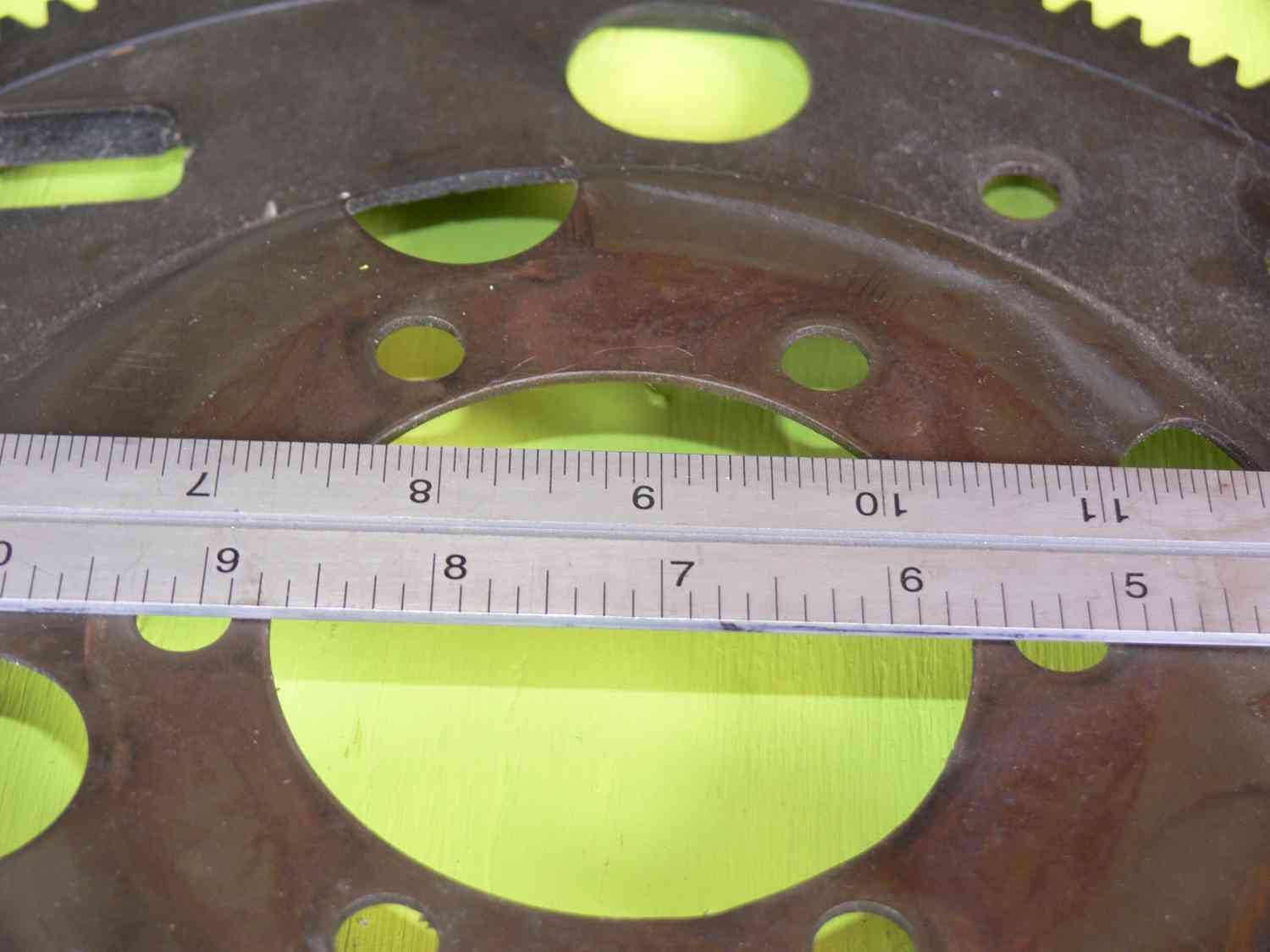
design as I suspect would be required with the RX8 flex plate.
What do you think Dave?
Paul Lamar
Looks elegant to me. Does the "Ford auto TX part" seat into the guide
bearing in the E shaft?
Mark LaPierre
The input shaft with the sun gear does that.
The Ford part has an internal spline that runs on the input shaft.
The Ford part is the same as Tracy uses now and it can be salvaged and re
used by drilling out the rivets.
Paul Lamar
If you decide to make a run of these, count me in for one. Or whatever
solution is decided to be best.
C. Smith
This is going to hinge on what Dave says as he is our
chief part Zerstörer right at the moment. Mark Steitel is
second in command with a p-port 3 rotor now flying.
I'll take over when I get a P-port in the RV4.
Paul Lamar
--
The Rotary Engine NewsLetter. Powered by Linux.
ACRE NL web site.
http://www.rotaryeng.net
Youtube key word PaulLamar2
Copyright 1998-2011 All world wide rights reserved.
Paul,
My 20B is back together with a new 13B flexplate. I suspect these two
recent failures are at least partially due to excessive runout of the
flexplate. I know that my flexplate wasn't running true. I did my best to
straighten it, but doubt that I got it perfect. As far as I know, it may
have even been cracked when installed with as many years having past since
first installing it. My new flexplate is true within .010". I'll be
watching it very closely.
I like your design, but would like it even better if it used all twenty
10-32 bolts. As you may remember, I had to replace the rivets in my adapter
with close tolerance bolts due to smoking rivets. Call me paranoid, but I
would feel a lot better if the new design used all 20 existing holes.
Looks like it would be up to the job, but I'll defer to Tracy and Dave, at
least for now.
Mark S. in TX
A 10-32 is .1875 inch in diameter.
R = .09375
squared = .00879
Area = pi times r squared = .0276 square inches.
At a modest 100,000 psi each bolt will take 2760 pounds in theory.
Most bolts are 120,000 psi or higher. I think grade 8 is
180,000 psi.
250 foot pounds of torque is 3000 inch pounds.
On a 2 inch radius 4 inch diameter that is a tangential load of 750 pounds.
Ten bolts is 75 pounds each in theory.
2760/ 75 = 37
That is a safety factor of 37 in theory.
Check my arithmetic. I flunked it in the 3rd grade.
I used two 10-32's spread 2 feet apart to take the torque of big block Chevy
mounted in the 2F chaparral :) The mechanics would twist them off with
regularity :) We had to go all the way up to 1/4 inch :)
20 10-32's will not hurt anything so by all means use 20.
Paul Lamar
--
The Rotary Engine NewsLetter. Powered by Linux.
ACRE NL web site.
http://www.rotaryeng.net
Youtube key word PaulLamar2
Copyright 1998-2011 All world wide rights reserved.