Pix of unknown rotary at Oshkosh yesterday. You folks that are there,
any details on it?
Sam Chitwood
If it did not run it could be phony :)
Find a bunch of existing castings and cobble them up
to look like an engine.
Experimental aviation is the happy hunting ground of charlatans
and scam artist. Are they selling stock yet? :)
http://www.rotaryeng.net/What-is-a-rotary-engine4.html
<ttp://www.rotaryeng.net/What-is-a-rotary-engine4.html"
Paul Lamar
I'm trying to picture how it looks inside.. I'm a bit confused..
All the intakes, outlets and spark-plugs are in one end plate......
And the rotor housing is a 2 piece unit.. Wouldn't that have sealing issues?
Keith Bennett
Well yes as a matter of fact they are looking for investment partners! The usual
stuff, will run on any fuel and they had a nice young ignoramus dealing with
questions, I understand it hasn't run yet. It is at booth promoting New Zealand
innovation, I went to a forum on the subject, some of their stuff is quite good,
but this seems to have a long way to go.
Anyway it's not really a rotary as the pistons reciprocate, perhaps something
like the Dynacam - what happened to that?
John Evans
Governments never seem to be competent enough to figure
out what is worthwhile and what is not. It should not be up to
them to pick companies and spend public money promoting them. The market place
is much better at doing that. As far as I know Felix Wankel never
got a public nickel. He wrote a very well researched and documented technical
paper on the subject of rotary engines and presented to a society of engineers.
It was then recognized to be a real advancement so several companies
licensed it.
-------------------------------------------------------------
History of the invention of the rotary engine by Julian Marsh
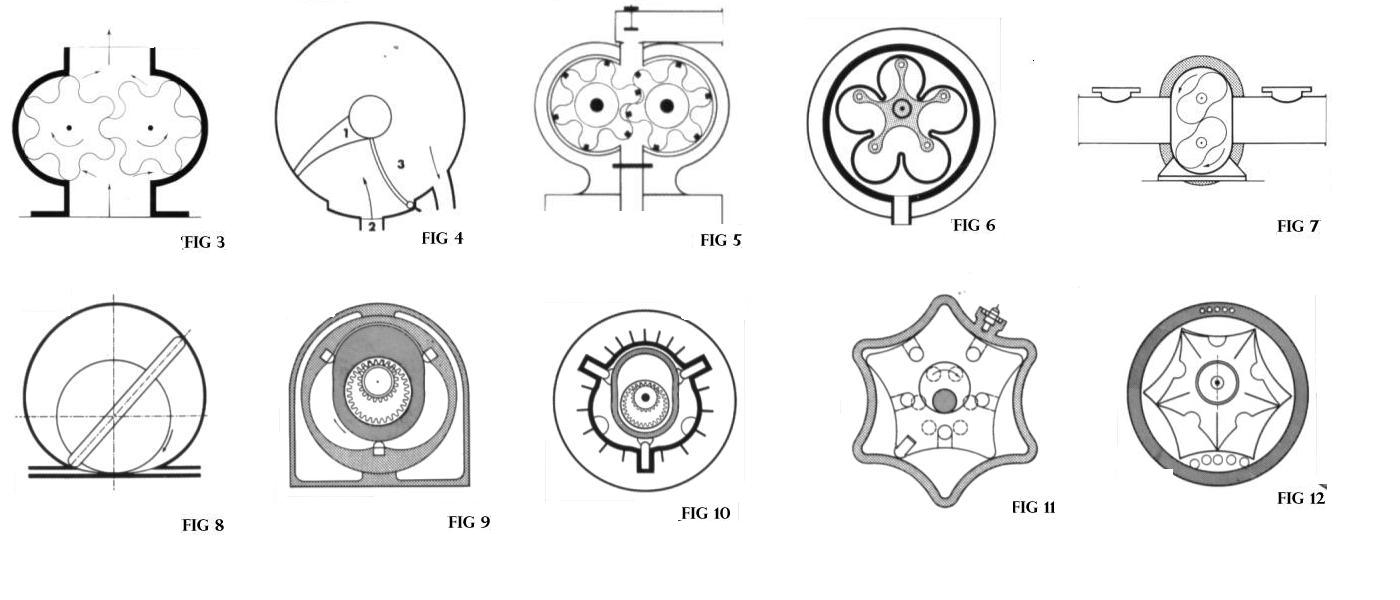
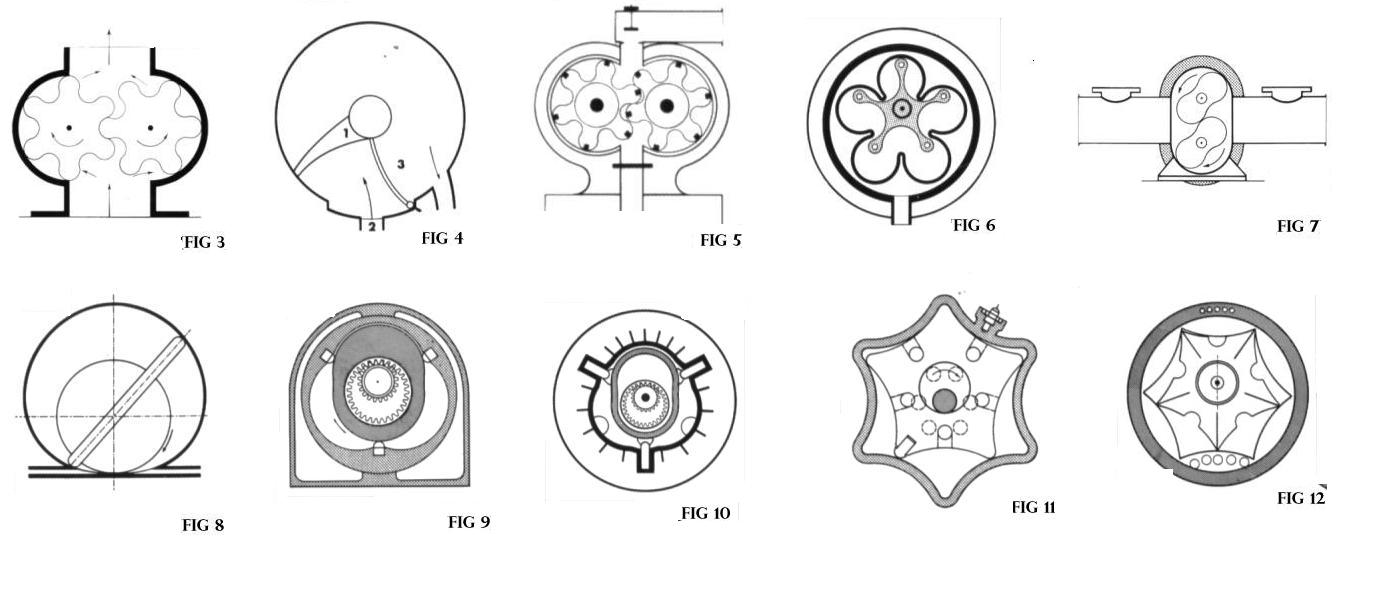
1588 Ramelli, an Italian engineer invented a water pump which
continues to be used in oil pumps and compressors.
1636 Pappenheim, a German engineer invented the gear pump which
is still used to lubricate engines. This gear pump made it
possible to dispense with the reciprocating slide valves used by
Ramelli. [Fig 3]
Pappenheim drove his machine by an overshot water wheel set in
motion by a stream and was used to feed-water fountains. The
emperor Ferdinand II granted him a "privilege" - the equivalent
of a patent in respect of this invention.
Even in the 17th century, engineers were trying to solve the
problem of ?leak-proofing? between moving parts and this problem
continues to be the Achilles heel of the rotary piston engine
although Mazda would seem to have reduced this problem to
manageable proportions.
1650 Otto von Guericke built a vacuum pump which employed
leather washers to prevent leakage between cylinder and piston.
1782 James Watt who invented the steam engine?s connecting rod
crank mechanism which made it possible to convert the piston?s
reciprocating motion into rotary motion designed an oscillating
piston machine in which a wing-shaped rotary blade performed an
almost complete revolution uncovering inlet ports in a chamber
separated off by a curved radial wall. [Fig 4]
1799 One of Watt?s co-workers, Murdock, adapted Pappenheim?s
gear pump to create a rotary piston steam engine. [Fig 5]
1846 Elijah Galloway built the first rotary piston engine with
inner epicycloid and enveloping outer line. [Fig 6]
1859 Jones, modified Pappenheim?s gear pump and produced a
double rotor with only two teeth per gear. Rootes compressors
and pumps employ this principle. [Fig 7]
1900 Alotham and Franchot designed a vane compressor comprising
a bust rotating inside a cycloidal housing. [Fig 8]
1901 The American, Cooley, lodged a patent for a rotary piston
engine with an internal epicycloid and enveloping outer chamber.
[Fig 9]
1908 The Englishman, Umpleby, transformed Cooley?s steam engine
into an internal combustion engine but experienced problems with
gas tightness. [Fig 10]
1923 A Swedish patent was granted to Wallinder and Skoog in
respect of a true rotary piston thermal engine with toothed
meshing, enveloping interior hypocycloid and internal five
pointed rotor with a 5:6 rotation ratio which could be used as
either a two or four stroke internal combustion engine.
[Fig 11]
1938 Sensaud and Lavaud, (the French engineers responsible for
the Traction Avant automatic gearbox which was a failure)
applied for a patent for a rotary piston engine with internally
meshing gears in a hypocycloid housing and a 5:6 reduction
ratio. Both Renault and Citroën, at the instigation of the
French Air Ministry provided backing for this project and a
number of engines were built at Batignolles. Unfortunately the
engine failed to live up to expectations and the project was
abandoned. [Fig 12]
1943 The Swiss manufacturer Bernard Maillard built an air
compressor based on a British patent for a rotary piston machine
with a 2:3 ratio and internal hypocycloid surfaced chambers.
Leakage under pressure made it impossible to use this design as
a thermal engine. [Fig 13]
--------------------------------------------------------------
Paul Lamar
--
The Rotary Engine NewsLetter. Powered by Linux.
ACRE NL web site.
http://www.rotaryeng.net
Youtube key word PaulLamar2
Copyright 1998-2011 All world wide rights reserved.