Hi Paul,
I have been building a Zenith CH801. This is a four passenger STOL
aircraft. It is not a fast airplane and cruises at about 105 knots. Its
strengths are its take off and landing characteristics. In fact, its high
degree of attack in take off could present cooling concerns. It stalls at
about 35 knots and climbs out at about 70 knots.
I have purchased your book How to Cool Your Wankel. I have had a radiator
made which is one inch thick by 40 inches by 20 inches. It has been folded
in a "U" shape as pictured on page 25 of your book. The radiator has been
mounted horizontally under my rotary engine as is shown on page 43 of your
book. The automotive Mazda oil cooler, which is 5 inches by about 22
inches, will be mounted on the side of my cowl as is pictured on page 44 of
your book.
I have included a picture of my plane as I begin fiberglass construction of
the front of the cowl. I have created a duct opening at the front of the
radiator for air intake of 5 inches by 20 inches.
As I viewed airplanes at AirVenture in Oshkosh this past week, I saw no
airplane with such a large duct opening. I was wondering if there is a
formula for creating the size of the duct opening for both the radiator and
the oil cooler? It is for that reason I am writing you.
Hopefully, you will be able to help me.
Sincerely,
Ken Johnson
I assume this is a p-port and you have 250 HP. If you wish to cool 250 HP
while climbing out at 70 kts you will need a lot of air going through
the cooling system. The air flow is proportional to the speed squared.
If you climbed out at 100 kts you would have twice the air flow and the
opening, in theory, would be half as large.
You are on the cutting edge here. I know of no
other airplane with 250 HP that climbs out at 70 KTS other than perhaps
a Helio Courier. What makes this extraordinary airplane possible is the
extraordinary power to weight ratio of the Mazda rotary P-port.
Twenty percent of the core surface area is about right for 70 Kts.
You can always reduce that opening later but it is better to over cool
on the first flight rather than under cool. Under cooling on the first
flight can cause a panic and perhaps a crash. Don't worry about it until
after you fly it for awhile in the hot summer. Then you can reduce the size
of the opening and see if that adds to the top speed.
What gear box is that? What is the ratio? Take some side view pictures
and send them. It looks rather blunt from the front view but a side view
might give a different impression.
Paul Lamar
I'm in the fortunate position of cooling too well. I have to cut my air
scoop opening down about 20-25% at least at first. On an 80 degree day, I'm
climbing at 70 kts and getting 150 water, and about 130 oil temps. I'll also
bet the plane is really draggy because of my cooling. loafing about at 4000
ft, 70 degrees, 120 mph, the coolant temp is around 120 and the same for
oil.
Brian Trubee
How is it running lately Brian? What climb rate are you seeing at 70Kts?
From that I can estimate the HP you are using?
Your RV4 weighs only about 1300 pounds. You also do not have 250 HP.
I should have mentioned max angle of climb which is what you are supposed
to do with a STOL like the Zenith 801 :)
I am glad it is cooling well. 12 years ago when this news letter started
nothing cooled :)
Paul Lamar
12 years!!! "fair dinkum". thanks Paul.
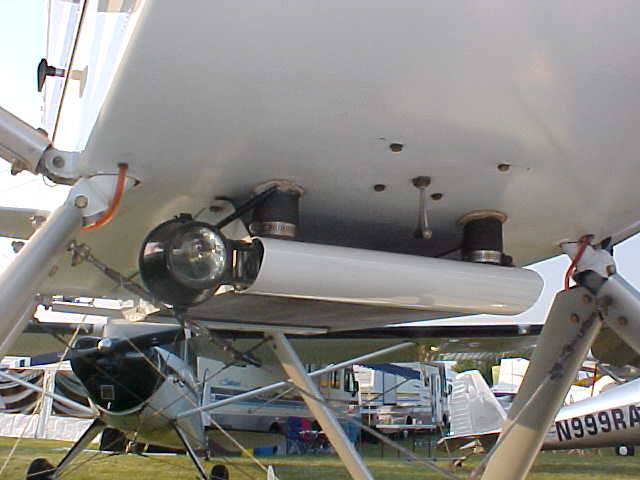
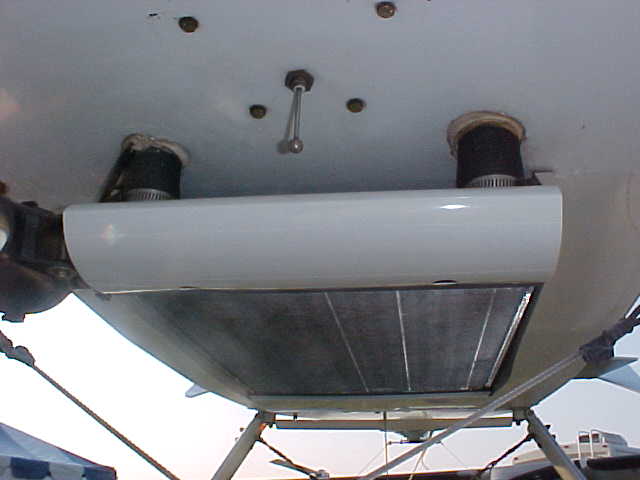
I might also point out, in the interest of full discloser, Brian
increased the frontal area of his RV4 by mounting the rad under the fuselage
in sort of an enclosed version of the quick and simple cooling
system. Now I am not ready to say this configuration is necessarily more
drag than a stock RV4 as there is some evidence to support
a lower drag situation if the wing does not intersect the
bottom of the fuselage. There is more to overall drag than just the cooling
openings.
Example of this mid fuselage approach are the Corsair and P47.
Paul Lamar
--
The Rotary Engine NewsLetter. Powered by Linux.
ACRE NL web site.
http://www.rotaryeng.net
Youtube key word PaulLamar2
Copyright 1998-2011 All world wide rights reserved.