Paul and everybody, thanks for continuing to patiently educate me in
these
topics. I might be interested in participating in a group buy of the new
damper, but should we be concerned that the Kawasaki KE 175 was only 17
horsepower? Also, could this damper's location at the rear hub possibly
indicate that its purpose was only partly to dampen engine pulses but
more
to dampen driveline lash when the clutch is engaged, or when
shifting?...hence its location downstream from most of the drive- line.
I
used to ride a lot, and sometimes just by engaging first gear [even with
the
clutch disengaged] this caused the final drive chain to jump and slightly
jerk the bike [noticed this is Yamaha RD 250, Honda 750, but not so much
in
my shaft drive BMWs...] Paul could address such issues from the durometer
value.
I was reading in the attached Centa catalog on page 5, para 6, that
"For other applications and for generators whose mass moment of inertia
is outside the stated limits, we request that full details of the
proposed
drives are sent to us. We can then carry out a torsional vibration
calculation free of charge."
If I am way off base, then please ignore!
Gene Kahn
Good luck with them. We are not big enough to interest them. We tried a
different type on a rotary and they were usually limited in an RPM range
to
a number below what we run at. The type we tried were too stiff.
Some of
the parts in this catalog are cast iron. 4130 has much higher strength
the
weight ratio. These are not cheap as well.
Paul Lamar
--
Hi, these are worth taking a look at;
http://www.sgf.de/uppics/Datenblaetter_Industrie_englis.pdf They are
used on auto drive shafts and Porsche used one on their aircraft engine.
They are cord reinforced rubber like a tire, most others are just rubber
and have lower speed limits.
Murry
Promising. The GA000-012 or -029 might work. Interesting and very simple
concept. Ideal size at around 6.3" OD. 10,700 RPM
Good work Murry.
Paul Lamar
--
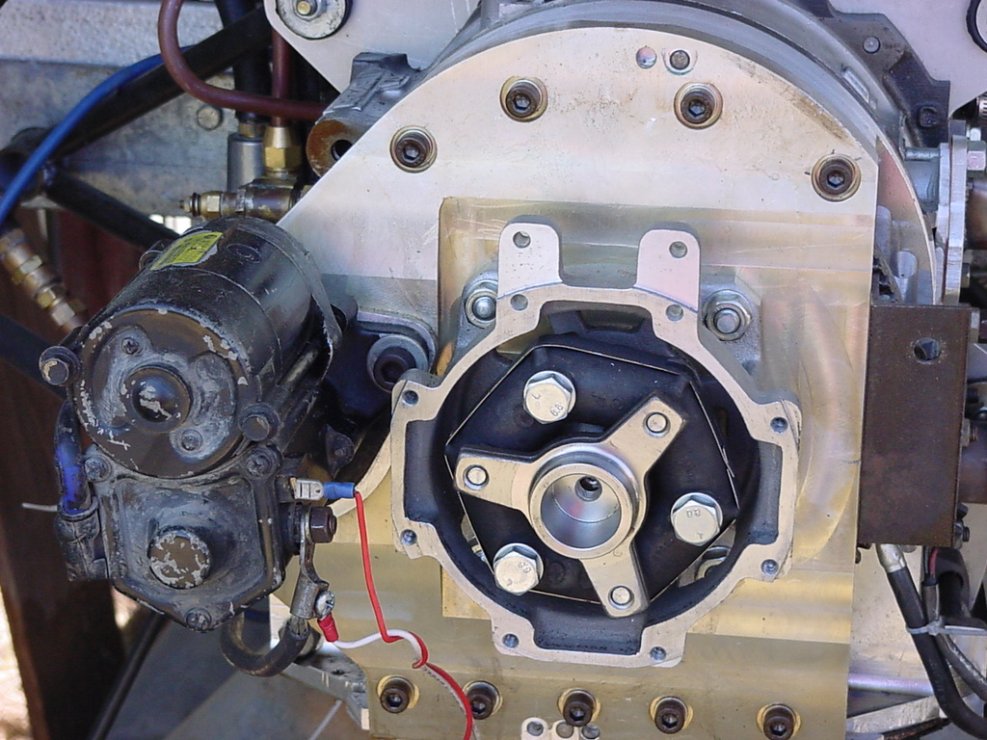
This is the kind of coupler I am using on the single rotor. I never saw a
problem with it so far. Since this coupler came with the redrive, I do not
have an independent source for it.
One thing I like to point out for using this type of coupler, it is very
important for the input and output forkes to be very precisely centered with
each other. Insufficient centering will lead to immediate destruction at
elevated power levels. I have seen that on automotive engine dynos quite a
bit.
FWIW
Richard Sohn
N2071U
www.fairpoint.net/~res12/home.html
What idle speed do you use Richard?
Paul Lamar
--
The Rotary Engine NewsLetter. Powered by Linux.
ACRE NL web site.
http://www.rotaryeng.net
Youtube key word PaulLamar2
Copyright 1998-2011 All world wide rights reserved.