-----Original Message-----
From: Rotary Engine [
mailto:rotaryeng@earthlink.net]
Sent: 15 August 2011 22:46
To: AAA Put this in the To box
Subject: One way and centrifugal clutches
After reading about all the failures related to the damper, I started
to research into the subject of torsional resonance and found this
article on how they have solved their problem on Bede 5. The original
PDF is rather long so I just copy part of it for you to take a quick
look. You can find the original file here
http://ibis.experimentals.de/downloads/torsionalvibration.pdf
The part that I think is of most interest is reproduced here:
"THE FREEWHEEL CLUTCH
The idea for a freewheel clutch came from our machinist, Ray Johnson,
and I must give him the credit. He came in one day and told me that
when he was a kid, his dad had a thrashing machine on the farm They
would run the belt from the tractor to the thrashing machine and it
had a freewheel device on it so that any vibration coming from the old
two cylinder John Deere would be somehow taken care of. The minute he
said "freewheel clutch", it rang a bell. After previously seeing the
oscillating torque reversals of the prop I knew we needed some way to
allow a torque reverse to occur without the bounce back. I had been
looking at centrifugal clutches, manual clutches, etc. that could be
used to disengage and allow some slip. We even tried a test with a
super loose belt with idler pulleys but the slop still wasn't enough.
The torsional amplitude was just too great at the low system frequency
we were dealing with.
Immediately after Ray mentioned the freewheel clutch, I started
investigating and found a Borg Warner clutch that was used in
automatic transmissions It was a double cage, full phasing sprag
clutch. The double cage caused all the little cams inside to engage
precisely at the same time. I had previously had experience with
freewheel roller type clutches at Avian but we had problems with the
brinelling of the clutch races when one roller would engage before the
others and momentarily take the full torque, causing eventual clutch
failure. The double cage full phasing, sprag clutch solved this
problem."
From there, I wonder if Tracy's original design really works or not? I
am not sure if enough on the subject of torsional resonance has been
done. May be even a different approach is necessary?
Also, from my readings, it seems that many people recommends more
cylinders for smoother torque curve. In my simple mind, a smoother
torque curve alleviates the problem. The 2 rotors have one firing
every 180 degree, similar to a four stroke so torque curve is not
smooth. (See information on EPI Inc. on this subject) A 3 rotor is
similar to an in-line 6 at 120 degrees so may be 20B is more
suitable/reliable for aviation? A 4 motor would be even better. Many
great airplanes in WWI are V12s and they would not have a lot less
problem with torsional vibrations.
I am not a mechanical engineer, so anyone out there please correct me
as much as they can. I am not building yet, not even a license to fly.
But sure hopes to find time to do it soon.
Henry Nee
Hi, One way and centrifugal clutches can help if the system has a low
rpm resonance peak. The drive is not connected or only 1/2 connected so the
build up of loads at resonance can not occur. If you go through the
critical rpm only once on start up and shut down, clutches can work. If the
critical rpm is in the operating range, they will most likely fail.
The NSI gearboxes used sprag clutches. I have info on the effect of the
SGF coupling on the Porsche aircraft engine if anyone is interested.
Similar torque, rpm and firing freq as a two rotor. I have a Mercedes SGF
and the part numbers do not match the SFG chart. Matching dimensions may
identify oem units. Since they are normally used behind the cars gearbox
and see first gear torque, a unit from a pretty small engined car would be
likely the right size. Finding a retail source other than car parts
departments might be a challenge. I'll do a little searching.
Murry
Decades ago you could get a manual transmission car with overdrive accessory
.... and it had a one way clutch that might be applicable. The older SAABs
with the 2 cycle engine also had one way clutches in the transmission to
prevent car momentum from spinning the engine on overrun since there was
little to no lubrication to the engine if the throttle was closed. Either
of these parts might be used.
SD
Hi You Guys
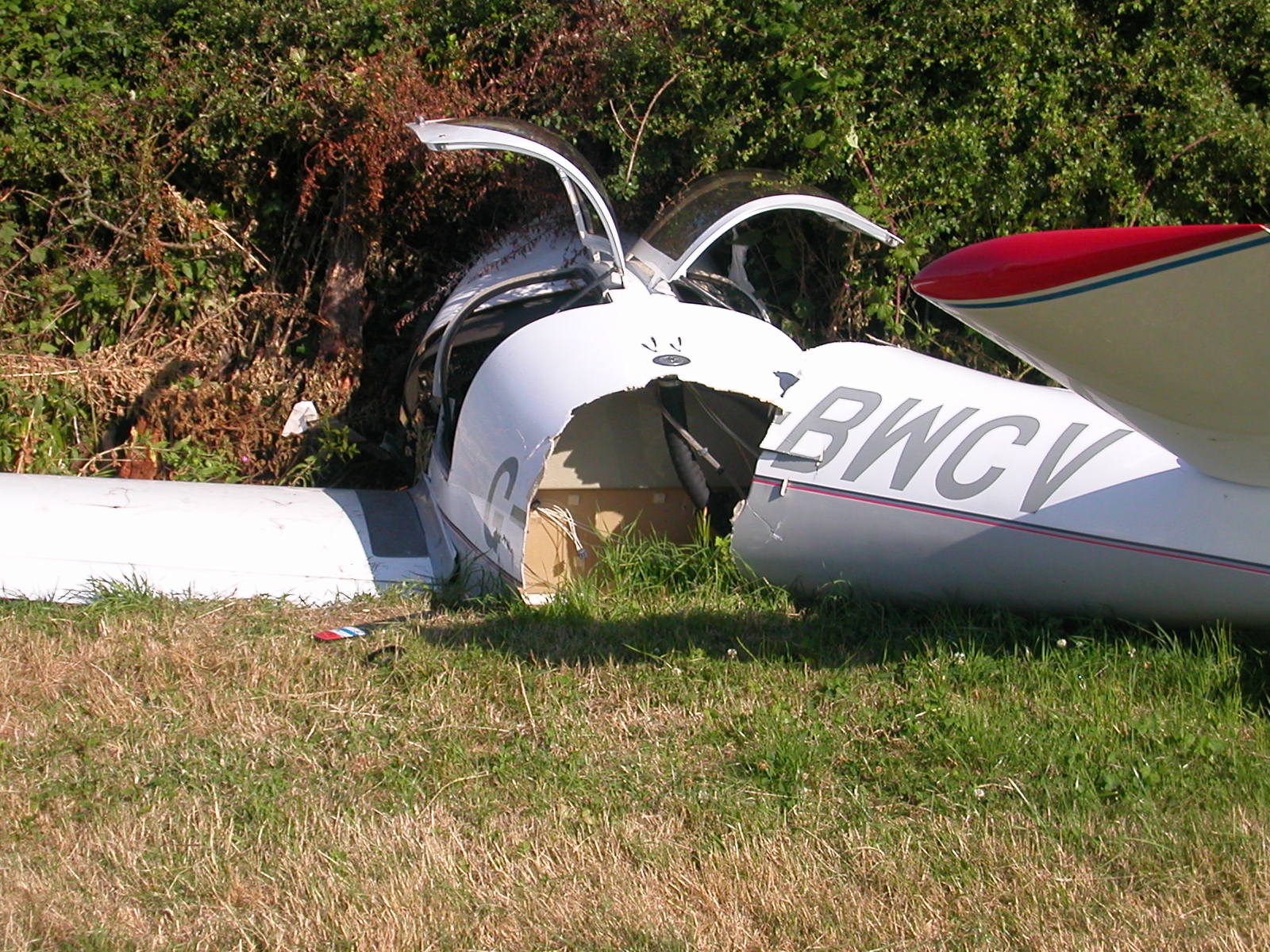
Here's a picture of what happens when an NSI engine stops in flight.
The engine was stopped dead in flight due to the alternator bearing ceasing
( this was because adding the second belt NSI deleted the cooling fan,
bearing became too hot and ceased and in turn two belts and the ceased
bearing were enough to stop the engine turning).
Anyway my point is this. with the engine stopped the freewheel was now not
locked up so the propeller freewheeled and being in windmill mode created a
HUGE amount of drag.
The pilot reported a rate of descent in the order of 3000 feet per minute,
from memory I thing he was only 2500-3000 feet.
I think this is the same type being discussed here, so thought you all
would want to know.
Kind regards Clive.
--
The Rotary Engine NewsLetter. Powered by Linux.
ACRE NL web site.
http://www.rotaryeng.net
Youtube key word PaulLamar2
Copyright 1998-2011 All world wide rights reserved.