Paul,
I made it out to the airport early this morning and made a flight while it
was still cool (below 100*). This time I set the prop controller to 2300
rpm instead of the usual 2150. I held it at the numbers at part throttle
to
allow the prop to partially adjust, then released the brakes and applied
the
power gradually. Engine rpm came up to 6980, more or less. Much better
than at 2150, but it takes some finessing to keep the rpm's below 7500. I
took some video, but not of the initial ground run. It starts after I'm
in
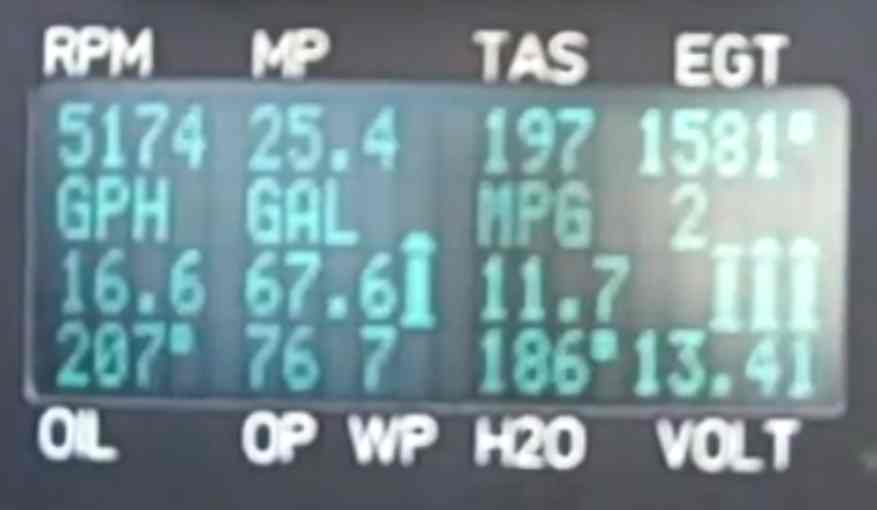
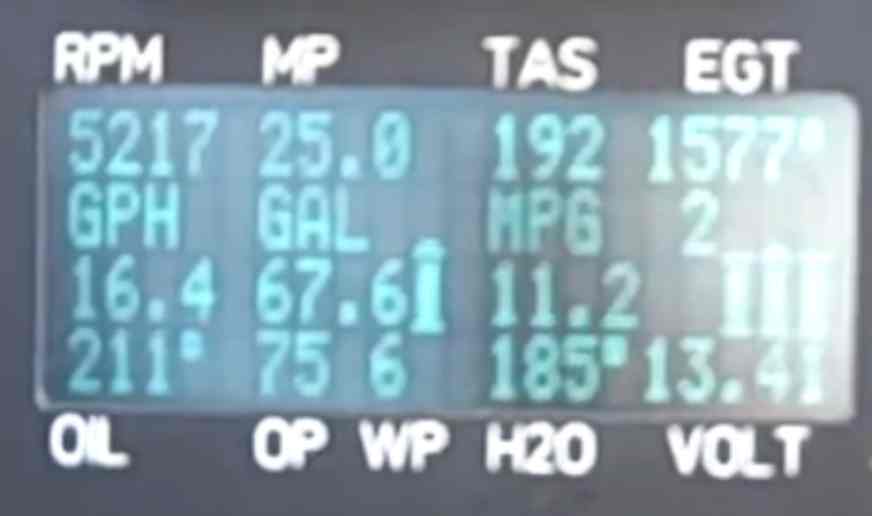
the air and climbing, but it shows the various EM-2 screens. I used a
tripod and the data is much easier to read.
Upon reviewing the video, I was able to calculate the bsfc based on a fuel
burn of 16.5 gph and 220 hp. Came out to .45 bsfc. So, yes we can!
The file is too large to attach and send via email, but I'll try to load
it
on YouTube later today and send the URL.
I also took a second video where I went from a cruise setting of 1700 rpm
(prop) to 1900 rpm. Speeds climbed to 208 mph. This was at 6500 msl,
straight and level. Some day I'll go to 2100 or higher and see what she's
made of.
Mark S.
P-port 3 rotor Lancair ES.
Good work Mark but I kind of doubt the .45 BSFC. That would be a world
record
for a rotary :) NOBODY has reported less than .47 so far at full lean.
How did you determine 220 HP?
Paul Lamar
Paul,
I read the hp from one of the EM-2 screens, so it is calculated. But I
don't know the formula Tracy used to determine it. The fuel flow is from
the main EM-2 screen, and yes, it could still need some "calibration"
before
it can be called accurate enough to use for the Guinnes World Record Book.
Mark
Ah so. Tracy uses an assumed average BSFC of .55 as I recall from reading
the
EM -2 docs. page 18.
0 - BSFC
"Break Specific Fuel Consumption This variable defines the average
efficiency of the engine and is used to calculate things like HP
output and percentage of power. All internal combustion gasoline engines
have an average BSFC of around .55. It is a bit lower
when running lean mixtures and a bit higher when running at best power
mixtures which are much richer. The EM2 uses this entry
as the average BSFC and either adds or subtracts a bit when it calculates
horsepower depending on fuel mixture being measured by
the O2 sensor (if installed). It uses the default value as-is if no sensor
is installed."
BSFC is given in pounds of fuel burned per HP generated in one hour.
You first convert GPH into pounds per hour by multiplying by 6.
Six pounds per gallon. So 16 GPH is 96 pounds of fuel per hour.
Some say the number is 6.2 pounds per gallon.
We will use six.
16.5 GPH is 99 pounds of fuel per hour.
Then you divide 99 pounds of fuel by .55 and you get 180 HP.
Now Tracy adjust the BSFC number by reading the O2 sensor. Lets say the O2
sensor
is saying the engine is full lean. Around seventeen to one. In that case
the BSFC
should be around .47. So 99 pounds per hour of fuel gives a gives 210 HP.
Lets say Tracy got highly optimistic and used .45 BSFC then it would come
out to 220 HP.
Here is a chart on the 3 spark plug per rotor Le Mans engine, Note the BSFC
is only .469.
Paul Lamar
Paul,
Well, its beginning to make more sense. Did you see the second video?
Mark S.
Yes. Here are some screen shots. In the display with the two lines in the
middle that are unmarked..what do they represent? That is screenshot-9.
Was this straight and level all the time?
It would be nice to set the camera angle so you can see the air data display
for altitude.
Paul Lamar
--
The Rotary Engine NewsLetter. Powered by Linux.
ACRE NL web site.
http://www.rotaryeng.net
Youtube key word PaulLamar2
Copyright 1998-2011 All world wide rights reserved.