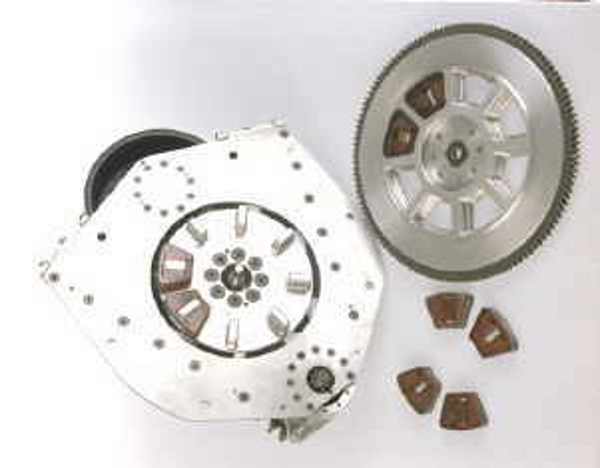
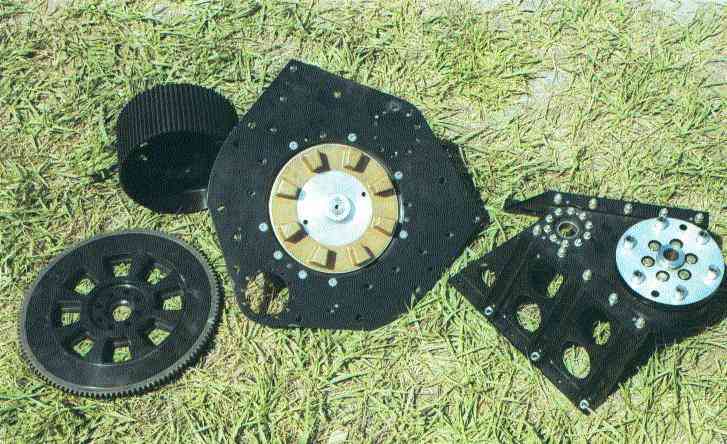
I made the coupler smaller in diameter to reduce the polar moment
of inertia and gyro reaction stress. The 4130 rectangular
tubes are off the shelf at AC Spruce. The advantage of
this design is: everything can be changed if necessary.
For example if the main 4130 plate cracks the thickness
can be increased in later version.
It does not depend on a proprietary part that could
be discontinued at any time. I will build one some time
this year.
Paul Lamar
I am really starting to like this design. Can you have it to me by reno?
:-)
--
David Leonard
Turbo Rotary RV-6 N4VY
http://N4VY.RotaryRoster.net <
http://n4vy.rotaryroster.net/ <
http://n4vy.rotaryroster.net/
http://RotaryRoster.net <
http://rotaryroster.net/ <
http://rotaryroster.net/
Are you kidding? It takes a couple of weeks just to get the 4130 steel
laser cut:) Then I have to get it in the tig welding shop
for another couple of weeks. Reno is two weeks away and then
we would have to test fly it first.
BTW I got the radio working today in the RV4. Both transmitter and
receiver.
The VSWR is less than 2 at 122.9 MHZ. Works great.
Paul Lamar
I made a scale dwg showing the counter weight, PSRU adpater plate and
rubber coupling.
Here it is. The last attached jpg.
There is not a lot of room for an outboard style alternator/CD ignition
system on the front or back of the flex plate but it might be nice to
have
that all in the same package.
I have an idea. Let's see how it develops.
Paul Lamar
------------------------------******----------------------
Here it is. I recessed the rubber coupling back into the 4130 flex plate
and eliminated the aluminum spacer between the counter weight and the old
flat 4130 flex plate. We will need a jig to hold everything in place
to weld this up. One less part no less and shorter bolts.
There will be some minor trimming required on the Ford splined device as
well.
This made room for a Harley type alternator in front of the flex plate.
The Harley version will require a battery to ignite the RX8 coils.
Some outboard stators and magnet wheels will also probably fit.
The outboards type are truly a best bet as no battery would be required.
The high voltage coils charge one or more capacitors and they are
discharged to
fire the plugs. With a high wing airplane to feed the fuel and a carb no
battery
or separate alternator at all would be required.
You would still have 40 amps or so for lights etc.
Paul Lamar
--
Any idea what the coupler, as designed would cost?
I'm interested.
Lewis.
0.090" 4139 steel sheet 12" by 24" from AC Spruce is $28.
No idea what the laser cut parts are going to cost but you are a good
welder so you could borrow my tig and weld it yourself.
BTW how is the belt working out?
Paul Lamar
Paul,
I'm interested in one, assuming it can handle the HP of the pp 20B.
I can do my own welding.
Mark S.
It should. We have a lot more rubber in there and silicone can handle
the heat. This is the .O90" thick version but once they have the laser
program
something cut out of thicker 4130 sheet (.125) should be no problem cost
wise.
You could tig weld it yourself. It can also be sent out for heat treat to
make it cannon proof:)
I would much rather not get in the biz as I have my plate full with
current projects but if somebody does want to it I will send the dwgs.
Paul Lamar
Paul,
Just thought I might share a PSRU design and the accompaning
torsional damper which uses high pressure fiberglass laminate strips
which
are .312 thick and 1.25 wide. There is also a spacer with a 1-1/2" bushing
for the input pilot similar to the stock flexplate spacer.The planetary
is
a Borg Warner 4407 with a 2.62 ratio. The oil supply is the space between
the 1/2" plate and the planetary. The hollow prop shaft front bearing is a
spherical roller, the rest are timkin tapered roller. Adjustment for
preload
is by the bearing cap shims as found in the timkin catalog. The pressure
lube pump fits around the input shaft and is also the spacer between the
brarings. The bearings are different than the ones from the transmission
for 7000 RPM continuous. This PSRU works as a pusher or tractor and is
approximately 10 inches longer than the RD-2 to get the prop furthur from
the engine for more room to install cooling ductwork.
The damper is similar to the one that connects the front 3 rotor to
the back 2 rotor engine module except that the fiberglass strips are
thicker. I used this laminate for 30 years for machinery I designed and it
runs just above ambient air temp with an efficiency rating of 98%. It is
used as the suspension/springs on a vibrating conveyor. Efficiency in this
application should be higher due to the very short actual movement.
All the components are running near their rated speed but at a small
fraction of the load capacity which should provide a little more speed
capacity except for the oil seal behind the prop which is a dual wiper oil
retaining type from the automotive section of the timkin seals catalog.
This is the first draft of this PSRU and the internal oil passages are
not written in stone yet. There should also be some lower motor mount pads
to counter torque at the gearbox to work with the top mounts on the
accessory end of the engine.
george grimes
Paul, Just a thought but has anyone looked at the marine outdrive couplers.
They turn at engine speed and handle 260HP connected to a prop. I saw one
today at a buddys house. It was a 17 tooth spline about 1"OD. The hub was
about 4-1/2" diameter. The bolt pattern is the same as the rear of the
engine crankshafts. The engines used are Ford,GM (small block and big block)
Volvo and anything else used with a Mercruiser, Alpha, or Bravo drive
system. The space between the splined hub and carrier are filled with
vulcanized rubber. I got the attached photos from E-bay listings as a
sample and there are pages of them. Some are $99 new some go up to $189. LOW
polar moment of inertia. If you want more flex for a small engine just drill
holes in the rubber section. The pilot bearing is in the crankshaft, just a
clearance hole thru the coupler. Splines are about 2" long. I am reluctant
to add options since we are discussing several already so if you preffer you
don't have to post this.. I just thought it looked like a nice piece.
george grimes
This may be the cheapest and simplest of all as it does away with
the large Ford flange and female spline. Something we would have to deal
with if we put the rubber in the PSRU. What does the male splined shaft
look like. Can it be bought off the shelf?
Paul Lamar
Paul,
If you would like some of these parts already made you should get the rear
wheel from a large displacement motorcycle. They use a captured rubber
system that is small diameter and designed for high shock loads. On my
1000cc Yamaha the hub is less than 200mm diameter. These bikes have about
150 hp available at the rear wheel.
Bill Jepson
Yes I know. I already posted some pictures. Here they are again.
Are you reading all old messages? :)
They are rarely exactly the right size.
If you have any dwg's with dimensions on them I would love to see them.
Paul Lamar
--
The Rotary Engine NewsLetter. Powered by Linux.
ACRE NL web site.
http://www.rotaryeng.net
Youtube key word PaulLamar2
Copyright 1998-2011 All world wide rights reserved.