With a rash of loss of power episodes, and with the lack of a definite
cause, and with a common thread being that they had a Hushpower muffler, I'm
thinking of either or both of these options- rip the guts out of my current
hushpower muffler, or design and build a muffler that is the same dimensions
as the Hushpower. It needs to have a 2" inlet be about 18" long, and be no
wider than 4 1/2 inches in diameter. I'm thinking of ordering or making 2)
2 inch to 4 inch transitions made from .065 321 stainless, with a center
section that is cylindrical. I want something that is not going to have it's
guts blow out and obstruct the exhaust flow and kill power. It should also
attenuate the exhaust note to some degree.
When I last checked my Hushpower, I took it off and it rattled like a baby
rattle. I used a flexible camera and both inlet and outlet cones were
intact. Still, this muffler is the thing that makes me most nervous about my
installation.
Any ideas for the internal design of a muffler that is the same rough
dimensions as my hushpower, but is somewhat failure tolerant?
I have one of those cylindrical SS mufflers made in Canada, I forget the
name of the manufacturer, but it is cylindrical and about 24 inches long. It
has angle pieces welded across the cylinder part in a spiral pattern. I
might just cut it and shorten it to fit.
Thanks,
Brian Trubee
Is Boeing surplus still up there? If you can get some inconel that would be
a way
to go. .065" 321 SS is pretty good. I would design it in two pieces and
bolt them
together with 1/4 inch SS bolts. That way you can take it apart from time
to inspect it.
Paul Lamar
Brian,
You're describing the DNA (Dynamic Noise Attenuation) muffler. I've been
running one for over a hundred hours on my 3-rotor and it shows no sign of
failure. It isn't the best at reducing the rotary's bark, but it works
better than a straight pipe. Someone said that the company is no longer
making that style muffler. If you decide not to use yours, let me know and
I'll buy it from you to keep as a spare. FWIW
Mark S.
http://www.engineeringtoolbox.com/noise-reduction-silencers-d_81.html
"The Dynamic Insertion Loss - DIL - is the difference between the sound power or intensity levels
measured in the same point of the duct work before and after the insertion of the silencer."
"The reactive silencer may have excellent low frequency performance, is non-fibrous and cleanable
and has small or negligible pressure loss. The simplest kind of a reactive muffler is the expansion
chamber. In general reactive silencers are used for fixed speed machinery producing pure tones. The
reactive silencer is suitable for engines requiring very low exhaust system back pressures for a
maximum engine performance."
The secret to an effective low drag 4 inch diameter rotary engine muffler is make it longer.
That keeps the drag down while quieting the engine better. One can try making helmholtz
sub sections of differing length and connect them together. Basically large washers between
sections. Band saw it length wise and weld on flanges to be bolted back together.
For a two rotor:
5000 RPM is 116 hertz
6000 RPM is 200 hertz
7000 RPM is 234 hertz
For a 3 rotor:
5000 RPM is 174hertz
6000 RPM is 300hertz
7000 RPM is 351hertz
Helmholtz resonators have been widely used for various types of applications. They are
effective in passive control of sound of single resonant peaks by acting directly on the noise
field. There has been much work on the theory of Helmholtz resonators, calculating resonant
frequencies and effects of resonator shape on its characteristics. See the attached pdf.
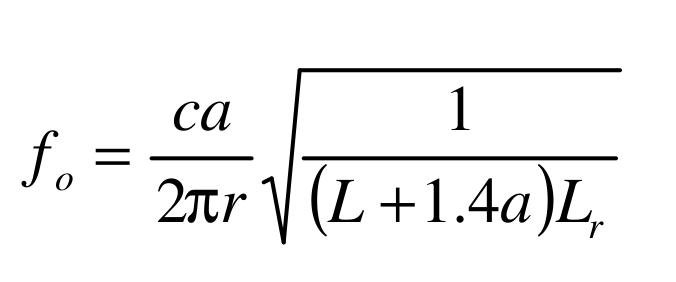
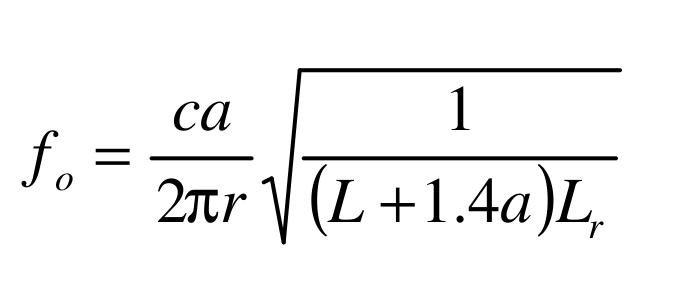
A cylindrical Helmholtz resonator with a body radius of r, and a body length of Lr, a is
the cross sectional area, c is the mass of air I think. has a natural frequency given by fig 4.jpg
Mass is weight in pounds / 32.2 given in slugs.
http://physics.kenyon.edu/EarlyApparatus/Rudolf_Koenig_Apparatus/Fourier_Synthesis/Fourier_Synthesis.html
http://physics.kenyon.edu/EarlyApparatus/Rudolf_Koenig_Apparatus/Fourier_Analysis/Fourier_Analysis.html
I recommend doing a bit of experimenting using a sine wave signal generators, a high fi amp, a 4
inch speaker and short pieces of .065 4 inch diameter SS tubing. A radio shack DB meter would
be a good idea to quantify the results. One could also make a tape recording of the engine
without out mufflers and use that to test a design.
Paul Lamar
--
The Rotary Engine NewsLetter. Powered by Linux.
ACRE NL web site.
http://www.rotaryeng.net
Youtube key word PaulLamar2
Copyright 1998-2011 All world wide rights reserved.