Paul,
I don't keep up with these racing planes, but what happened to the radiator
on this Mustang? How is the engine cooled? And I thought that the Mustang's
radiator ductwork was designed so that it actually yielded positive thrust?
If so, why remove it?
Csaba Csera
============================================================================
=======
From a pilot friend.
Galloping Ghost crash
Ok... here's the skinny on the accident....
A P-51 normally has two trim tabs. One on each elevator... This one had one
and other one was fixed in place.
He was warned about all the forces being put on that one tab. It failed.
He had at least a 10G load when the plane pitched up from the loss of the
trim tab and he went "nighty night" and probably never woke up.
Here's the "theory" of the crash from experienced racers.
In 1989 this type of thing happened to another pilot but he lived to tell
the story. When flying a P-51 at 450+mph you need to have full nose down
trim to keep the plane level. The elevator trim tab broke off and the
aircraft immediately went in to a 10G climb, confirmed by the G-meter. The
pilot came to, from the sudden blackout and realized he had slipped through
the shoulder harness and was looking at the floor of the airplane. He was
able to reach the throttle and pull it back to slow down and was able to
recover and land.
Fast forward to 2011
Photo one is the airplane taxiing, note the pilots head in the canopy.
Photo two is typical oil canning as a result of the tremendous torque these
engines put out at high power. [The oil canning could be due to several
things.
One is the down force on the tail to counter the effect of a CG ahead ahead
of the lift. Another is the helical shape of the slip stream affecting the
vertical fin and horizontal stabilizer causing a torque on the fuselage.
Another could be caused by the violent snap roll the aircraft experienced.
Obviously the skin thickness was reduced when the aircraft was rebuilt to
reduce weight. The history of that is interesting as it was changed on late
model production P51's as well. PL]
Photo three is a photo of GG upside down with a missing elevator trim tab.
Note all you see is the back of the pilots head indicating he is being
forced down in the cockpit.
Photo four is a view of the left side nose down with the tail wheel extended
and no view of the pilot. The tail wheel is held up by hydraulics only with
no mechanical uplock, thus indicating a high G-force causing it to extend.
Photos five and six are from the left side prior to impact, note no view of
the pilot and the tail wheel extended.
Photo seven is the debris just after the crash. To the right of center above
the crowd it appears to be the wing with the leading edge down.
The people were mostly hit by chunks of concrete, asphalt and aircraft
debris. They were also hurt by the trampling of people getting out of the
way.
Peter
============================================================================
Its a myth the thrust from the P51 cooling system completely over came the
drag from the cooling system. It was still more drag than no cooling system
at all. One must add in the frontal area of the duct and scoop. One reason
the rotary adds less cooling system drag as the engine is so compact the
entire cooling system can be placed in the cowl without adding frontal area.
However that is not to say the rotary has no cooling drag. The cooling scoop
acts more or less as a perpendicular flat plate extending down from the cowl
surface. The porosity of this plate plate controls the cooling drag. If
there is no rad in the duct the air going in the scoop will go out the exit
only with a bit of skin friction drag.
The key to low cooling drag is come up with a rad or rad configuration that
achieves the cooling with a minimum of drag. The P51 rad and rad
configuration was not optimum. Later work on heat exchangers improved the
situation.
That is a long story and best told by my book "How to Cool Your Wankel"
and other books such as "Compact Heat Exchangers" and "The Aerodynamics of
Propulsion".
http://www2.leewardairranch.com/racing
"She [GG] now represents the leading edge of air racing technology with a
3,600 hp racing engine, state-of-the-art boil-off cooling system,
streamlined aerodynamics and a real-time data acquisition and management
system."
Of course the amount of cooling required is directly proportional to the
amount of HP being generated. That is not the same as saying directly
proportional to speed as you have more mass of air to work with at higher
speeds.
The total loss boil off cooling system adds weight and will only work for
short periods of time as found in Reno air races. The weight has a small
affect on drag. Probably the largest effect is a change in CG location that
must be trimmed by the horizontal trim tab.
Paul Lamar
Paul,
Doesn't it seem odd that they would remove one of the elevator trim tabs
when they so greatly upset the balance of the aircraft by fitting the
boil-off cooling system in the aft part of the fuselage? I guess this is the
racer mentality where you sacrifice safety for speed.
Csaba
It is not that odd. These guys are not total idiots. I am sure
they had the CG problems figured out. The trim tab position is a more subtle
issue. A lot of these guys are highly experienced aircraft fabricators
and not necessarily conventionally educated aircraft engineers.
Obviously the scenario that occurred was not thought of in advance.
"What if the single tab failed while going 500 MPH."
Most airplane have only one tab.
After discussing this at length on the Internet with a lot of highly
experienced pilots the probable scenario is an unfortunate sequence
of events occurring that caused the crash.
The elevator was trimmed down due to the speed of the airplane
well above design top speed. In other words the angle of attack
of the wing was much less at 500 MPH than needed for 400 MPH.
When the tab broke holding the elevator down the elevator went
up to full trail causing the wing angle of attack to increase
causing a sudden large increase in lift.
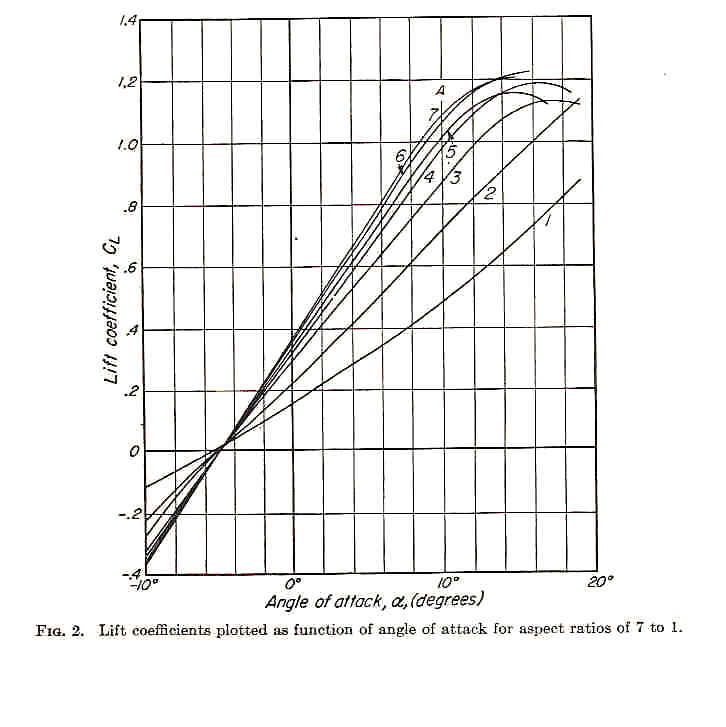
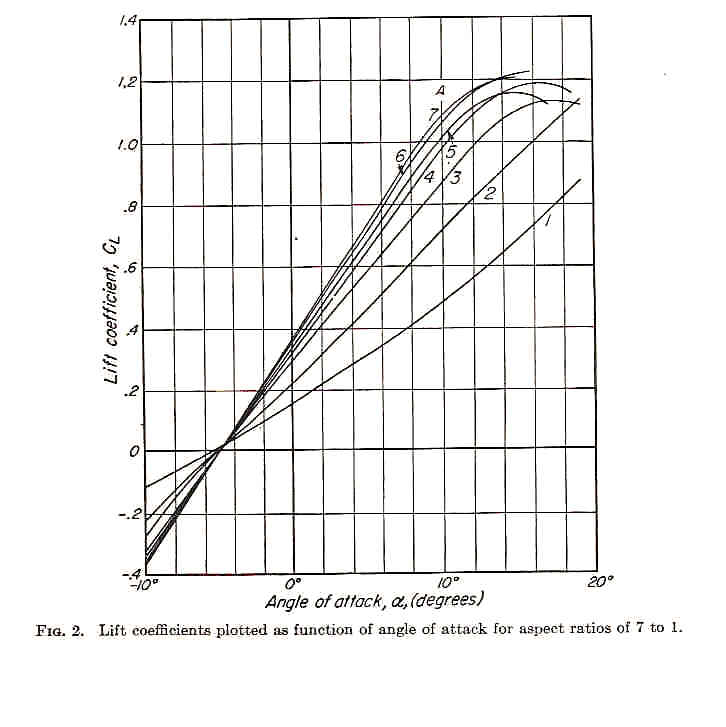
We are only talking about two or three degrees here.
At 500 MPH the dynamic pressure is 650 pounds per square foot.
The weight of the airplane is about 6,000 pounds and the wing
area is 235 square feet. The wing loading is only about 25 pounds per square
foot. At a C sub L of one at around 10 degrees the lift would have
been 152,750 pounds. Calculating it is 650 times 235 square foot
at a C sub L of one.
It only needed 6000 pounds not 150,000. 6000 / 150,000 x 10 degrees
is .4 degrees. 10 G's of course is 60,000 pounds or about 2.5 degrees
increase.
This caused the initial pitch up at 10 to 11 G's which either
caused the pilot to black out or breaking the pilot's seat.
In either event the pilot probably lost his grip on the stick about
the same time. The aircraft snapped rolled clockwise about 360 degrees
while climbing vertically due to prop torque. It slowed losing some
aileron authority in the process.
It then climbed until it more or less stopped and stalled.
It then nosed over and dove more or less straight in. That is what
I saw. If it had rotated a about 90 degrees more it may have missed
the boxes and impacted further away.
I doubt anyone calculated the design of the pilot's seat to withstand 10G's
let alone expecting the pilot to experience 10G's.
Paul Lamar
--
The Rotary Engine NewsLetter. Powered by Linux.
ACRE NL web site.
http://www.rotaryeng.net
Youtube key word PaulLamar2
Copyright 1998-2011 All world wide rights reserved.