Any body running an engine notice that or is it just
my RV4? Also the mixture is rapidly varying which of course
could be caused by the rapidly changing fuel
pressure. My pressure regulator is referenced to intake
manifold pressure. Is everybody doing that?
It is so bad I can't believe the engine runs.
Now that I have learned to steer the RV I can focus
on what is going on with the engine :)
Paul Lamar
Paul,
First try pulling the manifold pressure hose from the regulator (then
plug the hose of course)
and run the engine (monitor the fuel pressure in cockpit for
result)..........
Kelly Troyer
If I pull the hose the tuning will be way off. The engine may
not start run. Worth a try however. I'll just clamp it off
with a large paper clip.
Paul Lamar
Paul,
Cannot see how it would affect EC2 tuning unless both pressure regulator and EC2
share the same manifold pressure hose..........
Kelly Troyer
Because the amount of fuel the injector squirts is a function of
the fuel pressure. Less pressure less fuel. More pressure more fuel.
While Tracy's computer thinks the fuel pressure is changing with manifold
pressure so the pulse width is tailored to the fuel pressure and RPM.
That is the way it is supposed to work. Even if they shared the same hose
the amount of fuel injected would be wrong for that RPM because the fuel
pressure is now different than what it would be if it were controlled
by the manifold pressure.
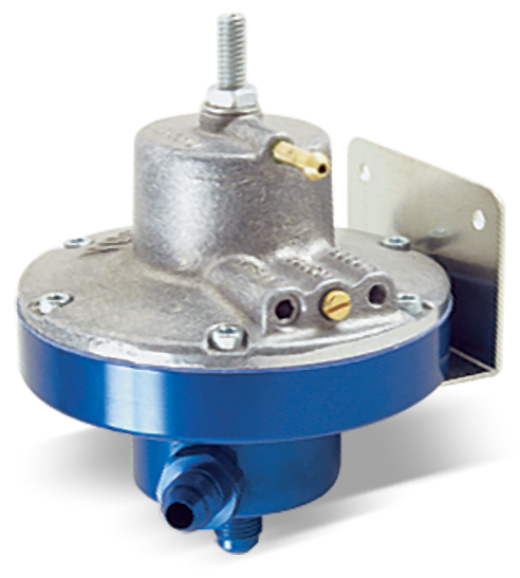
Here is a costly device that addresses many of those issues.
http://www.vortechsuperchargers.com/product.php?p=30
Super Fuel Management Unit
V-6X100-001
"Vortech's Super Fuel Management Unit (Super FMU) is a tuner's dream. It permits complete tailoring
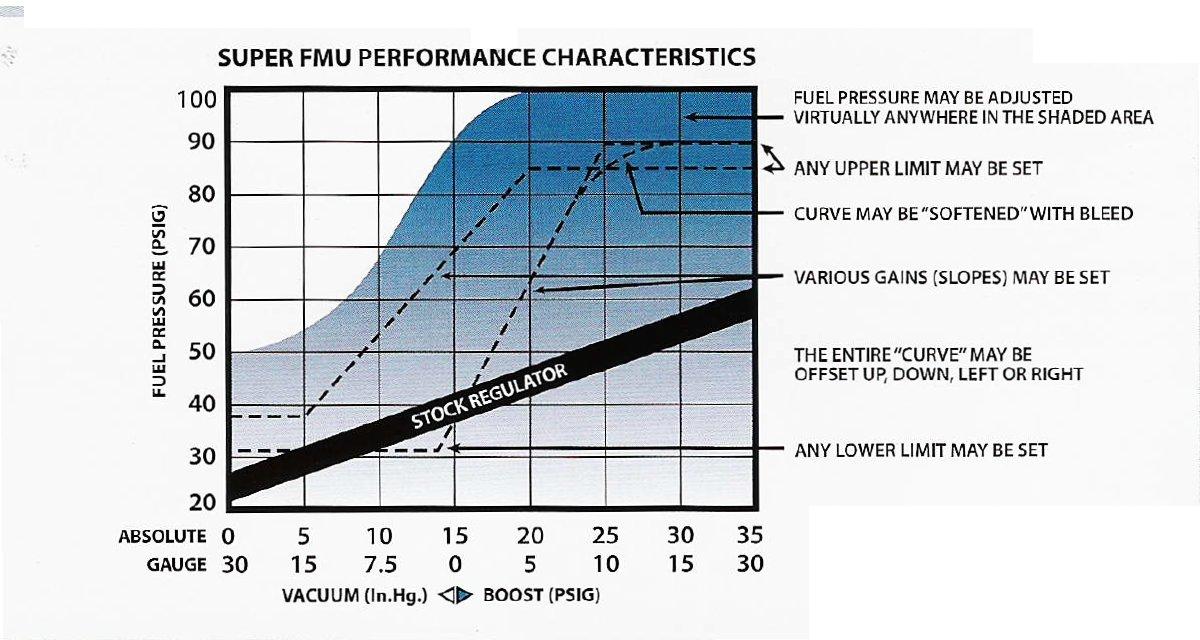
of the fuel pressure curve relative to manifold pressure, including upper and lower limits. The
Super FMU can be used in a series or as a stand alone component. Its super high-flow capacity can
handle large single and dual pumps while fluctuation and pressure creep is eliminated. The unit can
also be used to adjust static pressure. Features include four pre-calibrated gain ratios: 7:1, 5:1,
3.25:1 and 2.5:1. Easily replaces our standard non-adjustable FMU."
Paul Lamar
--
The Rotary Engine NewsLetter. Powered by Linux.
ACRE NL web site.
http://www.rotaryeng.net
Youtube key word PaulLamar2
Copyright 1998-2011 All world wide rights reserved.
V-6X100-001

    * Allows complete tuning of fuel pressure curve relative to manifold pressure, including upper and lower limits.
    * Can be used in series or stand alone and can be used to adjust static pressure.
    * Recommended for high horsepower applications which require finite fuel curve tuning.
    * Replaces non-adjustable FMU included in Vortech supercharging systems.
    * Includes Super FMU, mounting bracket, mounting screws and addtional components for recalibration.

Why is this unit "Super"?
It is super because it has five separate adjustments that can be used to "shape" the fuel pressure curve. In addition, the flow capacity of the SFMU is large enough to by-pass the flow of a very high flow fuel supply system at idle. Therefore, there is no increase in idle rail pressure because of regulator restriction.

Supercharged engines that are highly modified with big cams, big heads, high rpm ram manifolds, and high capacity fuel pumps are the most in need of a "tunable" fuel pressure regulator. That's because this equipment drastically changes the power and torque curve from what the factory designed controller was meant to serve and even the addition of a simple FMU is not enough. The net result is the fuel delivery to the engine is not correct for all rpms through the speed range.

The SFMU has five separate adjustments:
1.) The main spring adjusting screw
2.) The calibration ring & disc
3.) The vacuum screw
4.) The optional bleed screw
5.) The boost screw

What do these adjustments do?
1.) The main adjusting screw sets the basic static fuel pressure level of the unit. By adjusting the main screw any initial pressure can be set.
2.) The calibration ring and disc are used to set the slope of the fuel pressure increase with increasing boost pressure. Four different diameter rings and discs are included with the SFMU.
3.) The vacuum screw acts like a vacuum regulator. If it is set to give, for example, 5 in hg gauge, the upper chamber of the SFMU will only see 5 in hg even though the engine manifold pressure may drop to 18 in hg at idle. The result of this is the fuel pressure remains constant from idle vacuum up to 5 in hg then the pressure will start to increase.
4.) The optional bleed screw does two things. First, it will lower the slope of the curve set by the calibration ring. So, it can be used to "fine tune" the pressure vs. boost curve. Second, it acts as a damper to "soften" the transitions in the curve.
5.) The boost screw acts in a similar manner as the vacuum screw in that it performs like a pressure regulator. It can be set to limit the maximum fuel pressure. If the screw is set all the way in it will not regulate and the curve will continue to rise as boost increases. If the screw is set to relieve at, say, 10 psig then once that manifold pressure is reached any manifold pressure above that will not increase the fuel pressure. More here.

For almost all applications only the SFMU would be used. Using the restrictive stock regulator with the SFMU with a high flow rate pump would cause the rail pressure at idle to be too high and cause a rich condition. Because the SFMU has so many adjustment features most requirements can be met with it alone.

What if I need -4 fittings instead of the unit's -6 supplied fittings?
Vortech sells an adapter assembly that will enable you to replace the -6 JIC fittings with -4 SAE Fittings (standard Vortech FMU hose size).