I just finished tearing down my engine. I am doing a rebuild for low
compression on one of the faces (determined by a change in the force
required to pull the prop through on that face and a quiet
'ka-chunk'), and
some leaking of combustion gases into coolant causing occasional
loss of coolant if not checked before every flight.
Results of tear down..
Where are the rubber buttons? There are no rubber buttons in any of
the corner seals.. not even a residue. Do they usually disappear??
I am pretty sure I recall them being there in the past, or am I
mistaken? I used the strip that comes in Tracy's gasket kit.
I found a side seal that was stuck at one end. quick clean should
fix it.
Coolant issue: Not sure I am happy with the TES 0-rings. Yes, they
seem to have been very resistant to the heat. In general they are
in excellent condition. Except, they have very little elasticity
and have molded to the shape of the channel. In the hot area, they
no longer extend above the top of the channel and are more or less
flush with the top. It seems that in this area they would be
exerting minimal sealing pressure there. I am thinking about going
back to the stock. Anyone else have a similar experience or heard
of this problem?
Otherwise the engine is in OK shape. No evidence of overheating.
There are quite of bit of chatter marks on the rotor housings, the rotor
bearings seems pretty well worn but probably re-usable.
--
David Leonard
Turbo Rotary RV-6 N4VY
http://N4VY.RotaryRoster.net
http://RotaryRoster.net
Did you mic the rotor housings? Any shrinkage?
Were the rubber buttons silicon rubber or were they black rubber?
Check the apex seal springs for stiffness and height. The temper
can go away on certain non stock apex seal springs due to
temperature effects of the wrong spring material. This is one of the
causes of chatter. Are the apex seals Mazda stock? If after
market they could be steel and steel does not retain lubricant
like the microscopically porous stock Acicular cast iron.
I think this was discovered 100 years ago in piston engines :)
Apex seals look simple to make but they are far from it.
http://www.keytometals.com/articles/art21.htm
http://www.rotaryeng.net/history.html
Inconel apex seal springs would be best.
Also the amount of 2 cycle oil in the fuel
has a strong effect on the temperature of the apex seal and
springs. Increase the 2 cycle oil in the fuel to 2 ounces
or more per gallon from one ounce per gallon.
Also try increasing the amount of lube oil going to the rotors
for better cooling. You may need a 3rd gen oil pump. The 3rd gen RX7
turbo engine was making 280 HP in final form.
I suspect a p-port would cool the apex seals and the apex seal
springs better. It would also reduce the back pressure on the
exhaust at a given boost level.
For the new people this engine went 229 MPH at the recent Reno air race
in an RV6 and is a more or less stock 1991 Turbo II engine with a highly
modified stock turbo running 45 inches of Hg. The stock Turbo II
usually only made 200 HP at about 35 inches of Hg max.
Paul Lamar
Hey David;
Combustion gases in the coolant and loss of coolant are signs of overheat.
Typically iron warpage, rotor housing shrinkage or failing orings.
These overheats symptoms seem to more common with after market TES-orings.
Particularly as you described the condition on yours.
They tend to take a bit of set, but not molded as you described,
the teflon splits in the hot area with most failures I have seen.
Do you have any pics?
As Paul said, mic the rotor housing width.
Not sure whose apex seals/springs you have -Mazda apex springs
Check irons for warpage.
The rubber corner seal buttons tend to disappear in high power
applications such as yours.
You might look into solid corner seals - although, I haven't heard
enough history on any of them.
Your rotor bearings have now been clearanced :)
Cheers
Cary
In theory the O-rings do not do the combustion chamber sealing.
The metal to metal contact is supposed to do the sealing.
The combustion pressure is attempting to elongate the
distance between the end housing. The job of the tension bolts
is to prevent this elongation. In this case they are expected
to prevent as little as .004 inches. When you boost an engine
to 45 inches of Hg the compression forces are 1.5 times higher.
It is possible that the stock tension bolts are stretching slightly.
It is possible the drag racer used to running high boost do not
notice the loss of coolant.
A tension bolt is 18 inches long. If it stretches .004" in 18 inches
that is .004/18.000 or .00022 %. There is another factor. The
tension bolts are already stretched when they are torqued down so
the compression forces must over come this pre load first. Never the
less there is a possibility the bolts are stretching slightly under
boost allowing the combustion gases to get to the O-rings.
Stock late 10 mm tension bolts are .384" in diameter. The cross
sectional area is .116 square inches.
After market 1/2 inch tension bolts are .196 in cross sectional area.
That is .196/.116 OR 169% more area and more stiffness.
You don't need to change out all 17 bolts. You only need
to change out the 4 or 5 that surround the high pressure combustion
chamber.
Mazdatrix has a jig for drilling out the tension bolt holes.
Paul Lamar
I would think that now would be an opportune time to do a p-port conversion.
You would get more power with less boost. With also changing out the required
bolts to the 1/2" should give more reliability with respect to the cooling
system integrity.
Maybe check into Hurley's corner seals.
Dale Davies
Less back pressure as well.
-----------------------------------------------------------------
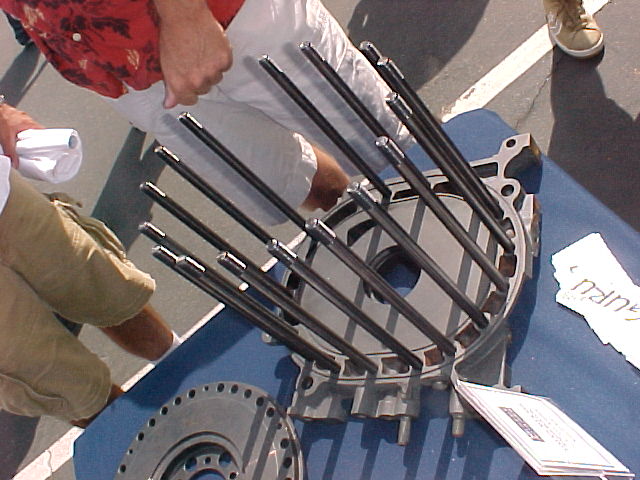
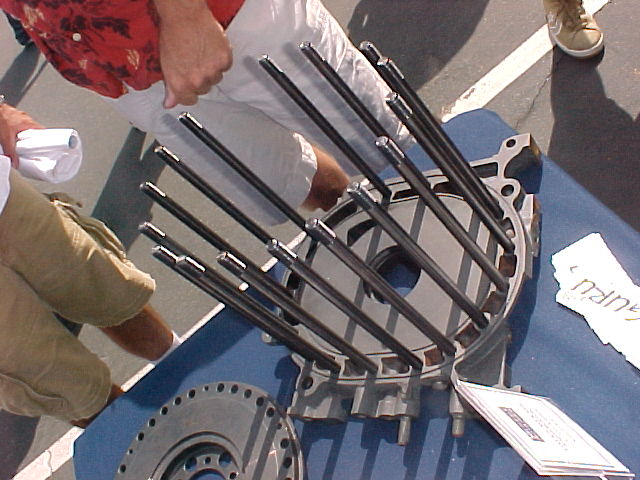
Installing 1/2 inch tension bolts.
http://www.mcmaster.com/#steel-rounds/=etmrgr
.4531 1/2 20 tap drill
10 mm is .393
If one has a couple of old end housing lying around then one can make
their own drill jig for half inch tension bolts.
Drill one out for tap drilling the front end housing to .4531 inch.
29/64 drill.
Drill the second one to .5 inch for the 1/2 inch clearance holes in the
rotor housings. The second one can be the one you are going
to use in the engine. The large hollow dowel pins will keep everything
in alignment.
You don't need high strength steel rods as you are looking for
stiffness and mild steel is just as stiff as high strength steel.
One the other hand 4130 rods 3 feet long are only $10 each.
Paul Lamar
--
The Rotary Engine NewsLetter. Powered by Linux.
ACRE NL web site.
http://www.rotaryeng.net
Youtube key word PaulLamar2
Copyright 1998-2011 All world wide rights reserved.