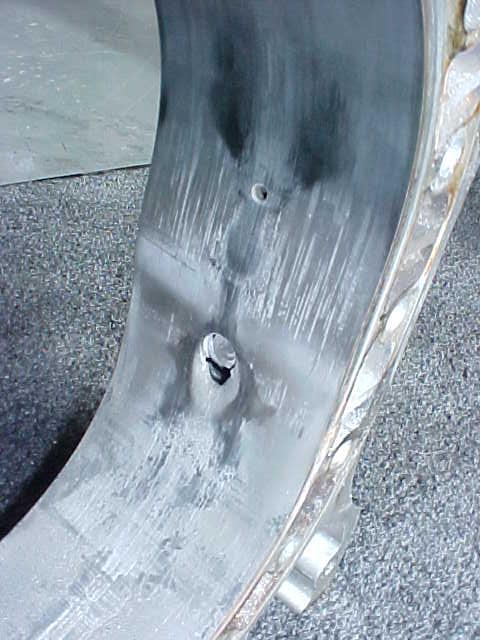
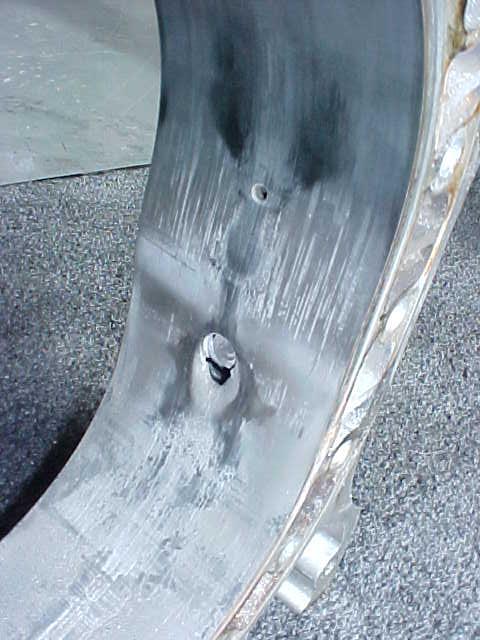
Every time I see an engine torn down that used
these seals I get really angry. Not only do they
chatter they gouge grooves in the chrome plated $600 rotor
housings. Furthermore they do not have "crown". Crown
is slight curvature of the top of the seal that fits the rotor
housing.
In addition to all that the apex seal springs supplied lose thier
height and temper.
If you have these seals and they are not installed or they
are installed and you have noty run the engine yet take them out
and throw them away.
Use only stock Mazda seals and Ianetti silicon nitride seals.
If they are already in your engine kiss..... your rotor housings goodbye.
The engine won't stop but it will be down on power and burn
more fuel than normal. That is a testimonial on the tolerance
the Mazda rotary has for inferior parts.
Read this for more info.
http://www.rotaryeng.net/**seals.html<
http://www.rotaryeng.net/seals.html
http://www.rotaryeng.net/**history.html<
http://www.rotaryeng.net/history.html
Paul Lamar
When I was with Tracy a few weeks ago we talked about these seals. He said
the main customers for these seals were Earthbound racing engines, because
the seals normally did not break if a FOD entered the engine like the cast
seals do, helping preserve the engine for another race if it ate something
He told me that even if I decided to turbocharge my engine, I likely
wouldn't benefit from or need his seals.
He went on to say that the primary customer for the RWS seals were racing
high HP high rev short run before OH engines, not aircraft engines.
When I asked about buying an engine and rebuilding it, this was one of the
first things he volunteered.
Kevin Alderman
Where does it say on his web site? "Not for use in aircraft engines."
Ceramic seals are immune to shattering with out destroying the rotor
housings.
------------------------------------------------------------------------
"I did some extensive test on the matter while I was at Mistral."
" Detonation will damage your apex seals, but actually, damage
steel seals don't leak too much as long as they stay hot."
"We never damaged a single ceramic seal however (and we tried hard, believe
me)! Even if you were to crack one such seal, you would keep perfect
compression on one chamber of the damaged rotor, and probably some
compression on the two chambers separated by the damaged seal. The worst
case scenario is, however, a ceramic seal breaking away from its slit and
pieces of it breaking the remaining seals. Such scenario would obviously
make you lose all power on the affected rotor. But believe me, it would
take an awfully violent detonation event to break those ceramic seals;
possible only on a quite highly boosted turbo engine and most improbable if
not impossible on a N/A engine. By the way, Iannetti makes 3mm thick seals
(instead of the normal 2mm ones) which he recommends for high-power
applications. We never felt the need to test those."
"Conclusion: rotary engines are impressively robust and forgiving, they
really are! Some of Mistral's technicians, coming from the piston engine
side of the industry, could initially not believe how much abuse a rotary
engine could survive."
Best regards to all,
François Badoux
--------------------------------------------------
Dave Lemon continued to run an engine in a road race after all coolant
was lost until a hole was melted in the rotor housing steel liner
causing the engine to stop. He removed the ceramic seals and
used them in his next racing engine.
Paul Lamar
--
The Rotary Engine NewsLetter. Powered by Linux.
ACRE NL web site.
http://www.rotaryeng.net
Youtube key word PaulLamar2
Copyright 1998-2011 All world wide rights reserved.