Hi Dave,
You mentioned you had scales for the mains.
Can I borrow them?
I'll drive down and pick them up.
Brian,
My bathroom scale says I have 103 pounds on the tail wheel.
Is that about right for a parked RV4 with nobody in it?
Paul Lamar
Got the numbers thanks to Dave's scale
Left main 546 #
Right main 459 #
Tail 73
12 gallons of fuel 75 pounds,
Less fuel empty weight 1003 pounds.
Not bad for a 250 HP engine in an RV4.
Climb ought to be excellent.
Van's claims 913 pounds for a 180 HP engine.
The battery is in the baggage area.
I think I can get another 10 pounds off the engine
by putting in an aluminum water pump cartridge
and getting rid of one redundant motor mount.
Leaving only three which is the correct number :)
Paul Lamar
Paul,
Why the big difference in the left and right mains?
Mark S.
Probably fuel imbalance and muffler and exhaust system is
on the left. Mike used real thick pipe and a heavy custom
muffler.
Paul Lamar
I was having dinner with my girl friend Lesley (when the cat is away
the mouse will play). Lesley happens to be a nurse. I asked her how they
weighed really fat people at the hospital. She said they had something
that looked like an engine hoist. The light bulb flashed on in my brain.
If I measured the pressure in the engine hoist hydraulic cylinder
I could save hundreds of dollars for a platform scale.
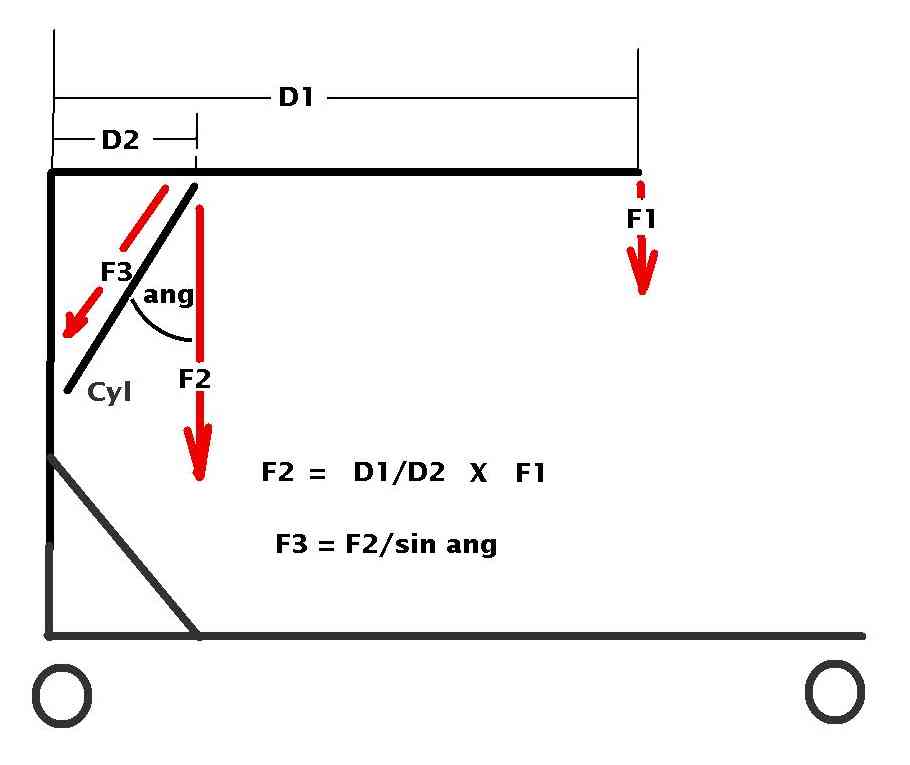
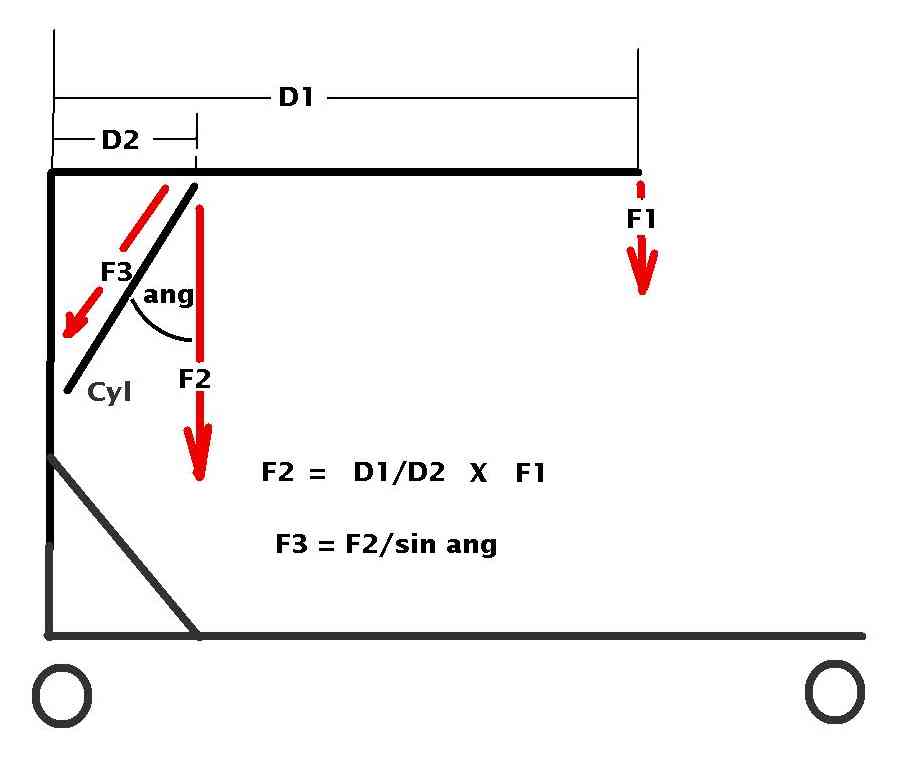
The trick is doing a bit of math.
Here is a diagram.
You will need to know the area of the piston in the cylinder.
There is usually a hole for putting in oil about half way up.
That will tell you the wall thickness. Subtract twice the wall
thickness from the cyl OD.
Then the piston area is pi times radius squared.
The force in the cylinder is the pressure in psi times the area of the cylinder
bore in square inches.
You can check your math by weighing yourself on a bathroom scale
and then pumping your self off the floor :)
You need to drill and tap a small hole in the bottom of the cylinder
for a pressure gage to get a pressure reading.
If there is 2000 pounds on the cylinder and the area is
12.566 (4 inch bore) the pressure will be 159 psi.
For a 3 inch bore the pressure will be 283 psi.
Put a shut off valve in the line to the pressure gage
so when you use it to lift something really heavy it
won't blow the gage.
Also adjust the beam to be near horizontal as possible to keep the math simple.
I have not tried this yet so there could be a bit of friction in the
system that may introduce some small errors.
Paul Lamar
--
The Rotary Engine NewsLetter. Powered by Linux.
ACRE NL web site.
http://www.rotaryeng.net
Youtube key word PaulLamar2
Copyright 1998-2011 All world wide rights reserved.