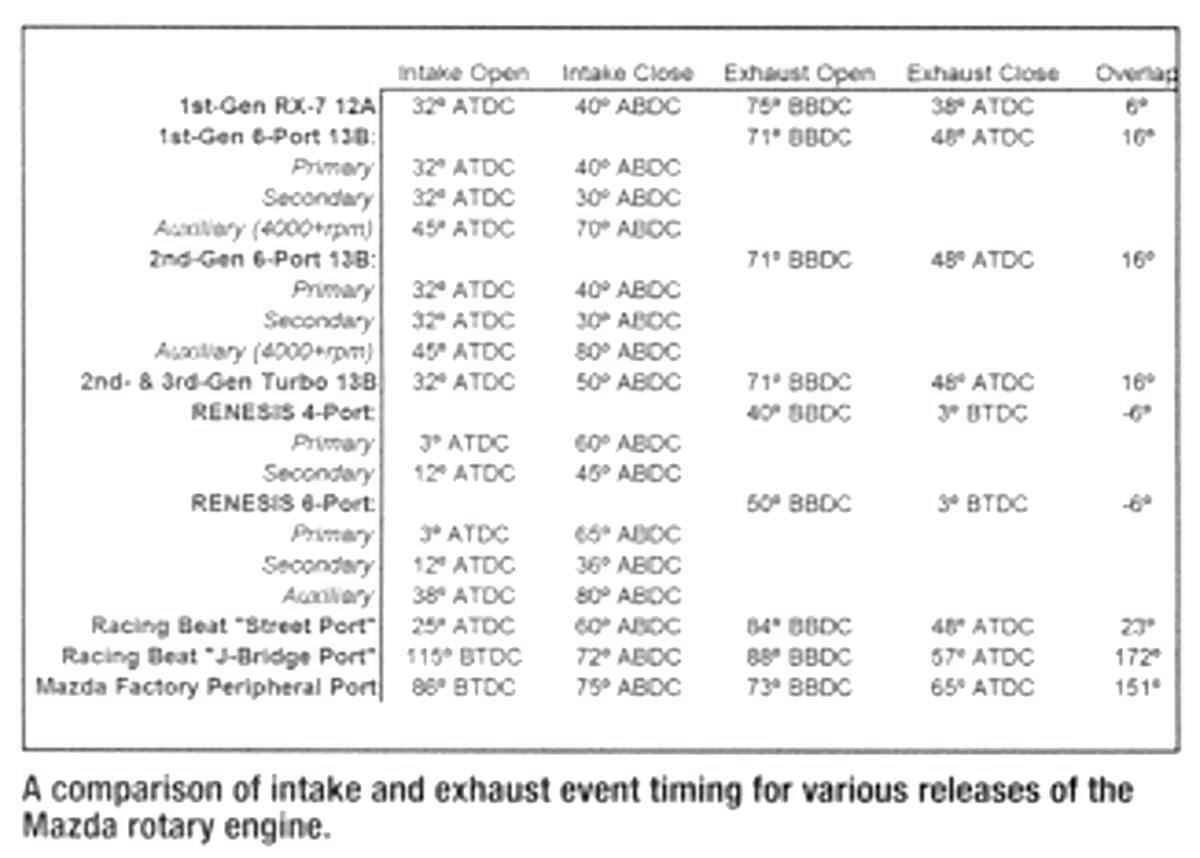
Is there any information on the website showing the timing of the intake
and exhaust port relative to eshaft rotation? I am specifically interested
in the overlap and the e-shaft angle at which the apex seal clears the
exhaust port. Inspired by your 555 system, I have designed a simple digital
converter to convert MAP to pulse width for controlling the injectors. We
know that the volumetric efficiency of the p-port at 6000rpm is 120%. I am
wondering how much of that 120% is represented by intake air passing through
the chamber and out the exhaust during overlap. If this occurs at all, it
would improve efficiency to minimize the amount of fuel in the bypassed air,
suggesting that the injectors should be opened after the exhaust is at least
partially closed
Victor Roberts
I don't have the numbers for the timing but it is exactly the
same as the Le Mans 4 rotor.
http://www.rotaryeng.net/Mazda_R26B_US.pdf
http://www.rotaryeng.net/Welded-steel-p-port.html
The numbers can be derived from the scale dwg in this last link.
The exhaust and intake P-ports in a rotary never really close.
In that regard it is more like a turbo jet.
What air does not go in one chamber goes in the next.
In a tuned rotary engine however the max pressure in
any given (One of 3) compression chamber depends on the RPM,
pipe length and pipe diameter.
http://www.rotaryeng.net/Mazda-p-port-press-wave-enhanced.jpg
The best place to measure this pressure is the apex oil injector
holes just above the p-port intake. Of course one is not using
these holes for oil injection. One mixes the apex oil with the fuel.
I am coming back to the 555 system and adding a single chip computer
that
has the sole job of adjusting the mixture using a USB port and
storing the trim data in a spread sheet format. The program becomes
extremely
simple and easy to comprehend. Merely a look up table in the single
chipper.
Henry Nee came up with this great idea and people can email and
share
trim
tables. Any number of trim tables can be stored in one's PC. It also
makes
editing the trim table simple as you do it in your PC using a spread
sheet
program. This should greatly speed the tuning of your engine and
similar
installations can use the same trim table. We can put them on the
web
site
for rapid download. Parameters affecting the trim are type or
drag of
the airplane, diameter and pitch of the prop, intake pipe length and
gear
ratio used. Assuming all are using a p-port.
Paul Lamar
Victor, I have seen the port timing numbers in the Kenji Yamaguchi
(SP?)
papers. I think there is a link on Paul's site and possibly on
Craigs
Rotary List site also.
george grimes
http://www.turborx7.com/porttiming.htm
cbeazley
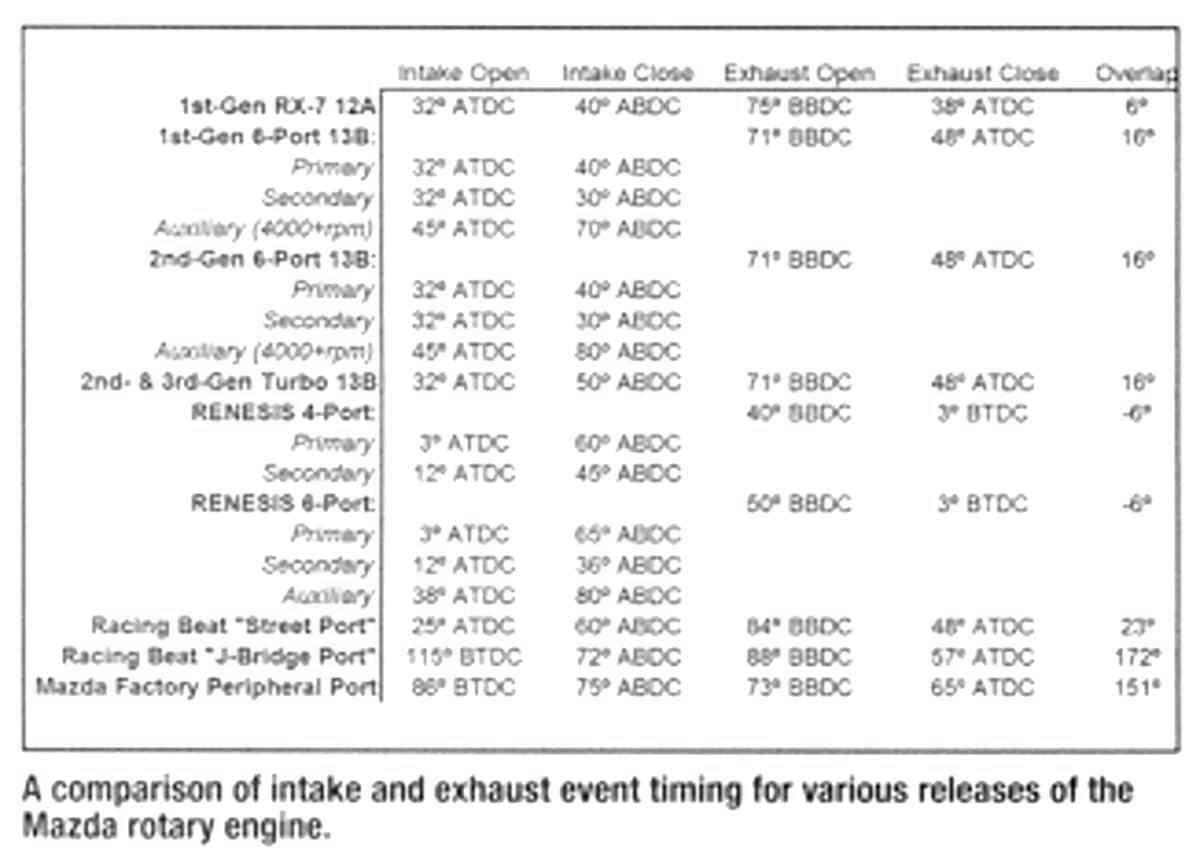
From Mark Warner's book Street Rotary, page 34, here's a port timing
chart of various Mazda models. Here's a link to the book:
http://www.amazon.com/Street-Rotary-HP1549-Horsepower-Reliability/dp/
1557885494/ref=sr_1_1?s=books&ie=UTF8&qid=1321457929&sr=1-1
Tom Sash
Much of this is useless info as it makes no sense to port a side
port engine for aircraft use. If you need to take the engine apart
to port it you might as well P-port it. The p-port intake manifold and slide
throttle are easier and cheaper to make than a side port manifold.
You wind up with 25% more power and a better BSFC.
Most of the road racers need it because p-ports are outlawed due to the
rotaries over helming domination of most road racing classes.
Only in the Rolex GT class are RX8 3 rotor p-ports allowed and then they
suffer from extra ballast and an enforced red line 500 RPM below the street
engine.
Paul Lamar
--
The Rotary Engine NewsLetter. Powered by Linux.
ACRE NL web site.
http://www.rotaryeng.net
Youtube key word PaulLamar2
Copyright 1998-2011 All world wide rights reserved.