These numbers for the Mazda P-port are bogus.
As Paul has pointed out, there is an overlap of intake timing between
adjacent rotor faces.
When the apex seal is in the center of the port, two chambers are
open
to the intake. From this position, after 360 degrees of shaft
rotation
the rotor face which was just beginning intake before the rotation
would
still be half open to intake after the rotation. The intake period
exceeds 360 degrees of eshaft rotation.
Reference these numbers to after TDC and it becomes apparent they
cannot
be true.
The intake opening at 86 BTDC is 274 degrees of e-shaft rotation
After TDC.
The intake close of 75 ABDC is 255 degrees After TDC.
This gives us 19 degrees of shaft rotation where neither is open.
For the exhaust, opening at 73 BBDC is 107 After TDC, and closing
at 65
after TDC - 42 degrees of shaft rotation when no exhaust occurs.
It appears to me that the interior circumference of the rotor housing
is about 27 inches; so 360 degrees of shaft rotation is 9 inches. A
two-inch port opening then requires 80 degrees of shaft rotation to
transit, so the trailing port opening occurs 80 degrees ahead of the
leading port closing. The intake period including overlap is about
440
degrees of shaft rotation.
The exhaust port appears to be half the size of the intake, so 400
degrees of shaft rotation from opening to closing.
Tell me where I am wrong.
Victor Roberts
Are you referring to these numbers as being bogus?
Mazda Factory Peripheral Port
IO 86° BTDC
IC 75° ABDC
EO 73° BBDC
EC 65° ATDC
These are typical representations of timing numbers used in rotaries.
Notice the similarity to numbers for a "J" bridge port.
Racing Beat "J-Bridge Port"
IO 115° BTDC
IC 72° ABDC
EO 88° BBDC
EC 57° ATDC
The numbers used are started at the nearest of four locations.
A TDC or a BDC. This to keep numbers small and understandable.
This is
adequate to lay out markings to port an exhaust or intake or lay out
your
Pport boring location. And recover overlap degrees,
All of these numbers can be resolved while looking at one rotor face.
The two TDCs are minimum volume right or left side and two BDCs
maximum
volume
top (Intake) and bottom (exhaust).
While it seems backwards, the Pport engines are more tractable than
the
bridge ported side port engines. Although both have very little
torque right
off idle we could drive the Pport to and from the false grid with no
problem where the "J" bridge ported were towed with a small tractor.
This to save
the clutch. A Tilton of course.
The Madeville modified factory Pport housings had enormous
rectangular
intake ports and are also quite tractible at low RPM.
http://alex62.typepad.com/**imsablog/2006/02/mazda_rx7_**winni.html_<
http://alex62.typepad.com/imsablog/2006/02/mazda_rx7_winni.html_
http://alex62.typepad.com/**imsablog/2006/02/mazda_rx7_**winni.html<
http://alex62.typepad.com/imsablog/2006/02/mazda_rx7_winni.html
)
They ran unmuffled at most locations and even with no back pressure
idled
smoothly.
The idea that much if any fuel will be lost to the exhaust system
at or
near cruise RPM is not founded. It is my opinion that when muffled
and at low
RPM exhaust pollution of the intake charge actually helps smooth out
the
idle in the Pported engine.
Lynn E. Hanover
I understand the BDC and TDC references. I converted them to a common
ATDC in order to make the relationships easier to calculate.
Because of
the 3:1 e-shaft to rotor gearing, each face of the rotor requires 360
degrees of e-shaft rotation to pass over any given point on the
housing
circumference.
I guess there is a question of what "port open" and "port closed"
means.
In my experience with piston engines, "open" means when the valve
comes
off the seat, and "closed" means when the valve returns to the seat.
"Overlap" defines the period when neither valve was seated. For
2-stroke
engines, "open" and "closed" refer the transition from closed to
partially open and open to completely closed, respectively.
On a p-port rotary, does "open" refer to the time the apex seal:
A. enters the port ;
B. clears the port; or
C. some other time?
What event defines "closed"?
For an engine to have a volumetric efficiency of 120%, the intake must
have been charged with pressure greater than 120% of ambient at the
time
the intake port closed, or part of the intake air must bypass the
intake stroke directly into the exhaust. It would appear most likely
that an elevated intake pressure would both charge the intake above
ambient, and force air into the exhaust during overlap, a period when
exhaust back pressure is at it's lowest. Since most of the
operation is
at cruise power, it is this condition I am concerned with.
I ask here because I have attempted to research these questions and
have
been unable to find the answers.
Victor Roberts
Here are some diagrams that might help.
Paul Lamar
Thanks - that helps a lot. I amend my opinion (not that it bears any
weight ) concerning direct injection at the oil injection hole; it
appears that as the exhaust port closes, about 40% of the included
volume of the intake is ahead of the oil injection hole, and the air
inflow might very well cause the mix to be richer around the leading
plug.
I'll shut up about this now.
Victor Roberts
Hello Victor,
I'll give it a try too. We use these numbers:
Mazda Factory Peripheral Port
IO 86° BTDC
IC 75° ABDC
EO 73° BBDC
EC 65° ATDC
To define a bit more the opening and closing events look at it this
way.
The leading apex seal opens a port, while the trailing apex seal
closes a
port. That applies to both, the inlet and outlet ports.
Looking at this scenario, from TDC at combustion the [rotary] piston
travels around
until the leading apex seal comes to the edge of the outlet port
when the
outlet begins to open. Using above numbers this is at 73 deg. BBTC.
When
the leading apex seal comes to the other side of the outlet port the
port
is fully open.
The blow down occurs over the next stroke of generally 180 degrees
minus
the early opening of the inlet port which happens when the leading apex
seal of that same chamber comes to the inlet port at 86 deg. BTDC.
This is
73+180-86 = 167 degrees later.
When the leading apex seal crosses the other side of the inlet port it
will
be fully open and both ports, outlet and inlet, are fully open. This
condition exists until the trailing apex seal has passed over the
outlet
port and closed it at 65 deg. ATDC. The beginning of closing is a bit
earlier.
The duration of both ports being open is between IO at 86 deg. BTDC
and EC
at 65 deg. ATDC or over 151 degrees. On the racing beat J-Port the
duration
is IO at 115 BTDC to EC at 57 ATDC = 172 degrees. For overlap only
these
two numbers count.
IC determines the degrees of chamber filling in connection with rpm as
well
as IO due to its size needed for breathing. EO should preferably be
later
for more expansion but due to its necessary size it sets the
position and
therewith the timing of EC as well.
Due to these restrictions side ports are being used that however have
higher flow restrictions.
I hope that helps.
Rolf
You defined opening and closing in the same way I have understood them.
The apex seal entering the port area is opening of the following
chamber, and completing transit is closing of the leading chamber.
Therefore, opening of the following chamber occurs prior to the closing
of the leading chamber. When the apex seal in in the port, both leading
and following chambers are open. One shaft revolution later, the
following chamber is still open as it's trailing apex is now in the port
and in the process of closing..
Port opening occurs before port closing.
I am easily confused by top and bottom and before and after, so I
referenced all events to TDC and tried to follow them around beginning
from the top. So TDC can be represented by 0 or 360, and BDC is
represented by 180.
If we represent all events as ATDC, we get the following:
EO 73° BBDC = 107 ATDC (180-73)
EC 65° ATDC = 65 ATDC
IO 86° BTDC = 274 ATDC (360-86)
IC 75° ABDC = 255 ATDC (180+75)
This has the ports closing before opening. Confining our discussion to
pports, according to our agreed definitions this cannot be true. The
duration of the intake or exhaust is 360 degrees PLUS the rotation
required to transit the port.
I apologize for continuing, I was going to let it drop as Paul's last
post gave me the info I needed, but unless you can show me an error I
continue to believe the port timing charts to be wrong.
Victor Roberts
Hello Robert,
the answer is that a 4-cycle operations happens over 720 degrees.
Best is to think of a reciprocating 4-cycle engine. I trust it makes it
easier to understand.
Per your distinctions of angles lets say we start out at TDC at firing
when
the power stroke begins and call that 0 degrees and count from there
as you
did.
EO 73° BBDC = 107 ATDC (180-73) (
*this is correct*)
EC 65° ATDC = 65 ATDC (
*this is a rotation later*,* should be 425
deg.*)
From EO at 73 deg. the piston goes to 180 degrees and then to 360 degrees
and then travels another 65 degrees until the EC happens. The exhaust
valve
is open all that time.
EC is at (360+65) 425 deg. Valve opening of outlet is over (425-107) 318
deg.
IO 86° BTDC = 274 ATDC (360-86) (
*this is correct*.)
IC 75° ABDC = 255 ATDC (180+75) (*this is the second rotation,
should be
615 deg*.)
From IO (at 86 BTDC) = 274 deg. the piston goes to TDC then to BDC and
then
travels another 75 degrees until it finally closes. The angular
position is
(360+180+75) =
615 degrees. Duration of IO is (615-274) 341 deg.
The inlet is a bit longer open than the outlet.
Between outlet open and inlet open we have (274 - 107) = 167 degrees.
(close to one stroke of 180 degrees, the blow down).
Overlap when both ports (valves) are open is (IO - EC) (425 - 274) = 151
deg.
I could provide a relation between port lip location and timing
values. But
usually one can't or rather does not change that anyway. It does involve
some calculation and I rather not go there as it is the realm of engine
designers. P-Ports cause limitations in port timing.
Regards
Rolf
Please put aside the timing chart.
Let us observe a port transition.
Begin with an apex between the spark plugs.
Rotate the eshaft so as to move the observed apex toward the exhaust
port. As we proceed, we reach TDC (0 degrees) and continue rotation
until at some point the apex reaches the exhaust port - we call this EO,
(exhaust open). DO YOU AGREE that EC (exhaust close) has not yet
occurred in this rotation?
As we continue rotating, we pass the center of the port, and the angle
ATDC is increasing. Continuing, we reach the other side of the port, and
we call this EC, exhaust close. Granted that it is a different chamber
that is closing, but this the shaft angle that will close the original
chamber on the next rotation.
If EO occurred at some angle, and EC occurs LATER in the rotation, how
can the angular notation of EC be a number smaller than that of EO (
both expressed as ATDC) ?
As the the suggestion that the duration of either port opening is less
than 360 degrees, consider the following:
An apex is in the middle of a port, so the chamber following the apex is
open to the port. Rotate the shaft one revolution, and the following
apex is in the middle of the port, and the same chamber is, and has been
continuously open to the port. Additional rotation is required to close
the port. Therefore, the duration of the opening is 360 degrees plus the
rotation required for the seal to transit the entire port.
Victor Roberts
Forget all this port timing stuff. It is too confusing and a waste of
psychic energy.
Think of it as a jet engine. Air comes in.... is compressed and explodes
in more or less a continuous process.
Nothing really opens or closes in the piston engine analogy.
Paul Lamar
--
Paul,
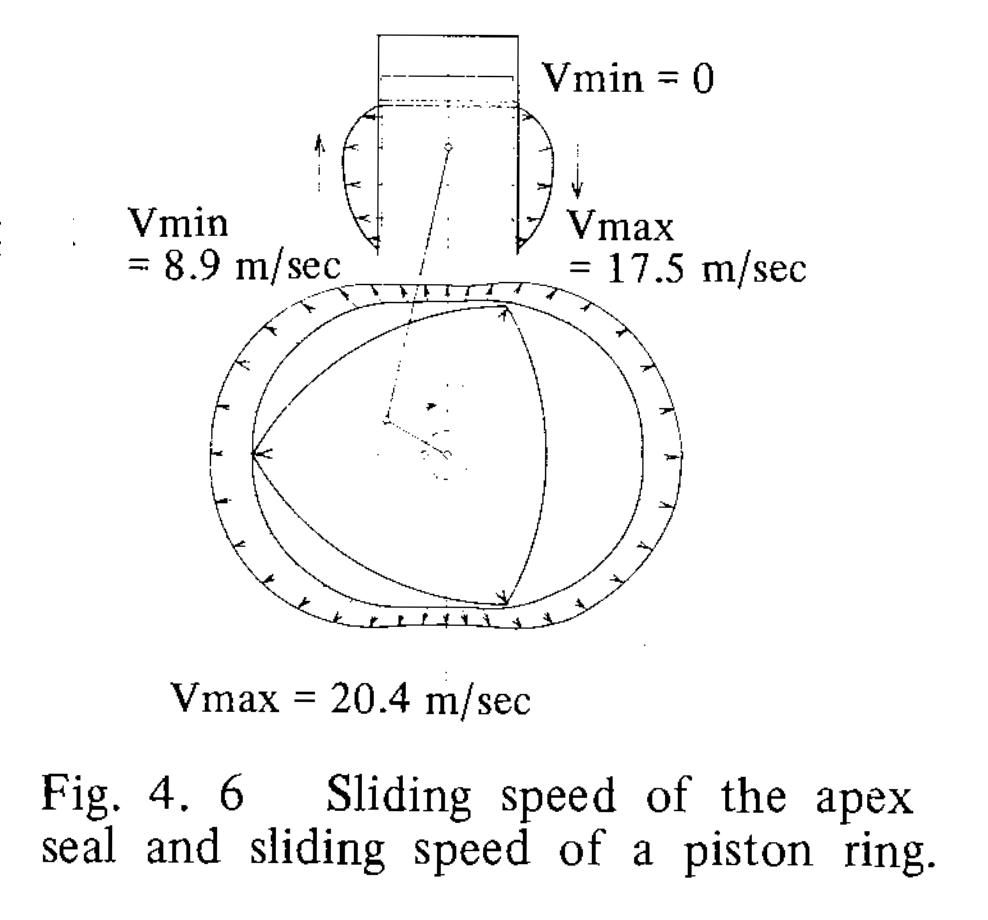
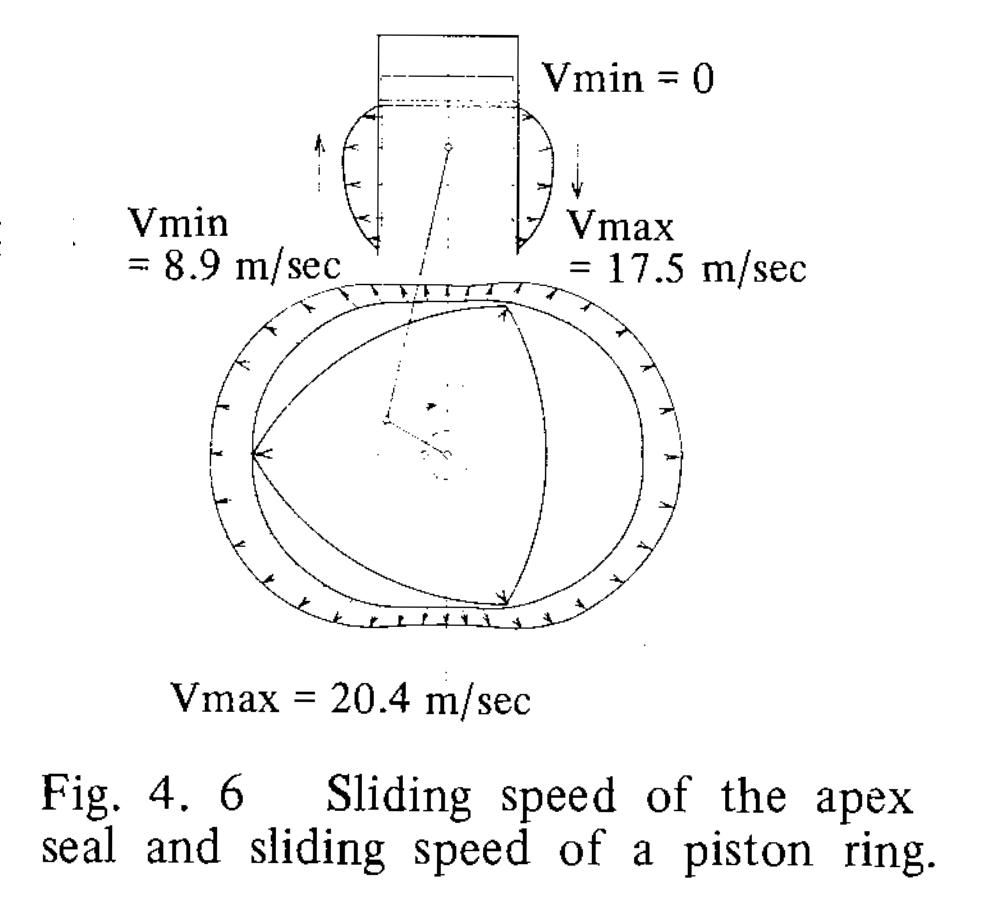
I do not agree, the Apex seal controls the housing peripheral port timing,
and the apex seal sliding speed accelerates and de-accelerates, four times
per rotor revoloution, the average of course is equal to the one apex seal
travel around the housing, to a point the ports if bigger produce more power
for the reason that you state above and at steady state RPM does not need to
be any more sophisticated than that.
I noticed that you have deleted my earlier comments, any reason for this?
Bob
UK
Just a mistake Bob. Sorry. I'll see if I can find it.
Is this the one?
----------------------------------------------------------------------
Not forgetting that the Apex seal movement is non linier to the eccentric
shaft, for a given rotation of the eccentric shaft, the Apex travels much
less at the minor housing axis, for port timing you must take this into
account, when trying to assess port timing verses crank angle.
I attaché a GWBASIC prog written by me over 25 years ago, when setting up
our Heller machining centre, the program got rid of the need for tool path
compensation, "as switching rapidly from inside to outside compensation
caused the Heller to crash", I also on later programs set the CNC path to a
linier along the housing surface rather than relate to the eccentric shaft
as the different cutting approach speed caused irregular surfaces in the
Aluminium Housing, similar to the chatter that you see on used Housings. By
improvements such as this we reduced the operations and deleted the pre
plate grinding operation, final grind still being carried out on our Koppe
Grinder.
In the program you could set the limit of the eccentric shaft angle and see
how this relates to an x,y postion on the Housing surface, or find a certain
y position housing with major axis vertical and run the program to find the
E angle.
Bob
UK
--------------------------------------------------------------------
Here is a graph of the apex seal velocity. Does not change much.
Paul Lamar
--
The Rotary Engine NewsLetter. Powered by Linux.
ACRE NL web site.
http://www.rotaryeng.net
Youtube key word PaulLamar2
Copyright 1998-2011 All world wide rights reserved.