http://www.androidzoom.com/android_applications/productivity/aircraft-horizon_zcuz.html
Robin Bergland.
That would be worth buying a small Android tab just for that.
http://www.everbuying.com/smlclass854.html?gclid=CJr9qfbE7awCFUWMtgodigzI9A
Paul Lamar
I know many phones and tablets can sense which way is down to
determine portrait or landscape orientation of the display but that
is a single axis sensor. How does he get roll AND pitch? i am
suspicious!
SD
I suspect the sensors are 3 axis.
There is an ap out there where you can look at the night sky and identify
star names by merely tilting the tab back and fourth pointing it in
the direction of interest. It also uses the GPS to locate one on the
planet.
Paul Lamar
It can do all of that stuff with just 3-axis accel, compass, and GPS. To
get "real" horizon info and not just a toy that works while you're standing
on earth, you need a gyro. I believe some phones may have a MEMS gyro, but
that software only claims to use the accelerometer, which is a flawed
method.
-Chris W
It sure keeps my toy helicopter flying straight.
A lot depends on the A to D used. A 16 bit A to D is one part in
65,000 more or less. In terms of percentage that is .0000153% I think.
Having said that I don't know what the A to D is but 12 bits are very
common and cheap. One part in 4096 or .000244%. Modern CPU chips found in
desk tops and tabs have enormous computing power.
Paul Lamar
Your toy helicopter uses a gyro and not an accelerometer, as far as I know.
At least my toy helicopter does. :)
-Chris Wood
What is the difference?
Paul Lamar
A gyroscope provides a reference from which you can directly measure
angular displacement and rate. Note that you need at least 2 gyros for full
spatial measurement, that is why airplanes have an artificial horizon AND a
gyro compass.
An accelerometer measures single axis, linear acceleration. Even with 3
orthogonal accelerometers you still can only measure acceleration. With an
array of 6 suitably oriented and displaced accelerometers and appropriate
integrators for each you could theoretically calculate angular displacement
but the drift might be far worse than gyroscopic precession.
Like someone said earlier, if it was easy, your inner ear would be
sufficient for IFR!
As for inertial navigation systems that the airlines and the military used
before GPS, note that they were based on ring laser GYROS, not just
accelerometers.
SD
IMHO:
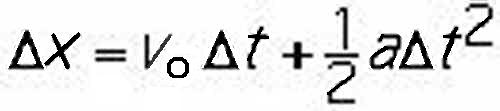
An accelerometer coupled with a computer equals an attitude gyro.
This law of physics (see the jpg) for constant acceleration gives a distance or angle.
If the acceleration varies in a known mathematical curve it can be integrated
using calculus. If the acceleration varies in a non mathematical way a $30
computer can accumulate all the little bits of acceleration to determine a total distance
or angle. It is called integration in calculus speak.
For that reason cheap computers have replace calculus :)
Mathematicians that teach calculus have been replaced by
teachers teaching programming :)
I think a ring laser gyro is a rate gyro or angular accelerometer and not an attitude gyro.
Four simple accelerometers (mass between two springs or a mass at the end of beam) equally
displaced from a central point can replace a ring laser gyro with the help of a computer.
Perhaps not as accurate.
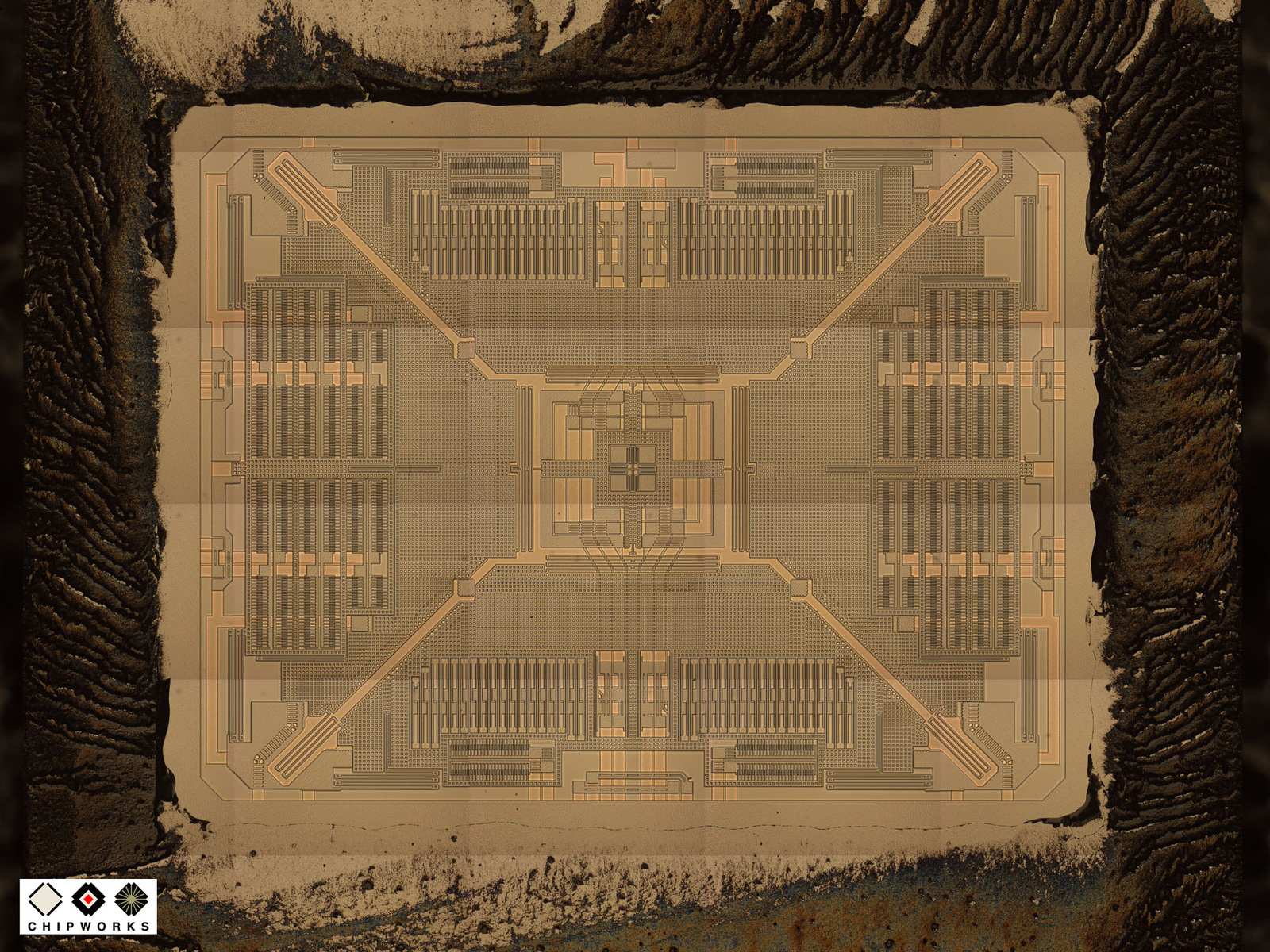
Here is a blown up picture of a MEMS. IMHO they are tiny masses on the ends of tiny
beams. The beams are instrumented to measure bending stress due to acceleration
of the tiny mass. My guess.
Paul Lamar
--
The Rotary Engine NewsLetter. Powered by Linux.
ACRE NL web site.
http://www.rotaryeng.net
Youtube key word PaulLamar2
Copyright 1998-2011 All world wide rights reserved.