The rotary engine suffers from high BSFC at low loads.
Low loads are the name of the game for automotive engines.
GM found back in 1978 that the temperature of the rotor face had a strong
effect on the low load BSFC. A 9.8% improvement in the BSFC
was possible with a hot rotor at low loads. Higher rotor temperatures gave
lower fuel burn at low loads. However if the rotor was not
cooled at high loads the cast iron over heated.
GM got a patent in 1976 on a hot rotor face insulated from
the rest of the rotor. Here is a pdf on the 3,995,602 patent.
The SAE GM paper on the subject was 780419.
The obvious solution is to control the temperature of
the rotor as a function of the load on the engine.
The amount of oil cooling on the rotor is now controlled
by a ball and a spring that opens at a certain RPM.
RPM is not the problem. Engine load is the problem.
A way can be found to cut off the oil cooling to the
rotor at low loads regardless of the RPM. In other
words run the rotor face as hot as possible at all RPM's.
One mechanical way of doing that is insert a stationary tube
in the center of the e-shaft that moves back and
fourth controlled by a servo that senses engine
load and cuts off the cooling oil supply to the
rotor. A peice of cake for todays computer controlled
engines. In fact it need not be controlled by a computer
or electrical servo but by a simple air servo connected to the
intake manifold pressure.
Patent applied for :)
Paul Lamar
Sounds like it should work ... however ...
Common sense (which often fails me) tells me that something else is
really going on in during the compression/ignition cycle that is not
addressed by the GM research. I find it hard to believe that somehow
the gas charge "knows" about a 100 degree temperature difference in a
metal surface that is whizzing for the briefest instant during the the
ignition/combustion process. It all happens in about 0.01 seconds. By
far the majority of the the gas-charge is separated from the rotor
surface by only only a fraction of an inch, but this fraction of an inch
amounts to millions of molecules of separation. That seems like miles to
me in my microscopic world-view. And the theory is that what would
appear to be a barely significant temperature difference in the middle
of a thermodynamic inferno is going to somehow extract 10% more energy
out of the reaction ?????? I dunno???
In defense of the theory, the operation of glow-plugs come to mind, and
of course, pre-ignition due to a build up of combustion-chamber deposits
can really affect the fuel burn. But these examples relate to very high
temperature surfaces. Back about 1970 I had a little Ford Bronco that
would start running really rough. A few times I was forced to pull off
onto the shoulder of the road and remedy the situation by dribbling
coffee from my thermos bottle down the throat of the carburetor as I
raced the engine to help the beast "clear its sinuses".
So yes, combustion is/can be influenced by surfaces, but at 300
degrees?
I have often wanted to experiment with extremely high-voltage, perhaps
radio-frequency spark plugs. (RF currents are not dangerous to humans,
since the molecules in our bodies are to sluggish to respond to the
signal as they do in direct currents.) So by applying a huge RF voltage
between the upper and lower plugs one might be able to get very
efficient ignition to occur. The design problem I have not yet solved
is what the nature of the combustion chamber and rotor surfaces would
need to be to force the RF electrical discharge to either arc across the
surface or create a blast of plasma through the gas-charge rather than
jump back into the housing metal for part of its journey to the other
spark plug. Ceramic engines? Maybe.
Patent soon applied for :)
R Berglund
There a lot of other things discussed in the SAE GM paper but those, in the
opinion of the GM engineers, could be addressed with high pressure direct
injection. It had mostly to do with the raw fuel wetting the walls of
the combustion chambers including the compression chamber and the exhaust chamber.
Mazda addressed some of those issues with the RX8 and how it recycles
raw fuel with the side exhaust ports.
IMHO it is just a matter of time before this problem will be solved.
Paul Lamar
Cell phones are 900Mh, Virg
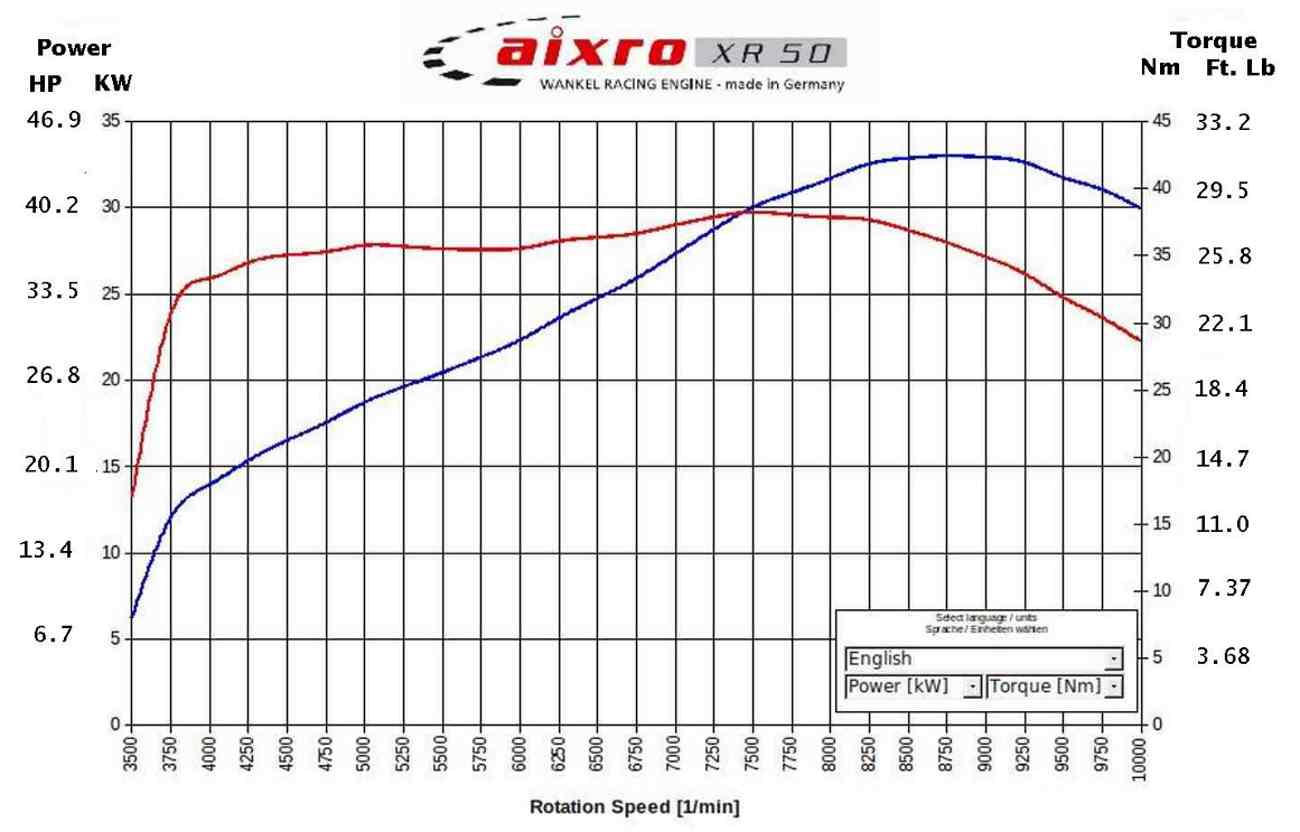
Here is how to have your modified 2.5 rotor RX8 get 50 MPG at a steady 65
MPH using an AIXRO one rotor kart engine mounted on
the back of the stock RX8 differential.
First read this.
http://www.rotaryeng.net/RX8-TC-eng3.html
Here is a cheaper and quicker way of testing this concept. Get an AIXRO Kart
engine and mount it on the back of the RX8 differential. Remove the stock
rear cover. Use a second pinion gear and run the AIXRO only at cruising
speed with a one way clutch to disconnect it at lower speeds.
Assume 30 inch tire. That is 94.248" circumference so that is 7.85 feet in
circumference. At 95 feet per second or 65 MPH that is 12 revs per second or
720 RPM times 4.77 is 3434 engine RPM.
So you need a 2.17:1 planetary reduction given 7452 RPM for the AXIRO engine. That is
also 114 revs per mile per hour or 96 MPH at 11,000 AIXRO max RPM.
BTW for those on here that have not yet heard a Mazda 13B 1991 Turbo II engine
more or less stock went 229 MPH at the recent Reno air races in a RV6 experimental
airplane.
Paul Lamar
--
The Rotary Engine NewsLetter. Powered by Linux.
ACRE NL web site.
http://www.rotaryeng.net
Youtube key word PaulLamar2
Copyright 1998-2011 All world wide rights reserved.