Hi Paul!
Here's a couple pics of the acrylic damper assem mockup. Presently, the
original 6.9" diameter for the damper section looks to be a little too
small when using the 1/2x1x7/8 blocks, as there is conflict with the large
washer ring. The image shows the blocks standing on their 7/8 side,
instead
of the one inch side, and it's still a bit too large.
What do you suggest is the next step?
Ed Carver
Looking good Ed.
The shaft project has run into a snag. I need to get the material back.
Michael that owns all those big lathes was forced to get a full time
job to pay the bills. He just was not getting enough biz to keep the
doors open. I'll see if I can get in touch with him tomorrow after
his work. I may be able to cut them to length with a carbide chop
saw I have. Jim thinks he can do it with his lathe. Just not as fast
as Michael.
------------------------------******--------------------------**
--**--**-----
As to the flex plate what rubber blocks are you using?
I assumed we would use custom molded rubber blocks to fit.
At least that is what I said in an old message in Sept.
-------- Original Message --------
Subject: Gear box pictures
Date: Mon, 19 Sep 2011 16:08:01 -0700
From: Rotary Engine <
rotaryeng@earthlink.net
To: AAA Put this in the To box <
rotaryeng@earthlink.net
lots of snips....
"Now it is possible to design the concave rubber blocks with enough
expansion
clearance so no axial force will be generated."
------------------------------******----------------------
OK I think I have it figured out. What you are saying is the 1" by .5"
rectangular tubing
is too big to fit the 6.9 inch diameter and the stock steel clamp ring.
I probably made a mistake on measuring the clamp ring diameter. What
number do you
have on that?
We can do one of two things. Cut down the clamp ring plate in a lathe or
go up on the 6.9" dimension
slightly. What do you think?
Paul Lamar
It's why we made a mockup. The ring diameter is odd in that it extends
outward past the bolt centers more than it does inward. Seems natural move
the diameter out at least .200". The ring is 5.115" OD.
Is there in the plans something to contain the rubber on the inside
diameter of the .5x1" blocks? The spline plate inward extension will ride
about .100" off of the e shaft.
The spline plate as shown in my photo does not have the OD cut down to
your
spec. That is because I am not sure if I will use it. I am going to use a
longer input shaft, and hence, a different spline plate.
Gotta do what you gotta do Michael. I'd be in the same boat if it were not
for the mass of old porsches and parts I collected over the past 25 years.
Even with the bust of the Euro, Germans still want their lawn mower engine
powered old 911's back. (I will always tease porsche lovers because they
whine too much when they lose at the track) ;)
A chop saw will easily cut the alum shaft material. I may be able to get
the shaft bored in the EAA hanger. We have a couple lathes in there, but
they are on the small side and I would need to create some sort of
bearings
+to hold the shaft at it's longest extension out from the chuck.
Perhaps Michael can do it as a side job. Can 4.5" material fit into the
bore of that chuck? The easy part for him would have been turning the
housing, which has a much larger diameter. That part is probably out of my
size range because it it too long for my mill.
Ed Carver
To cut it down to fit it must be 4.750" dia..
What we have going for us is the large 4130 plate is .096 thick while the
mild steel stock plate is .062" thick.
I'll try to have another talk with Michael today.
Here is flex plate rev 4 with with a 7.586 diameter.
We measures Jim's chuck and we can get 4 inches in there no problem.
Things are getting hectic around here so after Christmas is going to be
it.
We have a pack of relatives staying with us.
Paul Lamar
Here's a list of the radius points, all dimensions +- a few thousandths.
Clamping ring id: r1=1.55
Clamping ring od: r2=2.56
Damper blocks id: r3=2.76
Damper section od: r4=3.780
Ring gear id: r5=5.655
We now have about .200" between the blocks, (r3) and the clamping ring OD,
(r2). It looks to me as though we should weld a wall around the clamping
ring to act as the inner housing for the rubber blocks.
The ring gear id is taken from the 1988 RX flex plate ring gear. This is
the gear you can just barely see in the photo I sent of the acrylic mock
up. I removed the ring gear by cutting the welds holding it in place to use
it for this project. Your ring gear may be different. The stock flex plate
has .370" of the outer edge rolled 90* to hold the ring gear securely.
The depth of my 88 flex plate from the top of the ring gear to the flex
plate mounting surface is 1.170". Subtractions for various thicknesses
shown below:
New plate mount to counter balance: -.095"
New spline plate: -.095"
Leaving us with .980" for the rubber blocks, and the .5x1" steel
rectangles.
We can probably lower the spline plate into the damper a 100 thou or so to
help keep things in place.
I remember some discussion on the type of rubber to use as damping
material. When should I be concerned about this? When I know what it is I
will just go buy it.
Ed Carver
I am going to go over this when I am a bit more awake :)
Silicone rubber is preferred as it will tolerate 500 F.
Paul Lamar
Here is what I have for revision 4.
Paul Lamar
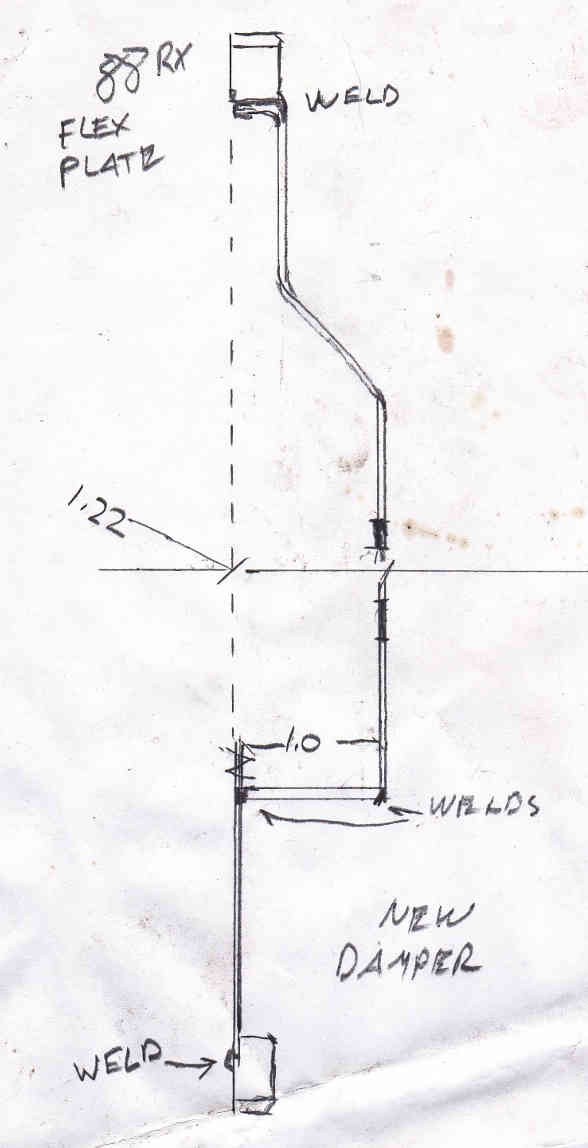
Attached is a sketch of our damper plate sectioned at the middle, with the
new unit on the bottom, and the 88rx flex plate on top.
Image shows how we can make it contain one inch thick rubber while still
using the original position of the ring gear. By moving the 16 hole plate
to the inside of the ring, it shortens the rubber approx. 5/16.
I have completed all of the plates. There was enough material to make two
16 hole parts. The mount plate fits nicely onto the counter balance.
The one inch tall containment wall is all that is needed to finish the
parts for welding. Would you like it one inch, or 11/16(approx)?
Ed Carver
I think I found a guy that can do our prop shafts in Santa Paula.
More about this after Christmas.
Paul Lamar
--
The Rotary Engine NewsLetter. Powered by Linux.
ACRE NL web site.
http://www.rotaryeng.net
Youtube key word PaulLamar2
Copyright 1998-2011 All world wide rights reserved.