I've got a turbo 20B which I have rebuilt twice now. I've sorted out
wiring issues, had Tracy's EC repaired, checked the timing, checked
for fuel and spark; repeatedly.
The engine was, possibly among other things, flooded.
Today I even tried engine starter fluid. I cannot get the engine to
even cough or sputter as if i's even trying to start.
Is there anyone within a reasonable driving distance of Canton, GA, an
hour north of ATL. With Rotary and preferably Tracy EC experience as
well that might consider
giving me a visit for some assistance getting this thing started? I'd
be happy to pay your travel expenses. Ive exchanged numerous emails
with Tracy, this newsletter and Mr. Anderson to no avail.
I am at my wits end.
Jay
Ed Anderson might fly in from NC.
Flooding is unlikely for a 20B.
Is the compression now good?
I assume the spark timing has been checked.
Do the injectors squirt?
Do you have a manifold pressure gage on there?
Can you borrow an oscilloscope from some body.
There is also a free program that uses the audio microphone jack
on all PC's as an input to a software O-scope.
Use that to check the CAS. It works great on my Linux machine.
http://www.zeitnitz.de/Christian/scope_en
http://www.picotech.com/picoscope-oscilloscope-software.html
http://www.electro-tech-online.com/general-electronics-chat/38689-good-cheap
-free-pc-oscilloscope-program.html
I do recall reading your emails on this subject.
Send a picture of the intake manifold and injector locations.
Apply 18 volts to the starter. Three 6 volt batteries in series.
Don't let it crank for more than 15 seconds at a time. You
could over heat the starter.
If all else fails I fly UAL (retired A&P wife) for a modest cost if
you could
meet me at ATL and provide room and board for a couple of days. Or I
could rent
a car. The wife would want to come along :)
Paul Lamar
Jay - I am in Roswell - less than a half hour away, and would be willing to
help. 770-815-5140
Victor Roberts
Jay,
Start with the basics.....the very basics.
1. Turn off your fuel pumps and leave them off
2. Make sure you have compression. Do two test. One as it sits, then squirt
20cc of auto trans fluid in each rotor and do another compression test.
3. Check ignition. Simply pull the plugs out, clamp them for a good ground
and look for spark.
4. Make sure the timing is correct. I prefer an old style timing light. Also
can just make sure rotor 1 is on tdc and the timing mark lines up on the
distributor.
5. If all the above is working and correct, install the plugs, leave the
fuel system off and use a can of carburetor cleaner (berrymans b12) and
spray it in the manifold while cranking. It will fire up and run if it has
compression and correct timed ignition. Do this a couple of times now just
because you've worked so hard to hear something. Its quite awesome to hear
it fire up.
6. Now work on the fuel system.
7. fuel pumps still off, put the system in primer mode, push the primer
button and listen for the injectors to click. It should be easy to hear. If
you do not hear anything theres a problem. Either wiring or computer. I
would bet on wiring.
8. If you do hear the injectors click, pull them out, turn the fuel pump on
and do the same test. They should spray fuel only when primer is operated
and should not leak or drip otherwise. Be careful, obviously your spraying
fuel around. The best way is to put the injectors in small glass jars.
If all the above is working, your only problem should be mixture.
As a reference. I do not start my 20B in cold start mode. I squirt 6 primes
in, turn my mixture knob to full rich, and it fires up every time. As it
warms up I start leaning it out
Hope this helps
Bob Mears
Thank you very much for the replies, suggestions and offers so far.
Although probably not the only/primary problem the engine did appear to be
flooded before my last start attempt. I took the plugs out
and motored the engine and all sorts of mist spewed out the plug holes.
Compression on all three rotors is about 80 psi.
I get spark both during the EC3 diagnostic test and when spinning the CAS by
hand.
I'm using after market fuel rails where the injectors simply slide/snap into
place. I 'm not sure how I would test them off the engine with fuel
pressure.
The injectors would simply squirt out. There is fuel vapor coming out of
the exhaust and using an engine stethoscope I can hear them firing when I
turn the CAS by and during the EC3
injector diagnostic test.
I'm using the stock intake manifold.
I have a manifold pressure gauge, I'll have to look again but I don't think
it's fluctuating during the starting.
I have two 12 v batteries wired in parallel. Although trying 18 v is
certainly worth a try at this point.
Paul I would not only pick you up but let you stay at my house as well.
I don't think I have access to an oscilloscope but I will check around. I
assume that's to check the CAS output?
Victor, I'll be back in town tomorrow afternoon and will call you Friday or
Saturday to see when it would be convenient for you. I'd gladly bring the
engine to you but
it's mounted on a test stand and it would be impractical for me to load it
up for travel. Even if I had something big enough to carry it.
Bob, I believe I've done everything on your list at one time or another.
Most of them several times. I even tried twisting the CAS sensor at 90 deg
intervals just in case I've managed to
get the timing really screwed up. Not even a cough. As mentioned I tried
engine starter fluid this last time and again, not even a cough.
Someone asked about my electronic prowess. Other than a ham radio license I
got in the early 70's I'm about one notch above beginner.
I have found wiring issues with the EC3 in previous troubleshoots but I
THINK I have it squared away now.
You know how sometimes you can struggle endlessly with a problem pulling
your hair out all the while with no apparent solution in sight? Until
someone walks up looks over your shoulder and spots the problem right away?
I think that's where I am.
Jay
I think Bob's checklist is an excellent idea. Go through that once more and
let us know what you get.
It should spit or pop once in a while. Maybe the timing is 180 degrees out.
Do you have an old fashioned timing strobe light? Do you know how to find
TDC on rotor one using a screw driver? You stick it in the spark plug
hole and feel for it :) A more accurate way is hollow out an old spark plug
and connect a clear plastic hose held straight up. Fill the combustion chamber with
oil and rock the e-shaft back and fourth so the oil level is a max
in the hose. That is TDC.
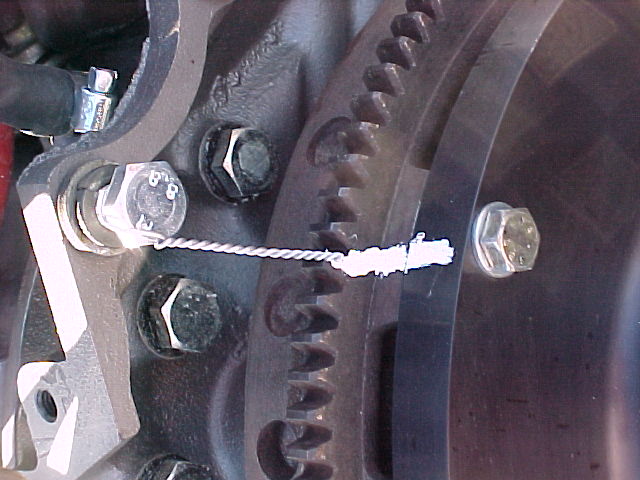
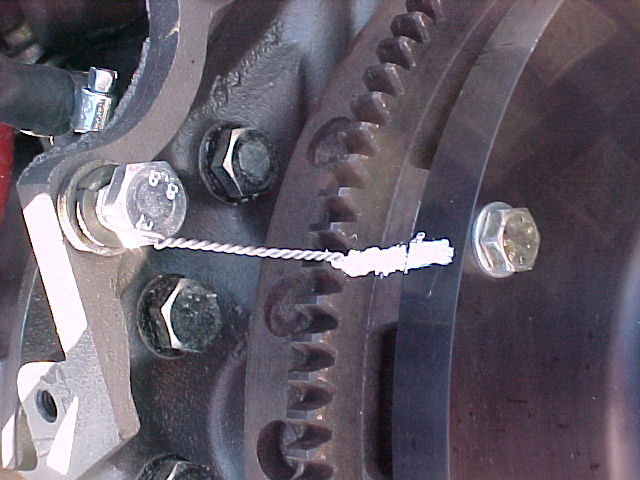
A very accurate way of marking top dead center is use the ring gear.
Paul Lamar
--
The Rotary Engine NewsLetter. Powered by Linux.
ACRE NL web site.
http://www.rotaryeng.net
Youtube key word PaulLamar2
Copyright 1998-2011 All world wide rights reserved.