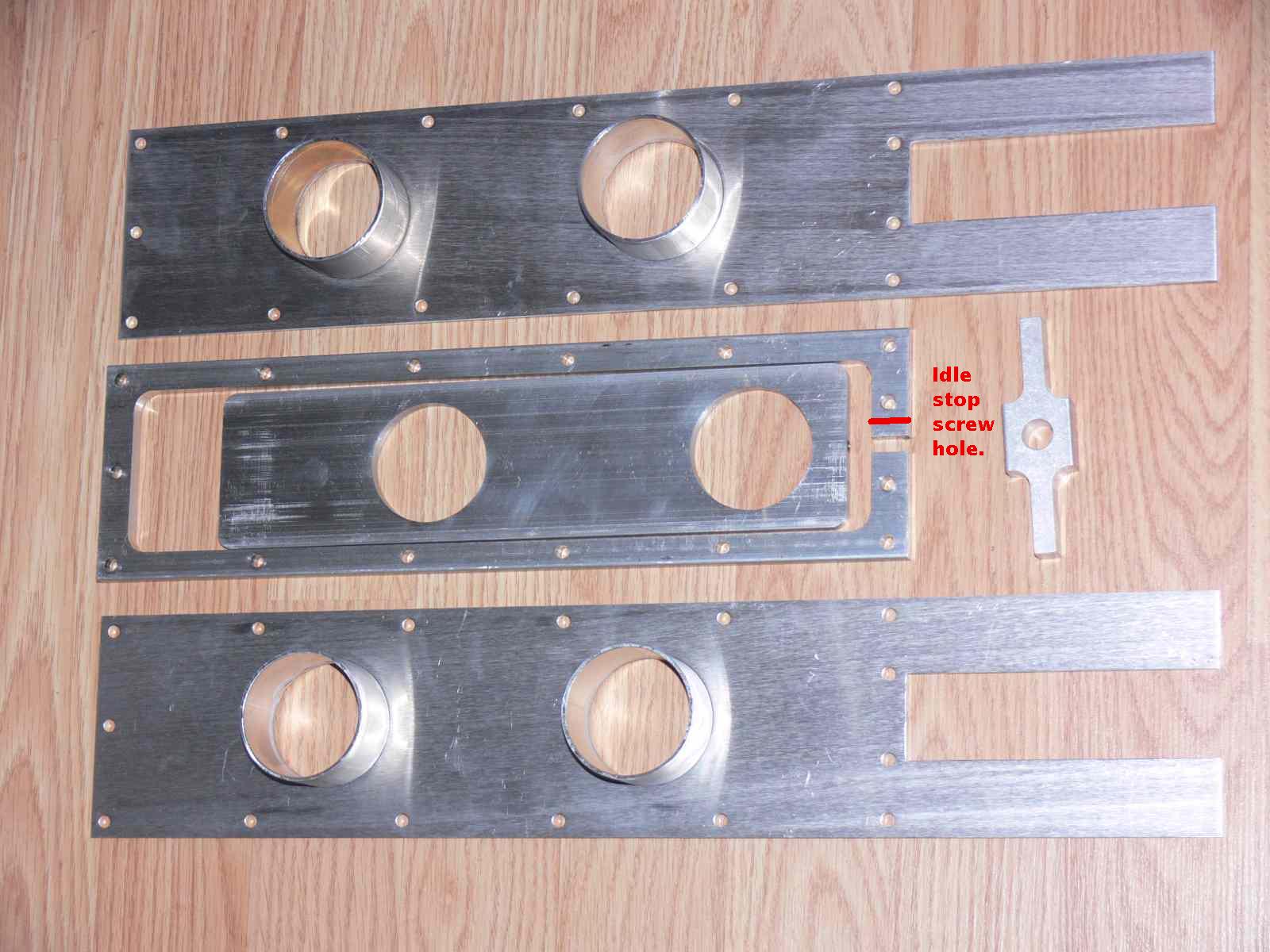
Paul,
Did you measure the MAP for your p-port Renesis during the dyno
runs?
Do you recall the readings you got, particularly at idle
speeds? I'm
questioning the readings I am getting at idle speeds (approx. 2k
rpm)
... around 17". I measure MAP at the old oil injection
ports. The
three are teed together.
Mark S.
Sorry to not get back to you sooner Mark. We had severe email
problems with earthlink servers.
I don't recall what those numbers were at 2K RPM. I don't
think we tested at that RPM. That sounds real high for only
2000 RPM. What mixture are you using at that RPM?
Does the engine idle smoothly at that RPM?
Is that a steam gage or electronic pressure sensor reading?
Paul Lamar
Paul,
2K is where it starts running rough. My wideband gauge quit shortly
after I had to switch to 100LL because of the ethanol mandate.
So, I'm
reading mixture off the EM-2. Mixture is set to where it runs the
smoothest. That is about half a bar on the EM-2. Prior to
p-porting,
the engine used to idle down nicely around 1500 rpm. The engine
runs
great at the higher rpms.
My suspicion is that the primary injectors (and idle) would work
much
better if they were located downstream of the slide throttle. I'm
currently trying to figure a way to test that theory.
Mark S.
I don't expect that will help much.
I forgot. Are you using a 2.85:1 or 2.17:1 gear box ratio.
2000 RPM idle is not bad for a p-port. That is 700 prop RPM with
a 2.85. My O-470 will not idle lower than that.
Are you having any trouble on approach?
If so try slipping. Slipping is safer and more accurate way of
landing
as one can always extend the glide if you have an engine failure on
final.
You should use one of these cheap high speed data aq as it can show
turbulence in the intake manifold at low RPM. It is sampling at over
1000 SPS. About the response time of the pressure sensor Tracy
is using.
Paul Lamar
Paul,
I may be way off on this, but my guess is that at low throttle (near
idle) settings, and with the injectors being upstream of the slide,
much
of the fuel is puddling in the runner just ahead of the slider. Every
so often, a bit of liquid fuel manages to get sucked through
causing the
engine to stumble. Of course, this doesn't address the MAP
readings I'm
seeing, but it may explain the poor idle. I would like to try to move
the primary injectors downstream of the slider.
I would like to try monitoring the MAP. Can you provide more info on
what's needed to do this?
Thanks,
Mark
Historically the way to get a good idle with a p-port engine is use
two ports. The second, much smaller port is on top of the big one
so the timing is later as in this NSU RO80/Spider. I drove one of
these p-port engine cars in Germany and the idle was very smooth.
The car pulled away from a dead stop without stumble.
The port diameter can be as small as 3/4 or 1 in diameter and can
stay wide open all the time. The main slide throttle would be totally
closed for idle. The primary injectors can go in the small
idle air tubes. The manifold pressure tap can stay where it is.
Guaranteed to work. What would work better in theory than even
this is a small one way ball valve that would close to prevent
a small amount of back flow at full power.
How important is a good idle?
Paul Lamar
Paul,
I think the root of the problem may be a vacuum leak around the hole
where the throttle cable protrudes through the slide throttle frame.
Any idea on how to seal this?
Mark
Small O-ring? I doubt that as Tracy's EFI does not really care where
the air comes from. It is setting fuel based on the total air
getting into the engine. The amount of air coming from there is
minuscule.
Have you looked in the intake manifold and seen how much open area
is in there when the slide is set for idle?
Try those small holes in the base of the slide first.
Paul Lamar
Paul,
There is almost no perceivable space in the bores at idle setting. I
agree with the suggestion of drilling 3 small holes (one per runner) in
the slide. I had considered doing that to help during idle.
As for the air leak... During idle, the 2" hole in the teflon slide for
rotor #1 moves very close to the hole in the frame for the cable. This
could provide a path for the air to bleed into the #1 rotor causing it
to run lean. This may account for the higher than normal MAP as well as
a mismatch in air-fuel mixture during idle. It would become less of an
issue as the throttle is opened, exactly as I am experiencing. I
suppose I've got it tuned as well as possible, but with this condition,
I don't see how I will ever get it to run well at low MAP. It shouldn't
be too difficult to install a small seal. It sure wouldn't hurt
anything. I could probably stuff a small piece of shop towel around the
shaft for a down-and-dirty test. If the idle improves I'll know that
I'm on to something.
Mark S.
A seal would be worth a try in that case.
For future use do you have room to make the slide an inch or so longer?
Paul Lamar
--
The Rotary Engine NewsLetter. Powered by Linux.
ACRE NL web site.
http://www.rotaryeng.net
Youtube key word PaulLamar2
Copyright 1998-2012 All world wide rights reserved.