... this is another of those stupid ideas that pops into my head from
time to time ... ignore me if you start laughing too hard!
But ... could a ball-valve work as an off-the-shelf throttle for your
Holly carb setup?
See the following:
http://images1.mcmaster.com/Contents/gfx/large/2693k22p1l.png?ver=19729922
Hog a couple of pounds of excess metal off the above unit(s) and run
your intakes into it (about $70 each, however).
Might be a bit stiff to operate (at least at first)
R.Berglund
A 2 inch ID brass ball valve would have a serious effect on the CG :)
Paul Lamar
Who says it has to be brass? Why not make it from a nice cheap PVC ball
valve. PVC is fuel proof and it shouldn't take too much to prevent it
from getting hot enough to melt. ;-) Just sayin!
A ball valve is not recommended for partial throttle operation. Ball
valves are indicated for on/off operation. Same goes for gate valves.
Mark LaPierre
Registered Linux user No #267004
I would say a gate valve is the same as a slide throttle.
Slide throttles work fine. The Le Mans winning 4 rotor had
a slide throttle.
Paul Lamar
A gate valve is loose in it's guides until it is fully seated. A slide
valve is fully restrained at all times. A gate valve will frequently
vibrate in the fluid flow due to vortex shedding causing the setting to
change rendering your carefully adjusted setting to drift.
A ball valve is a poor choice for throttling because they generate huge
turbulence at any setting short of full open, and are notoriously
difficult to adjust to a low flow setting. Tiny movement results in
large flow percentage change. In addition there may be an issue with
sucking the seal out of place at part throttle if the valve design is
susceptible to that.
Slide valves are quite effective for use where the valve is lubricated
by the fluid flowing in the system. The fluid seals the slide due to
viscosity effects in the very small clearance gap between the slide and
the guide. They require close tolerance machine work to be effective.
The larger the valve the more difficult the construction.
Have you considered cutting the opening in the slide in a teardrop shape
to make the idle adjustment less sensitive?
Mark LaPierre
Registerd Linux user No #267004
Yes we tried that and decided it was not worth it.
These are normally punched out with a CNC punch to keep the cost down.
http://www.rotaryeng.net/slide-kit.jpg
Paul Lamar
I don't know if this issue is worth discussing any more, but just for
argument sake I'd like to defend the ball-valve.
True ... a partially open ball valve creates "huge turbulence". Is this
bad? (It might even be a plus and serve to prevent a "wet" charge from
entering the combustion chamber). Would ball-valve turbulence
necessarily be any more than that created by a slide-valve?
As for the statement "Tiny movement results in large flow percentage
change", that too is true. But my mathematics (I will skip the calculus
here) tells me that with a slide valve the rate of increase in the open
area depends on the distance across a circular opening, which for small
openings is increasing very rapidly (some reciprocal square-root
relationship). With a ball-valve the rate of increase of the area of
the opening is determined by the overlapping areas of two circles, and
that rate-of-increase calculates to be less than that of a slide-valve
(I think).
Also ... ball-valves work well under huge pressures, and the
pressure-drop on an intake manifold can never be more than about 15 psi,
so I suspect seal problems would not be a major issue.
My only experiences with slide-valves were in a paper-mill, where they
are used extensively for low-pressure applications on large pipes of
lightweight stainless. They are probably comparatively cheap to make in
SS, but I seem to remember that most of the slide-valves in use had a
big puddle on the floor beneath them; they leaked a lot.
The biggest negative I see for the slide-valve in use for throttle
purposes is that they take up quite a bit a space (lengthwise).
R Berglund
Yes they do but the throttle linkage is super simple.
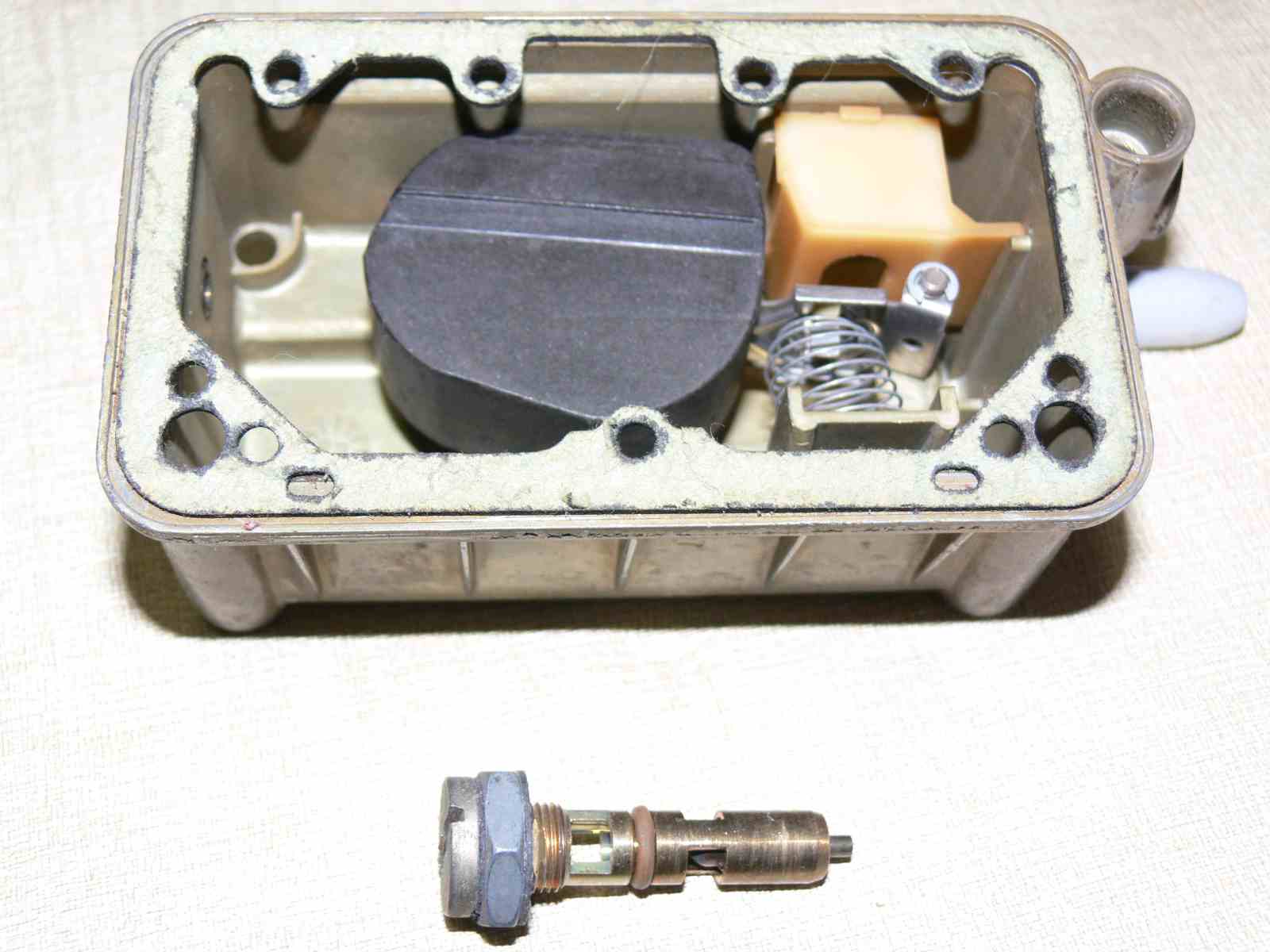
BTW I just realized you get an accelerator pump for free
as one of the Holly float bowls has it built in. Many
aircraft carbs do not have accelerator pumps so you have to be careful
about shoving the throttle in too fast.
The Holly design for this is extremely ingenious and and simple. All it
does is add a little volume to the float bowl and momentarily raises the
fuel level to richen the mixture when the throttle is jammed wide open.
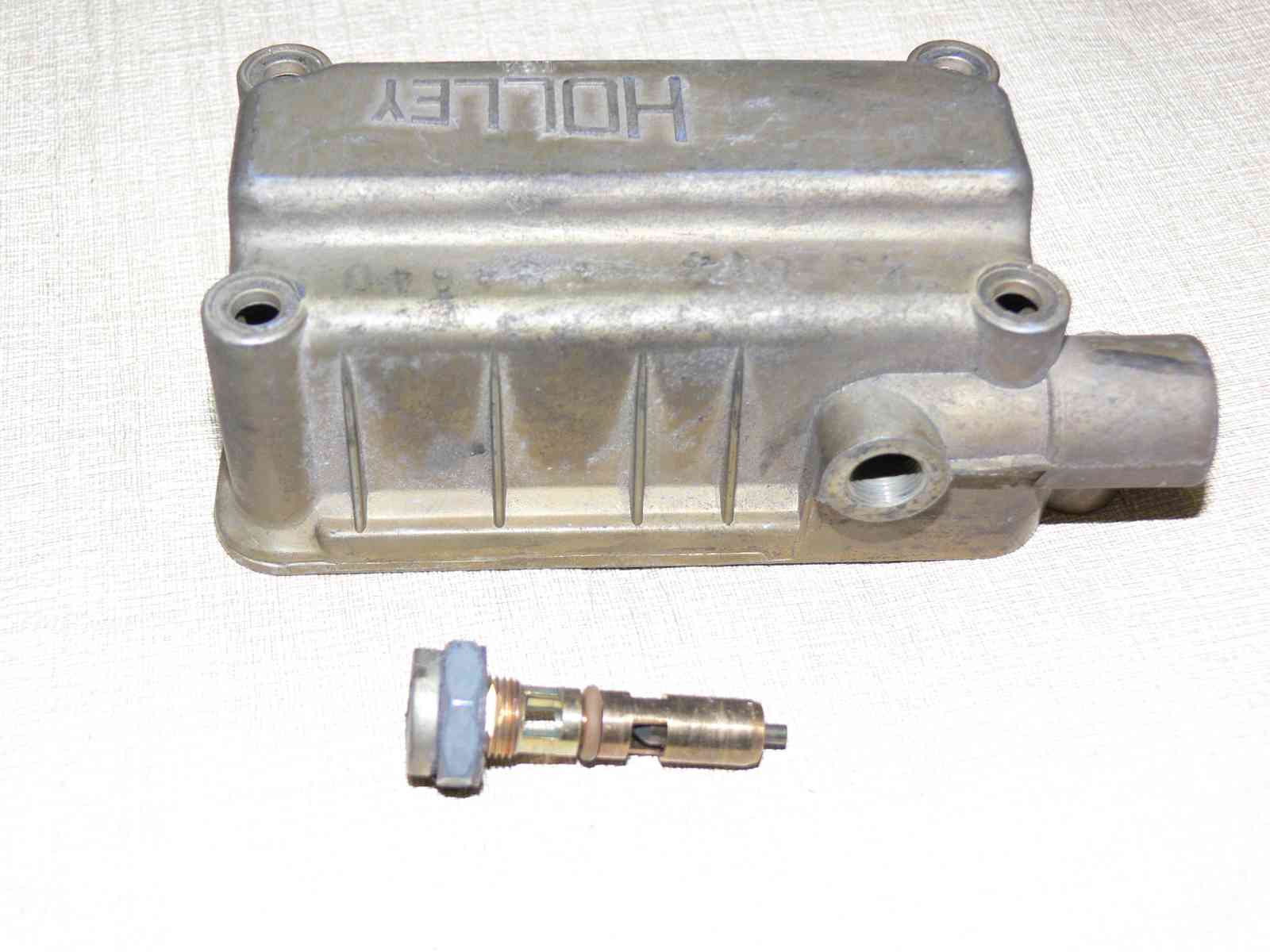
We can also use the stock Holly jet collection which gives us a huge
amount of mixture options.
Paul Lamar