Paul,

 1. I remember a chain about the efi unit that would require a single
 "computer" per injector and per coil. Do you have a schematic for it? I
 remember you referencing an 8051 chip, and a MOSFET I think.

 2. Why do you not use the OEM crank angle sensor that goes in the front
 cover? It looks like it is just 2 hall effect sensors. One pickup has 2
 points, the lower has 12.

 I want to make a unit that I can bench test my coils and injectors before I
 stick them in the engine, and maybe use it to fire the engine off and put
 some time on it as I build the plane out.

 Also, I have several prototype boards that I can program to operate the
 coils, injectors, etc. but I was hoping not to have to re-invent the wheel
 if I didn't need to.

 Kevin Alderman

 Yes that is fairly easy to do if you are willing to learn 8051 asm
 language.
 The stock sensors are magnetic and they work fine. A coil wound around a
 magnet.
 I would use multiple hall effect sensors to reduce and simplify the
 software.
 Similar to what Light Speed Engineering is doing with their ignition
 system.
 http://www.rotaryeng.net/simple-cheap-555.html


 Right now I am fooling with a cheap PC miniATX mother board.
 They are ten times more powerful than the single chip computers and the
 cost is about
 $80. Running DOS they can be programed in easy to learn quick basic.
 http://www.rotaryeng.net/fuel-injection.html

Everything, including a full blown EFI, can be written in hours using
 simple to learn Quick BASIC.  I already wrote a GPS driven moving map
 program in the early 90's in QB.  People will be able read the source code
 and almost anybody can change it.  Quick BASIC is a compiled language and
 the programs are small and lightening fast in modern mother boards.  QB/DOS
 can handle real time hard ware interrupts which were used in my moving map
 program.  The code is already written to read a USB GPS using the RS232.

 It is the combination of DOS, Quick Basic and modern mother boards that
 will make it happen.  All allow direct connection with the hardware to be
 controlled.

 Quick Basic has hardware interrupt handling built in.  We are looking at
 over 100 hardware interrupts in one second.  See my attached IEEE paper for
 more info on hardware interrupts.

 What I and several others are trying to do is add USB support to DOS.
 I am getting close. If I can get that to work it is a whole new paradigm
 in easy to
 program hardware controllers.

 However I would not wait for it as it might not happen. It makes no sense
 without DOS  USB support.

 Paul Lamar

I found a similar board that will run Linux and can be programmed with
several languages, some of which I am familiar with. What was your plan for
the individual units that needed one for each coil/ injector?

Kevin Alderman.

The plan was use a singly chip 8051 that has a built in USB interface.
They can be had for $10.

There are two problems with Linux. No Basic that is written in asm and that supports
hardware interrupts like Quick Basic does. Linux is multitasking and therefor time
crtical program are all screwed up. Real time linux would work but it is bloated and
not written in asm like DOS. Again no suitable basic.

DOS asm programs are typical less than 50K and consequently they are super fast.
you have to try DOS and QB running on new hardware to experience the extraordinary speed.

If you have XP it will run DOS in a window and I will send you QB. Zipped it is less
than 1 meg. QB running on DOS in an XP window is not near as good but you can get
inkling of how it works.

I have the ISO's for DOS 6.22 if you want them. You will need a 3.5 inch floppy to
install them. When and if I get the USB working DOS will boot off a stick. No HD
necessary.

http://www.petesqbsite.com/sections/tutorials/beginners.shtml

Paul Lamar

I am getting tantalizing close the getting the USB to work under DOS.

"The minor miracle here is using a driver file called "USBASPI.SYS" ("Panasonic v2.06
ASPI Manager for USB mass storage"). Given the right parameter incantations, this
16-bit Panasonic-developed DOS driver will let your system boot good-old DOS -any
flavour, and recognize all USB devices connected to the respective controllers."

  DOS=HIGH,UMB
  lastdrive=Z
  device=HIMEM.SYS
  devicehigh=USBASPI.SYS /v /w /e
  devicehigh=DI1000DD.SYS

Everything seems to go OK until near the end and then I get a "divide overflow
error". Can anybody help with this?

BTW if you don't mind using a floppy drive the system is still perfectly functional
in an airplane. The pictures are of a PC with a CRT running a QB moving map program
in the cockpit of my C182. The modern implementation would use a flat thin LCD
mounted in the instrument panel of course.

Paul Lamar

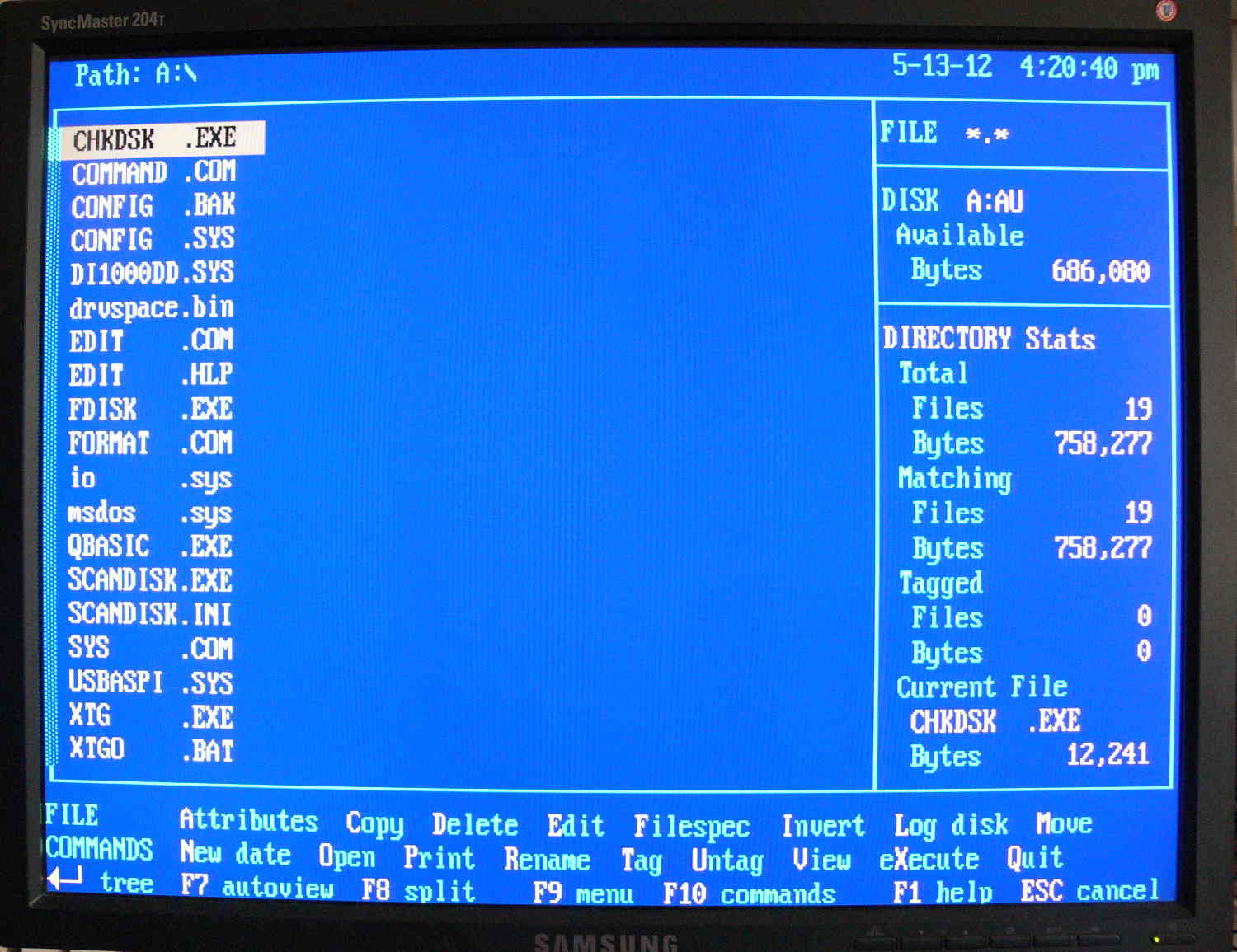
Back in the good old days all you needed was a floppy disk with a 19 files on it to
boot a very effective O.S. and file manager. The file manager was called XTree Gold
and to this day it beats Windows Explorer hands down. The only trouble with it was
the 16 bit nature of DOS limiting the memory to 640K. If MS had done a 32 bit version
of DOS and QB instead of Windows the computer world would be much faster and a better
place for serious computer work. The sad part abought it was those of us in the
computer biz at the time knew it. Some big companies are stll using DOS.

Paul Lamar

--
The Rotary Engine News Letter. Powered by Linux.
ACRE NL web site. http://www.rotaryeng.net
You Tube key word PaulLamar2
Copyright 1998-2012 All world wide rights reserved.