This looks like a real simple way of using megasquirts on rotaries and you have
 redundancy. The engine will run on one rotor. It solves a lot of problems using just
 one Megasquirt on a rotary.

 I has the advantage of using a notebook computer with a USB connector to tune and
 save injector tables to share with other people merely by emailing them.
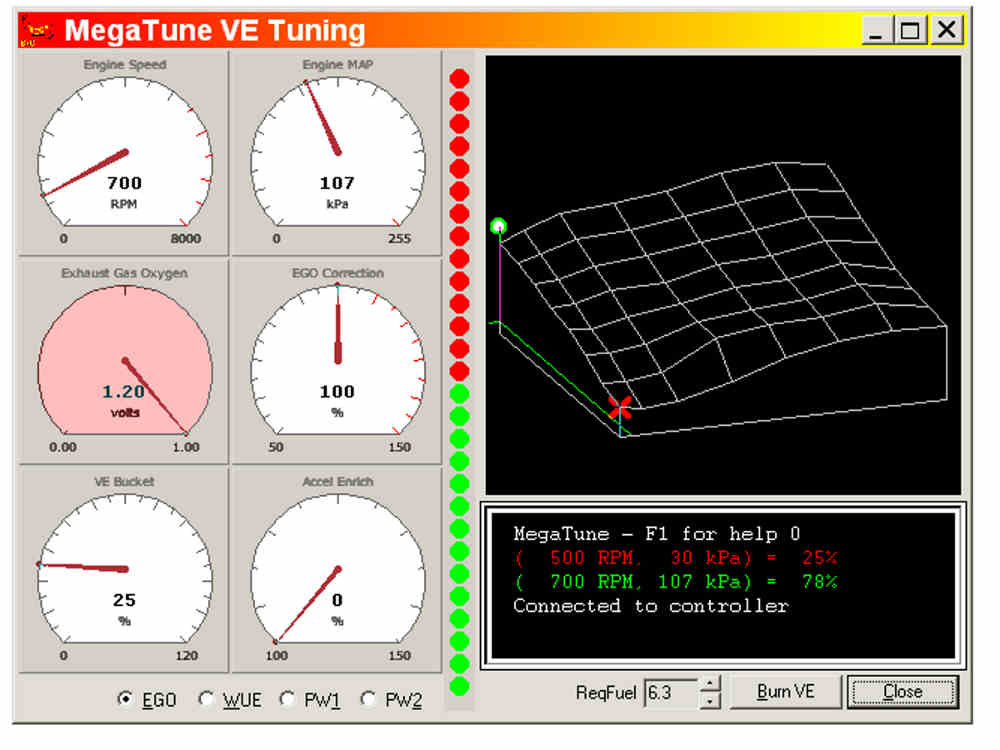
 Megatune is very sophisticated and easy to use tuning software that runs on a notebook.

 IMHO this is a great idea.

 Paul Lamar

 -----------------------------------------------------------
 Using MegaSquirt ‘out of the .box’

 www.not2fast.com/megasquirt/doc/rotary_injection.doc

 MegaSquirt introduction.
 The MegaSquirt was design by Bruce Bowling and Al Grippo to be a simple and cheap
 batch fire fuel injection system. Been around for years.

 There are 2 injector driver outputs on the MegaSquirt, running off the PWM channels
 of the MCU. This allows both saturated and peak and hold injectors to be used on the
 same hardware: very clever. This allows 2 different injection events to occur in
 parallel, which suits our purposes very nicely.


 Specific needs of Rotary engines.

 The rotary engine, due to the rotor layout has a few key differences with a
 reciprocating engine. Many of these work in our favor. And remember, the otto cycle
 is the otto cycle:

 There are 2 rotors, spaced 180° apart. EFI.

 Build 2 MegaSquirts.

 Fit a pair of hall effect sensors one at 22 degrees BTDC and  one 180° later (top and
 bottom) Hook one MegaSquirt to the top sensor and one to the bottom.
 Burn in injector staging code if required.

 Ignition.
 The ignition pulse on 1 rotor corresponds to 22° BTDC on the inlet cycle of the other
 rotor, give or take the amount of advance being used. Very handy.

 Use 2 MSD capacitor discharge units per rotor. One per plug. This is what the racers
 do and is it very simple and straight forward. Each Hall Effect sensor fires two MSD
 units 22 degree BTDC.

 Injection.
 Around 220-280° is available for injection. In a reciprocating engine, you
 can ‘puddle’ fuel on the inlet port to increase the injection time. In a rotary there
 is little time for this before the next inlet cycle starts. This forces relatively
 large injectors to be used, with staged injection being a
 useful method of getting high max flow rates and a good dynamic range. For example,
 at 8000 RPM 1 revolution is 7.5ms, giving around 6ms for injection.

 In terms of injector strategies there are a couple in general use
 The best for our use here is 2 injectors in each runner.

 The code mods are very simple, if needed at all
 You get the full 6 ms for injection at high RPM
 2 MegaSquirts are needed so adding a full $100 to the costs
 Tuning will be a little more tricky as you have to set each parameter twice

 ----------------------------------------------------------------


 I had an idea of using 3 megasquirts that fed a logic box that compares the outputs
 and forwards the one that at least 2 ms boxes agree on. Not sure if it's really
 feasible since that would induce some lag in the outputs.
 Joshua

 ---------------------------------------------------------------------


 SymTech Labs' coolant temperature sensor is a standard GM CLT sensor capable of
 interfacing with all MegaSquirt ECU's. It features 3/8" NPT threads and can also be
 used as an intake air temperature sensor (IAT/MAT). Each unit is shipped with a 6"
 pigtail for easy installation.

 Intake Air Temp/Manifold Air Temp

 The big question that I have is there seems to be conflicting info. Often they talk
 about a MAP sensor but this block diagram does not show it. A Manifold Air Pressure
 sensor (MAP) can be used to control the amount of fuel injected just like an O2
 sensor. That is what Tracy does.

 Any type of feed back from an O2 sensor will not work as 100LL is death to O2 sensors.

 The MS flow chart shows a read of the MAP but the schematic shows no connection to a
 MAP sensor.

 Can anybody help me out on this? Is the sensor on the mother board? Where is it
 connected?

 BTW The megasquirt has the built in capability to send engine parameters back to the
 notebook in real time for use as an EFIS. The notebook software is already available
 to display these engine parms in real time. This is a real cheap EFIS.

 Paul Lamar

Separate Megasquirts for each rotor is a great idea as long as there is no
danger of fire or explosion if the ignition for one rotor fails but the fuel in-
jector continues, and unburned fuel air mixture continues out into the hot
rotary exhaust environment.  Perhaps an electronic switch can be in-
corporated into the Megasquirt circuitry that allows the fuel injector to fire
only after a recent ignition signal--"recent" as established from voltage
remaining in a capacitor which is otherwise charged from ignition activity.

I am very interested in this one-megasq-per-rotor approach and would
appreciate if anyone has any ideas.  Thanks.

Gene Kahn

-
Read the tunning manual.
http://www.megamanual.com/v22manual/mtune.htm

The complete manual is 14 megabytes. If anybody is interested I will upload it to the
web site so you can download it from there.

It appears that one can connect the O2 sensor so the Megasquirt can auto tune it
self. Then disconnect the O2 sensor if you have to burn 100LL. Then the megsquirt
will continue to function properly on manifold pressure and  RPM.

Somebody needs to get one and set it up on the bench to test it.

The stimulator (aka. stim) is a small board that supplies the signals to MegaSquirt®
that would normally come from the engine to MegaSquirt® EFI Controller, and display
the outputs from MegaSquirt® on a series of LEDs. This allows you to test MegaSquirt®
EFI Controller, and learn the tuning software. It also helps you to verify that
MegaSquirt® is operating correctly if you have problems on the vehicle, and lets you
'play' with MegaSquirt® to better understand how it operates. Before assembling your
MegaSquirt® EFI Controller, you should assemble the stimulator, which you will use to
test your MegaSquirt® as you proceed.

http://www.megamanual.com/v22manual/v1stim.htm

The smallest, cheapest and simplest Megasquirt will work fine one per rotor.
It is also much easier for me to modify the code as it uses 6800 asm and the original
source code is available.

We don't need the ignition stuff if we use MSD.

Paul Lamar

--
The Rotary Engine News Letter. Powered by Linux.
ACRE NL web site. http://www.rotaryeng.net
You Tube key word PaulLamar2
Copyright 1998-2012 All world wide rights reserved.