http://www.7tune.com/video-ppres-6-rotor-beast-is-alive/

  Rob Woods

     Paul it's not a slide throttle is it?  they look like 6 butterfly's
  to me.  How would you keep the E shaft together, or can one be made
 in one piece. Would windup be a problem   as "P" ported should
 produce 100 hp per rotor 500 hp at the last rotor plus the extra
 from that rotor!!        John Burey

  All good questions :)

  A p-port will yeild 150 HP per rotor at 10,000 RPM if the shafts
 lives :) 900 HP!

  Paul Lamar

  http://www.facebook.com/media/set/?set=a.388296644556315.103373.208088479243

  Rob Woods

  http://www.hurleyrotary.com/page.php?currentpageref=6265

  "After ten years of development HME are now proud to offer our
 multi-rotor engine conversions, the first triple engine was built
 three years ago and has been tested by many magazines in the United
 Kingdom, Europe and Australia, all of which have been impressed with
 the performance and fuel economy. To date 25 engines have been built
 for road and racing."

  "The turbine smooth and refined performance of the triple rotor
 cannot be compared with a ported and tuned twin rotor giving the
 same max. power output. For example the acceleration time from 40-60
 MPH in fifth gear is only 6.5 seconds as compared to the standard
 time of 10.5 seconds = 40% faster, and a 0-60 in a little over 5
 seconds while still returning 25 MPG+ motorway driving, and an added
 bonus of the triple rotor is the truly magnificent exhaust note. The
 engine has excellent low speed torque which makes it very easy town driving."

  "The total weight of the Triple Engine is 315 lbs. together with
  carburettor
  and
  exhaust system, is in fact 15 lbs. lighter that the standard RX-7
 engine, with carburettor and exhaust system and is only 4 3/4"
 (120mm) longer."

  "...for the ultimate in performance
  600 BHP Hurley Quad Rotor Engine P.O.A.
  900 BHP Hurley Six Rotor Engine Seeing is Believing ! "

  Will it cool?

  Will that tiny e-shaft diameter at the back end live under high continuous
  power?

  Will the shaft couplings live?

  What do the oil drain backs look like on the other side of the intermediate
  housings?

  Paul Lamar

  Paul,

  Looks nice!.... E-Shaft strength and the harmonics going past four rotors
  seems to be difficult unless all things were design from the
 beginning for that use. I believe in bigger displacement after four
 rotor configurations. Very nice looking work on the engine.

  Eric Barger

 Paul,   This thread seems to be mixing two different companies.
 Pulse is in Nz and Hurley is in Uk,

         In the facebook link above  down in the comments there is a
 response from  Pulse concerning the E-shaft. As I read it they have bored
 the shaft out of the e-shaft and splined the bores to correspond to
 splines on the shaft and located these parts with "tappers" which
 may mean set screws. The counterweights are keyed.  As described
 there are no shaft couplings. As for strength , the shaft is a
 larger diameter than a transmission input shaft which on a race car
 can deal with 24 hour races at 900 HP. I haven't found anything on
 the oil drain back but it is workable even if the OD of the
 stationary gear is used as a pilot by drilling between the mounting
 holes for the oil to enter the intermediate housings. There likely
 would be some shaft wind up but each rotor is timed with a
 stationary gear independent of the other rotors.  In my opinion
 cooling is hopeless in a steady state condition. There have been
 housings converted to parallel cooling  but I see no indication of
 this modification in either of these engines. Also a stock Mazda
 water pump would not circulate enough coolant for parallel cooling
 beyond 3 rotors. The video shows a running engine which is unloaded
 so it is  only making enough power to turn it's own parts, probably
 30 HP.         As you might recall I was intending to do a six
 rotor. The plan is viable in all respects.It would be a standard 3
 rotor accessory end coupled to a second 3 rotor on the drive end
 which has the removable eccentric modified for a full diameter
 shaft.  The end housings are dowel aligned mating bell housings. The
 housing patterns incorporate all the oiling/cooling and structural
 modifications and the waterpump (chrysler hemi) and dry sump pumps
 are Nascar belt drive. I have altered the plan back to 4 rotors due
 to airframe  refinement in X-plane  simulations. A four rotor allows
 the use of stock RX-8 internals and rotor housings which are 1/3 the
 price of 3 rotor parts. Reducing engine weight and fuel weight
 significantly reduce landing speeds.

 george grimes

 If the shaft is not one piece there are couplings :)

 Yes I know. I did it on purpose. The e-shaft couplings appear to be different.

 Here is the way CW did it on a four rotor. Makes more sense in many
 regards (cooling, tension bolts to name a few) but would require
 split intermediate housing. If you are making billet housing that
 would be no real problem anyway.

 The shaft may not break but one must deal with the flywheel coupling.

 Paul Lamar

 Looking at sheets 1 and 3, it would appear the e-shaft is one piece. It also
appears that 1 and 3 fire at the same time and 2 and 4 at the same time. with
each pair 180* from the other pair.
 Sheet 3 also shows what looks like a split stationary gear/main bearing
assembly, which is required for the one piece e-shaft.

Dale Davies

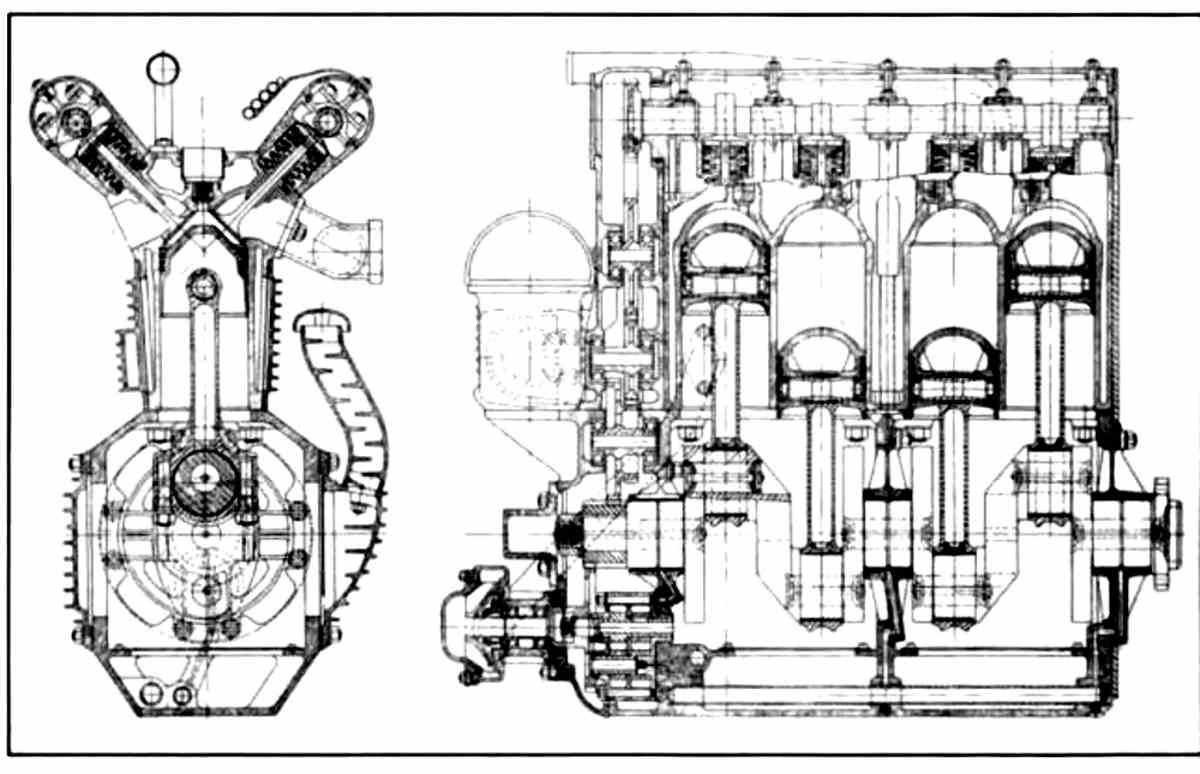
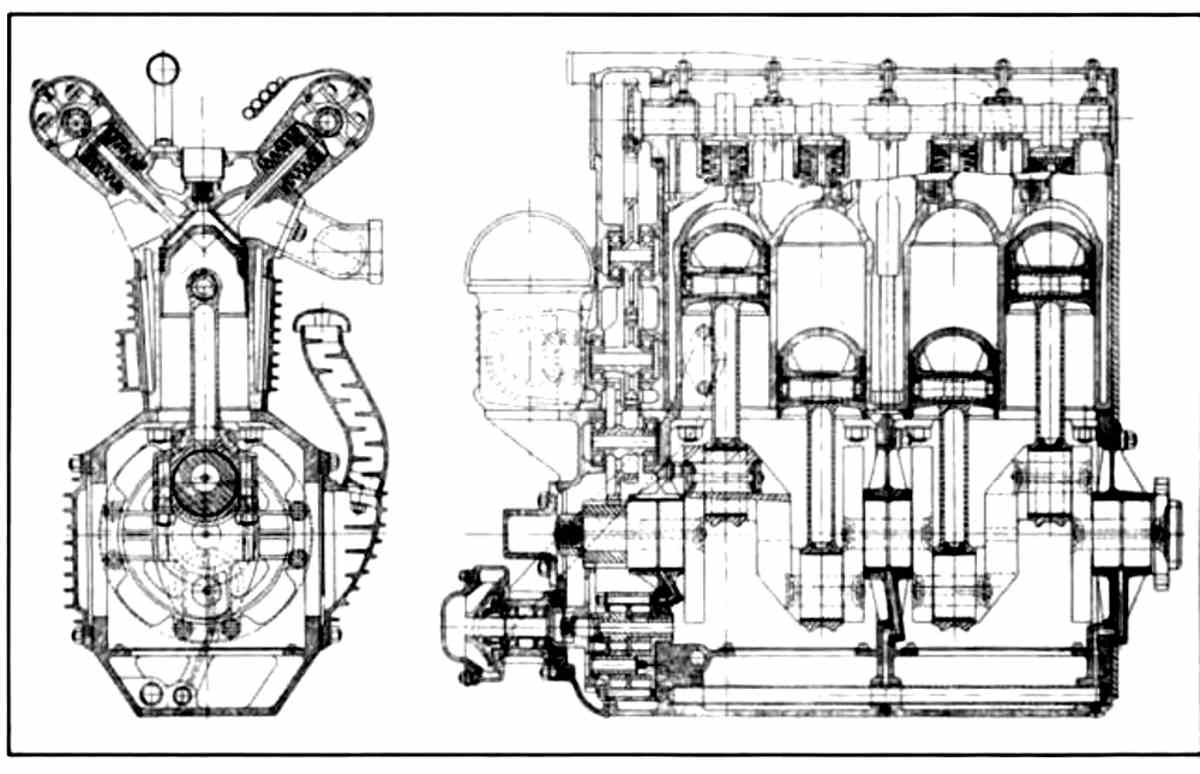
The world record holding HP per cubic inch Offenhauser had split main bearing
holders. The crankcase was one peice and the split main bearing bulkheads were fed in
from the end.

http://en.wikipedia.org/wiki/Offenhauser

"One of the keys to the Offenhauser engine's success was power. A 251.92 cubic inch
(4,128.29 cm³) twin-cam four-cylinder racing Offy with a 15:1 compression ratio and a
4.28125-by-4.375-inch (108.744 × 111.1 mm) bore and stroke, could produce 420 hp (310
kW) at 6,600 rpm (1.77 hp per cubic inch (81 kW/L). Other variants of the engine
produced up to 3 hp per cubic inch (137 kW/L). Another reason for the engine's
success was reliability; unit construction (no separate cylinder head) meant the
engine was not vulnerable to head gasket or cylinder stud problems and allowed for
higher cylinder pressures."

"Before turbo boost limits, over 1,000 bhp (750 kW) could be attained using around
120 in Hg (44.3 psi (3.05 bar)) boost."


Paul Lamar
--
The Rotary Engine News Letter. Powered by Linux.
ACRE NL web site. http://www.rotaryeng.net
You Tube key word PaulLamar2
Copyright 1998-2012 All world wide rights reserved.