I am thinking of ordering some of these. They are custom made to some
 extent.
 Price will be around $50 plus a small amount for mailing.

 With USB program connector on board.
 And a 80 Mhz PIC32MX460F512L.
 This is the full memory version of the PIC32.
 Program Memory Size 512KB.
 RAM 32KB.

 I expect it will look something like this with USB connector on board
 and the clock set to 80 Mhz?

 Can be programed in the language compiler of your choice. BASIC (2
 brands), Pascal, C
 or assembly language. Lots of accessories are available like graphic
 displays, PC2
 keyboards and GPS receivers. Source code and wiring information for these
 devices is
 free. The MikroBASIC is written to support these products. Henry and I
 will be
 working on an EFI version.

 If you are interested let me know in the next couple of days.

 I can send one to China for you Henry.

 The GPS receiver and display shown are extra cost.

 Paul Lamar


I would like to have ten of these. I can think of all kinds of uses for
them in addition to rotary engine control.

Zoltan

Send me a deposit for $250 and I will order more.

BTW back in DOS QB days we only had 64K to work with.
With the PIC32 we have 320K. The moving map is two modules less than 64K each.
It was easy for PIC to up the address bus to 24 bits.

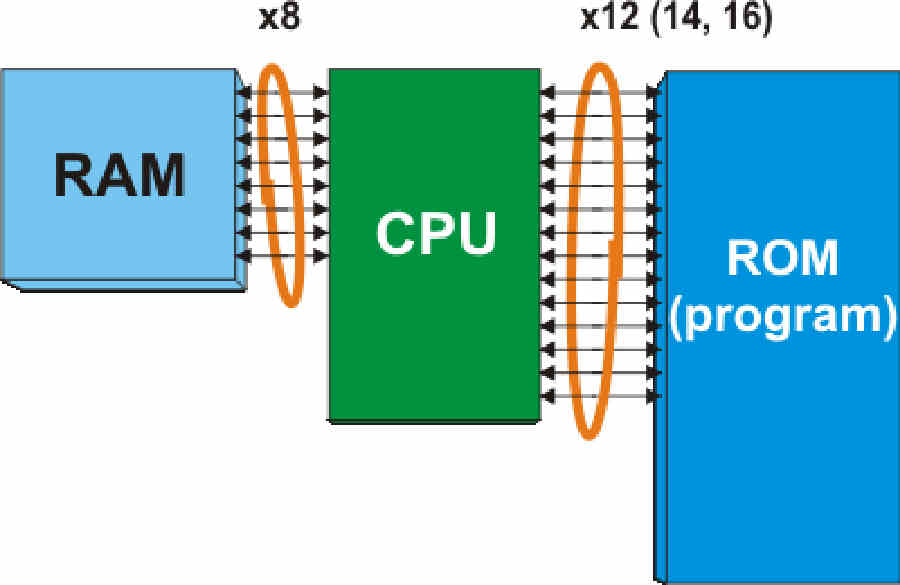
"HARVARD ARCHITECTURE"

"PIC microcontrollers which implement the Harvard architecture have two different
data buses. One is 8 bits wide and connects the CPU to RAM. The other consists of 12,
14, 16 or 24 lines and connects the CPU to ROM. Accordingly, the CPU can read an
instruction and access data memory at the same time. Since all RAM memory registers
are 8 bits wide, all data being exchanged is of the same width. During the writing
process, only 8-bit data is included. In other words, all you can change from within
the program and all you can deal with is 8 bits wide. All the programs written for
these microcontrollers will be stored in the microcontroller internal ROM after being
compiled to machine code. However, ROM memory locations are not 8, but 12, 14,  16,
or 24  bits wide. The rest of bits 4, 6 or 8, respectively, represents the
instruction alone specifying for the CPU what to do with the 8-bit data."

Paul Lamar


--
The Rotary Engine News Letter. Powered by Linux.
ACRE NL web site. http://www.rotaryeng.net
You Tube key word PaulLamar2
Copyright 1998-2012 All world wide rights reserved.