Paul,

    I had sort of an odd thought, and I'm not familiar enough with the
    the 13b to reason it out.  With a p-port engine, would it be
    possible to flip the rotor housings backwards and have the engine
    run in the opposite direction?

    Josh

    We have discussed this in the past and that is the first
 suggestion   that might work. The tension bolt pattern would not
 match up but if   you are building your own end housings that would
 not matter.

    Paul Lamar

  If you build your own end housings they could be designed so they
 are both including the bell housing pattern. That way they could be
 just turned around. For twins with reverse props, one engine turned
 around and a change to the PSRU if it has an internal oil pump. This
 way a dual supply of spare engines is eliminated.

  Dale Davies

 Don't forget about all the accessories such as the starter and the water
 pump.  They would not be happy running backwards.

  Mark LaPierre


 This is simpler than you are looking at. If you are building your own Al end
 housings, make the front one with the bell housing on it. If you build the
 e-shaft, make both ends like the Mazda rear with the taper. Then you can put
 an adapter like the flex plate or flywheel on. You put the ring gear and
 starter in the same place you always did. Just turn the whole assembly around.
 The drive is then reversed. The coolant pump would have to be mounted off the
 side, but should be fairly simple while doing CAD for the housings. Starter
 turns normal direction. Alternators may need to be turned around and mounted
 on the other side of the belts with a drive bolted to the ring gear hub. Same
 with the CAS on the e-shaft. With p-port you do not have ports in the end
 housings, so that simplifies that part. Makes room to mount the other needed
 accessories.

 Dale Davies

Paul--saw the post discussing possibility of counter-rotation.

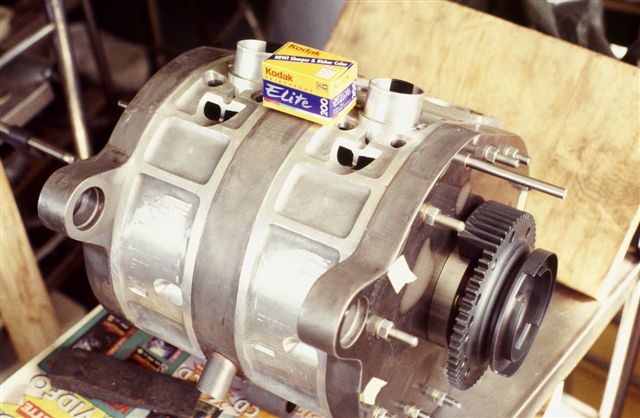
Our second-generation Superlight shown from 1991 shown here did just that.  You and
some of the folks know about this engine but here it is for those that are not aware
of it.

A pain in the ass to do and very expensive.

It incorporated our cast aluminum end housings. Following extensive tests on our
dyno, was flight tested in the first RV-3.

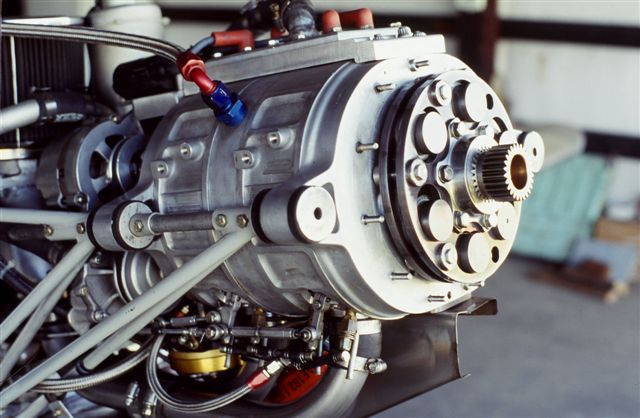
The front view shown installed in the airplane is with the planetary reduction gear
removed for inspection.  Shows  the pendulous dampers and drive gear.  Dry sump engine.

The early version very light @167 pounds with accessories.

The counter-rotation worked sweet.

We had reduced the mass of the engine to an extensive degree, with everything
packaged as close as possible to the centerline.  Counter-rotation helped
significantly reduce vibration of power pulses.  Used standard rotation prop.
Pendulous dampers took care of reduction gear.

But with this lightness and packaging comes a very high cost.

Photos show mock up in early stage and installed in RV-3.

In 1995 we focused on the design of a limited production engine design that used
Mazda iron side housings (thus nickname Iron Eagle) and some of the systems we
developed with the SuperLight.

 Both those engines shown together in photo when we took the SuperLight out of the
RV-3 to install the Mazda conversion engine.

Steve Beckham
--
The Rotary Engine News Letter. Powered by Linux.
ACRE NL web site. http://www.rotaryeng.net
You Tube key word PaulLamar2
Copyright 1998-2012 All world wide rights reserved.