We'll I finally got some time off to check out my airplane
after the
round trip from Everett to Medford. The heat cooked my left brake
line, and I suspected the muffler had too much back pressure, so I
resolved to investigate. Here's what I found when I removed my
Hushpower from the airplane. There is way too much heat coming
off my
muffler- the powder coating on my engine mount is cooked near the
exhaust pipes, even though I coverd them with fiberfrax and
placed a
SS heat sheild to cover the tubes from view of the exhaust. The
muffler was making like a baby rattle so I cut it open and this
stuff
came out of the inlet side. I'll send more pictures of the innards.

What I have is an RV-4 with the radiators and oil cooler hung
underneath the plane in a scoop that is reminiscent of a P-51.
I had
the muffler submerged under the fuselage. I"m thinking that it
would
be better to have the exhaust pipes exit the side of the cowl, in a
reverse scoop that would vent a huge amount of heat from the
cowl. The
muffler would be a straight 6 foot muffler like the one Paul
outlined
about a week ago. It would be mounted along the side of the
fuselage.
I hate to ruin the clean lines of an RV-4, but nothing would
ruin it
more than having a mechanical failure due to excessive exhaust heat
bringing the plane down. My biggest worry about this rotary
conversion
is excessive exhaust heat and how to manage it effectively.

Here is the muffler cut open. The red chunks are what is left
of the
melted insulation material between the perforated inner case and
outer. The outer case showed signs of bulging. The perforated inner
case was split on the seam closest to the camera. The inner cone
material which is also perforated was mostly gone, but big
chunks were
still left inside the muffler and undoubtedly were causing some
obstruction.

Here's the split in the inner perforated case. Not real confidence
inspiring.


Crap that I shook out of my baby rattle/Hushpower muffler.


Brian Trubee

That will work out OK but I would put it on the bottom like
Mike did.
I think you could get the rad under the engine.

Either that or use a narrower rad and put it next to the rad
under the
fuse.

Paul Lamar


If you ever replaced mufflers on a 2nd or 3 gen RX7 you would know
that Mazda built heavy, massive mufflers. I have a couple
around here.
Wonder what the inside design is like? Maybe I should cut one open.
Marc Wiese

That would be interesting. Measure the sheet metal thickness.

Paul Lamar


maybe something like this coating both inside and outside of
the exhaust
system would be useful to reduce heat.
http://www.jet-hot.com/__coatings/jet-hot-extreme-2500/
<http://www.jet-hot.com/coatings/jet-hot-extreme-2500/>

chris smale

Paul and Brian,
It is great watching your "Big Pictures Minds" working together.
Listening to ideas on turbo compounding, peripheral ports, etc.
 From my perspective of working on GE, Allison/Rolls Royce, and P&W
turbines for 35 years here are a few ideas to add to the mix.
I am suggesting using a 8" by 12" muffler called a turbo.
Ideally for power to weight a turbine engine would be best for the
hobbyist.
The hardest part would be making the gear reduction, fuel control,
governor and burner can.
A turbo actually turns a normal engine (recip or rotary) into a turbine
engine (An old perspective from Hugh MacInnes).
We then have a compressor and turbine section with the exiting engine
becoming the gear reduction, burner can, Fuel Control and Governor.
..... *and with your peripheral port it actually becomes a power
recovery compound turbo by blowing directly on the rotor!*
The exhaust is quieted by removing energy and heat.
The real problem is controlling heat. We would need to use surplus
compressed air to cool the exhaust. One place air could be injected at
the exhaust sleeve.
We would use a balanced system that could operate 'theoretically" with
no wastegate like the original GM Corvair. (using a extra large exhaust
housing AR of about 1.34 or larger).
Your thoughts,
Barry

The Rotary Engine News Letter. Powered by Linux.
ACRE NL web site. http://www.rotaryeng.net <http://www.rotaryeng.net/>
You Tube key word PaulLamar2
Copyright 1998-2012 All world wide rights reserved.


Barry,

Before we go too much further, we need a PSRU that can handle 500+hp.
We've already had flywheels [flex plate] disintegrate and my input
shaft broke the
lock pin. I would consider installing a turbo, but in my opinion, the
psru is the weakest link.

Mark
P-port 20b

Mark,
Have you guys done any vibration analysis on the gearbox and engine?
Your 20B would be an easy 500hp but a 13B would be just a "25 lb
muffler" adding a 100 hp.

Barry Boardes

My feeling it would be a waste of time as it depends some what on the
backlash and that is a function of wear. Vibration is not the probelm if
you idle it above 2000  RPM. The probem was the stock flex plate and the
joint between the input shaft and the sun gear. Fixed by two pins.

Paul Lamar


Paul,

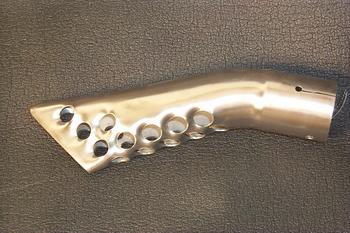
I was at a friend's hangar yesterday and spotted these on his IO-360 powered
RV-8A. He is a senior aeronautical engineer working for P & W on engines. He put
them on his bird a few years back to modulate fuselage bottom vibration when
using a straight exhaust and to knock down the exhaust noise. I asked how
effective they were with the noise. He said they really stopped the vibration
and reduced his exhaust noise significantly. I asked if he noticed any reduction
in power and he said yes, but not so significant as to adversely affect climb
capability.

They are easily checked during each pre-flight, should be far enough away from
initial rotary pulses to survive the hammering, can be dismounted quickly and
are relatively cheap. Wicks Aircraft Supply sells them online:

Perforated Exhaust 'Piccolo' Tubes

Bent Tube End - $47.59
Item # BEM175, Perforated Exhaust Muffler
http://tinyurl.com/d6hpvys


Straight Tube End - $37.45
Item # EXM175, Perforated Exhaust Muffler
http://tinyurl.com/d39qck6


Wicks' description:

"Mounting these "piccolo" tubes on the ends of aircraft exhaust pipes will
substantially lower exhaust noise. Tests on an RV-6 showed a 3 db drop in noise
power, or 3 times less than previously measured. Each can be quickly and easily
installed by slipping them over the end of standard 1-3/4" exhaust pipes and
tightening down the attached screw clamp. Available in 2 models: straight and
bent, the choice dependant on how the exhaust exits the cowl. Made of stainless
steel. Installed length 6", weight 6-3/4 oz."


Regards,
Jack Hilditch


--
The Rotary Engine News Letter. Powered by Linux.
ACRE NL web site. http://www.rotaryeng.net
You Tube key word PaulLamar2
Copyright 1998-2012 All world wide rights reserved.