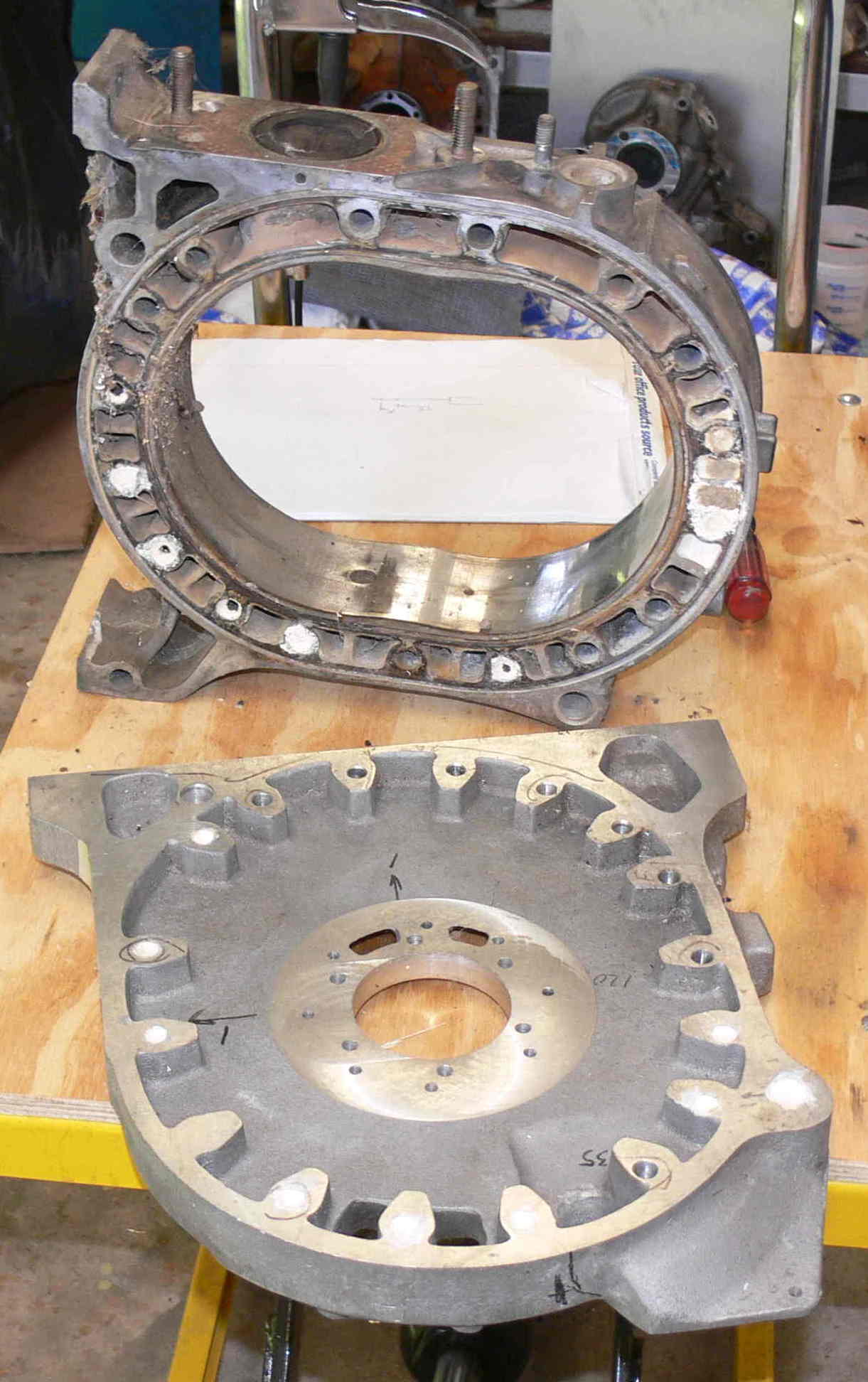
When Paul was visiting, I was in the process of attacking  two issues on
the single
rotor engine.

The first issue one was  mixture setting on the Rotec TB40 . The problem is
with the
reference  pressure to the pressure regulator. My mixture was to rich at
WOT to  the
point where the engine would just barely run. I emailed the guy at  Rotec
asking what
to do adjust the pressure regulator to my needs. The  answer was that I
should find a
place in the intake system for the  reference pressure pick up where the
mixture turns
out to be right.
To  make a long story short, I ended up calculating the pressure situation
in the  TB40
and determined that the reference pressure was way too high. The  second
position I
tested resulted in a mixture setting I can live with. In  addition, I now
have also an
18” tuned intake tube.

The second issue  is a persistent oil spill through the crank case breather
tube. I
have  observed this on the test stand engine as well as on the engine in
the  airplane.
I just could not believe it was rotor seal blow by, because the  two
engines are not
totally identical as far a rotor sealing is  concerned.
One possible cause I found is two holes in the 12A housings  exhaust port
are more or
less open into the oil pan. I never payed any  attention to those.
Today I did a test on the test stand measuring crank  case pressure under
different
conditions. At 5500 RPM the pressure in the  crank case is 1.5psi, this is
with the
crank case breather open.
The  next test with the crank case breather closed resulted in the same
pressure
reading. The pressure I saw can not result from blow-by because it  should
have been
higher with the crank case breather closed.
The next  step is engine tear down a see what I can find. Hopefully closing
off  the
two holes will solve the problem.


Richard  Sohn
N2071U

http://www.fairpoint.net/~res12/home.html


OK, I've got this one. Since I only did 12A stuff...............
The stock breather tube stuck into the oil filler pipe is too small for
even a lawn mower
motor. The minimum is a piece of 1/2" electrical conduit (actually 5/8").
The bigger the better. The crankcase gas blow by is too fast through the
soda  straw sized stock breather pipe and thus is carries away much oil to the
catch  tank or, intake system if so routed.
The higher on the filler pipe the better. The larger diameter reduces the
gas velocity (Bernoulli). and very little oil escapes.

Then when rebuilding the engine. Adjust side seal clearance to zero inches.
 This for NA engines. For turbo engines make it .002" If you can push the
side seals and corner seal down onto the springs and they pop back up, that
is  enough clearance.
The clearance begins to increase with engine hours. The seals are iron and
the rotors are iron, so it all expands at about the same rate. Works great,
very  little blowby.

The two holes in the floor of the exhaust port were fed by two hollow
shoulder bolts
from a void area that included a passage in the center iron (rectangular
hole below the intake manifold) that was pressurized by an air pump. If the
iron(s) and rotor housings were the same year as the center iron this would
work. But the hole is there but not connected long after the air pump went
away.  The object was to inject air into the exhaust stream to burn off
escaping fuel.  Used in conjunction with the big water melon looking cast iron
reactor. Since  the exhaust flow would produce a very low pressure in this
area, I would expect  oil loss to show up as some exhaust smoke unless the
muffler is very  restrictive. Racing beat used to sell the same bolts in solid
aluminum with  extra length.
So, when porting was complete, those holes were invisible and sealed. I
just left the stock bolts in place until porting was complete, and then TIGed
the bolt ends solid.

Lynn E. Hanover

Richard made his own 2 piece aluminum/iron-wear-surface end housings.

Paul Lamar

--
The Rotary Engine News Letter. Powered by Linux.
ACRE NL web site. http://www.rotaryeng.net
You Tube key word PaulLamar2
Copyright 1998-2012 All world wide rights reserved.