OK guys, its bad I admit it. We were banking on a change that didn't
happen. I was told years ago that there are 2 kinds of people- radiators
and drains. Radiators give off, drains suck it up. It seems that the number
of drains are outnumbering the radiators.
The good news is that with so many drains we aren't likely to drown anytime
soon. The bad news is that us radiators seem to be on our own.
Most of you know that I used to own and run a big company with way too
close to 100 employees, and I did so starting at 19. Many of us here are
wired just that way. So, now comes the beginning of a solution to our
problems- sort of. We can all agree that Government will not be helping us
be able to fly our planes. Gas is going up, fees are likely going up,
places that I have landed try to send me tax bills, etc. (no kidding). So
its up to us to make it happen.
I was on a board this morning before church reading several derogatory
statements about using alternative engines in our planes. It seems that
people just dont understand what we are trying to do, and are not willing
to do any work ourselves. This mentality parallels the issues with Linux.
While I use Linux for almost all of my work, many people are not willing to
try to learn it or see why its better than Windows. So, as far as our
planes goes, here is my plan:
With the help of Paul and everyone else on this board, I want to try to
develop first a working installation that can be mirrored to other planes
that are being built. When someone asks for a FWF we might be able to say
"no, but we can show you exactly how others have done it and what you will
need".
To do this I think we will need a few things- like an adapter plate of
sorts that will allow the Rotary to replace the Lycoming with the
dyna-focal mount. Those things are everywhere, and used on many smaller
planes. This gives the builder the option of swapping out the engine easily
to or from the Lycoming if he decides to.
Next, a standard EFI system with mechanical backup. I know from experience
that the stock Mazda coils will fire from the CAS without an EFI at
anything over 800 rpm. So given this, with a mechanical fuel delivery
system we have non-electrical redundancy. I like that. It can be as simple
as a throttle actuated regulator tied to the standard mixture control like
we are used to. If the computer goes out, you have a simple leanable
manuable system. Pilots will not accept our alternative engine without a
backup system.
I have heard that each installation is so different that we all are
reinventing the wheel with each installation- maybe so but not necessary.
Tom's Lancair is close enough to mine that I should be able to use much of
his data to speed up my installation. But without a flight to Texas, its
not readily available to me. Tracy's RV10 20b is functional and simple- but
the installation details are not out there for the world to see. We need to
change this.
I just bought a PSRU with several spare parts. I now have enough materials
and info to possibly have more input into the design of the more simple
PSRU unit.
If we are to get more people flying, we need to reduce the costs of not
only flying but of keeping an airplane in the air. This starts with an
affordable airplane from the outset. Affordable airframe, engine and
avionics. I spoke to a man yesterday at the EAA fly in- he is building an
RV-7. His budget is 30K for airframe, 40K for engine, and 30K or more for
avionics. He estimates that it will take him 5 years to save the money.
What if he could spend 30K on the airframe, 15 on the engine and 5 on the
electronics? Half price I am thinking.
I will order a new tablet in the next day or so- it is a cheap unit but it
has an Intel processor. There is a version of Linux out for ARM processors,
but I am hoping the current lightweight versions that are already ported to
an Intel processor will work with the Intel based tablet. The tablet will
run windows7, which means it isn't an ARM version. Lets hope- this will
allow our linux programs to work natively on the tablet.
Also, I am still working on the Arduino board that is ported to Android-
the plan is this: For a few hundred dollars we can have a good android
tablet (or 2) on our panels. These tablets will display engine info etc.
from the EFI board, and allow us to tune our engines from the tablet touch
screen too. Also, we can run apps such as the Garmin pilot on both units
giving a backup. There are gyroscopic boards and chips out now that will
allow us to interface the G reading boards like are in our phones to mag
chips for direction and gyro chips to confirm our spatial position. The end
results will be affordable, redundant electronic guidance. And in my case,
behind the tablets will be the usual compliment of steam gauges including 2
VORs. I really like redundancy.
I have said for a long, long time that if you spend all your life chasing a
dollar, you wont ever catch it. And if you wait for someone else to help
you, you will be waiting a long time. Its up to us to make our own destiny.
Nowadays, I give my time and talents to local organizations that need it, I
help who I can and all without money. We have enough to live on, and I can
devote time and talent to other things. I am willing to be the front so to
speak and try to see what I can do but I will need your help to make it
happen.
What do you guys think? Can we all work together to make flying cheaper for
everybody? Can we make flying in the US Open Source?
Kevin Alderman
Kevin, When I was designing my rotor housings I REALLY wanted to have a
Lycoming bolt pattern available on the accessory end housing. The problem
is that the Lycoming pattern whether it is conical or dynafocal (1,two, or
type three) is smaller than the shape of the front side housing. Trying to
add threaded bosses to the side housing tends to interfere with things iike
the location of tension bolts and the hollow dowel pins. Even if the
bolt pattern could be accommodated, the distance back from the prop flange
is different on the rotary and the opposed piston
engines which would require a different cowling and a means of
controlling the Cg of the firewall forward weight.
The mounting of the engine on the back housing requires the motor
core to counteract prop torque with the tension bolts which it does not do
in the automotive application. This is why I support the use of Jeff's
mounting plate which is substituted for the one supplied with the redrive
from Tracy Crook. This plate picks up the torque load at the shortest load
path and provides the mounting points close to the Cg of the drive train.
Regarding the PSRU, it doesn't get much simpler than the Real World
Solutions product manufactured by Tracy Crook. Some people question the
weight of the housing casting and believe it is too robust, however it has
a well proven flight record and seems proven to handle bending,
gyroscopic, and thrust loads both in a tractor or pusher installation,
While finite element analysis might tutn up some weight reduction potential
of possibly 3 pounds it hardly seems worth the risk of guessing what
combined loads to use in the simulation. The connection of the splined
input shaft of the PSRU to the engine E-shaft has shown some maintenance
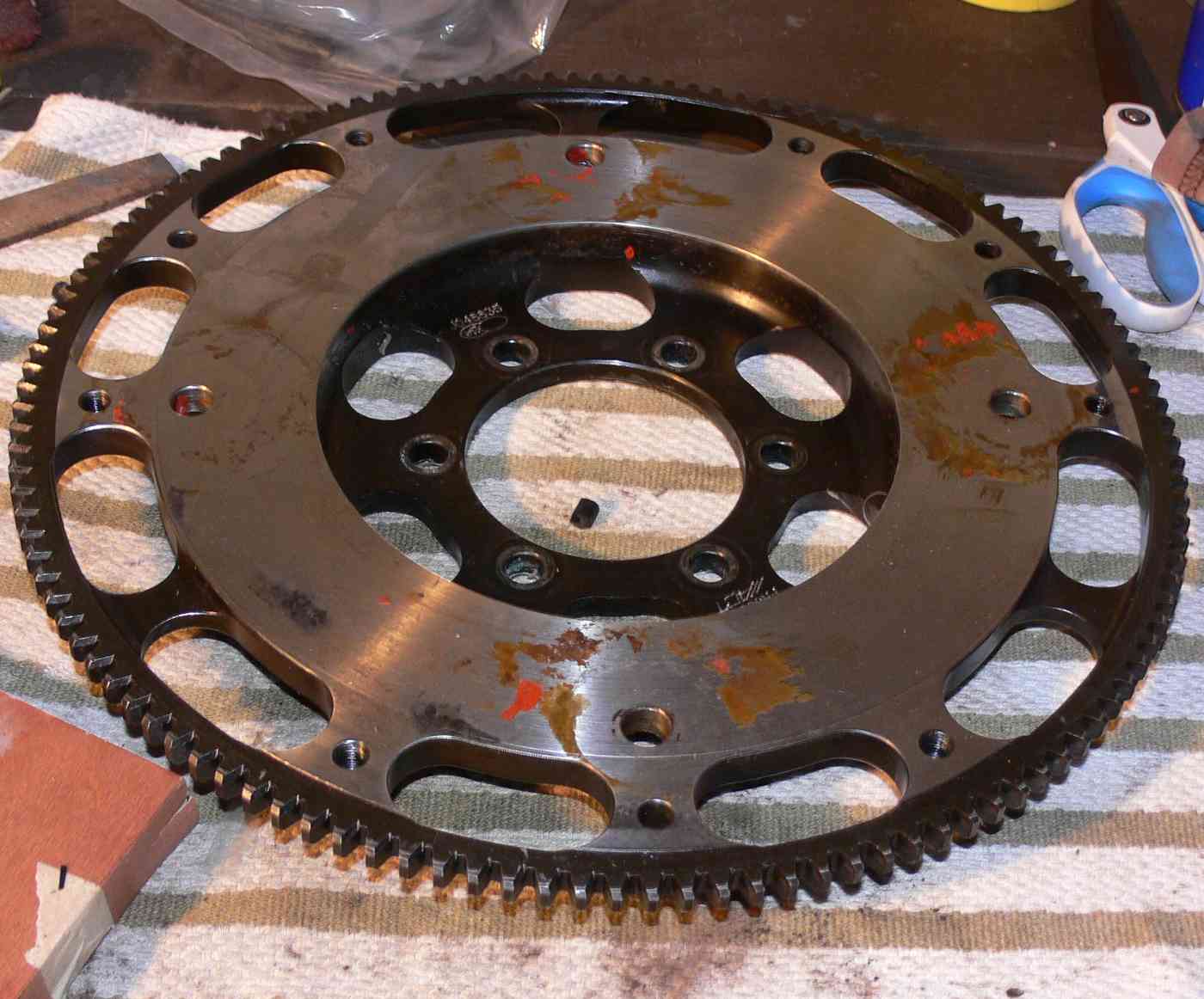
issues with the Mazda flex plate having fatigue cracking. Dave Leonard has
pioneered the use of a billet aluminum racing flywheel as a replacement for
the flex plate and by all accounts is happy with the change
As far as a redundant fuel system goes, I think an adjustable needle
valve on the fuel pump line with a solenoid blocking valve downstream
feeding into the intake plenum through an agricultural or oil furnace spray
nozzle would the fan doing something usefull provided either of the
electric fuel pumps is operational.
george grimes
This is the way Mistral did it. Lycoming mounts are 10 times as expensive
as Barry mounts.
http://www.rotaryeng.net/motor.html
I have lots of stuff on Tracy's redrive including most dimension.
Ask away and start a separate thread.
http://www.rotaryeng.net/psrus.html
Paul Lamar
Kevin,
There are a lot of us who are far from actually needing the FWF, but have bought into
Jeff's motor palte and Tracey's PSRU, because they were available at the right time,
bid the job and the price was right. Same for Paul's throttle plate, and intake
components, and the p-ported housings, as well as the coils from Paul's proposed system.
I'm hoping that a "standardized" EFI/Ignition system becomes a reality by the time I
start putting the FWF together. But right now, I'm still building wings.
I have been able to contribute test equipment to Paul, but with limited time and
money have to stay focused on advancing the airframe.
By the way I missed the details of Daves final solution to the flex plate cracking.
What model of billet fly wheel, and from whom was it purchased?
C. Smith
------------------------------------------------------------
07/18-2011
Ok the "ACT" "Streetlite" 13.8 lb flywheel was just delivered and I am in
process of taking your measurements to see where we
stand....
This flywheel is a thing of beauty (to a RotorHead) and
my RD1C drive plate will bolt to it with no problem (through drill and
spotface the rear of the flywheel because it has a slight taper in that
area).
I just have to verify just where the RD1C drive splines
will be positioned (fore and aft) on the input shaft compared to the RX7
flexplate.
The clutch plate friction area is slightly raised
(about 0.065) above the clutch mount area and I would probably take it down
tto the clutch level (probably not necessary but would reduce weight
slightly.
I have a 93-95 Turbo starter on the way (should take
care of starter mesh problem)..If you are interested I can guide
you to another 93-95 starter (used $49.00 with/shipping) if it is still for
sale.
I suspect it may be the diameter of the NA 13B flywheels
and may use the 86-91 NA manual trans starterYou need to talk to
the manufacturer..........They are in Lancaster, CalifThe 9.8 lb
version is a little more expensive due to more extensive machine work to
reduce weight.
See the link below
The link to
THMotorsports has the best price I have found on the 9.8 lb
flywheel......
The photo on their page is not the Rotary 9.8 lb
version..........
http://www2.advancedclutch.com/products/xact_flywheels.aspx
http://thmotorsports.com/act/act_flywheel_prolite/600140/i-47718.aspx