I recently ran across this article in EAA experimenter on how to convert
your rad to a three pass configuration. See the attached PDF.
BTW the authors both died in a Chevy V8 powered aircraft crash.
One of many.
Let me define an abbreviations. WIT = "which in theory" :)
What this does is reduce the cross sectional area of the water flow path
which in theory increasing the water flow rate. WIT improves the
heat transfer from the coolant to the metal of the heat ex-changer.
The problem is it raises the back pressure on the centrifugal water pump WIT
reduces the gallons per hour flow rate :)
The area of the flow path is directly proportional to the number of tubes
the coolant must flow through.
http://www.engineersedge.com/fluid_flow/operational_char_centrifugal_pump.htm
"Normally, a centrifugal pump produces a relatively low pressure increase in
the fluid. This pressure increase can be anywhere from several dozen to
several hundred psid across a centrifugal pump with a single stage impeller.
The term PSID (Pounds Force Per Square Inch Differential) is equivalent to
DP. In this context, it is the pressure difference between the suction and
discharge of a pump. PSID can also be used to describe a pressure drop
across a system component (strainers, filters, heat exchangers, valves,
demineralizers, etc.). When a centrifugal pump is operating at a constant
speed, an increase in the system back pressure on the flowing stream causes
a reduction in the magnitude of volumetric flow rate that the centrifugal
pump can maintain."
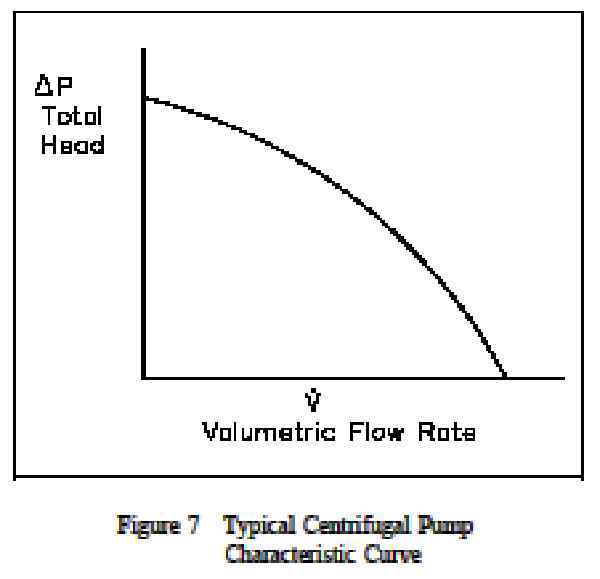
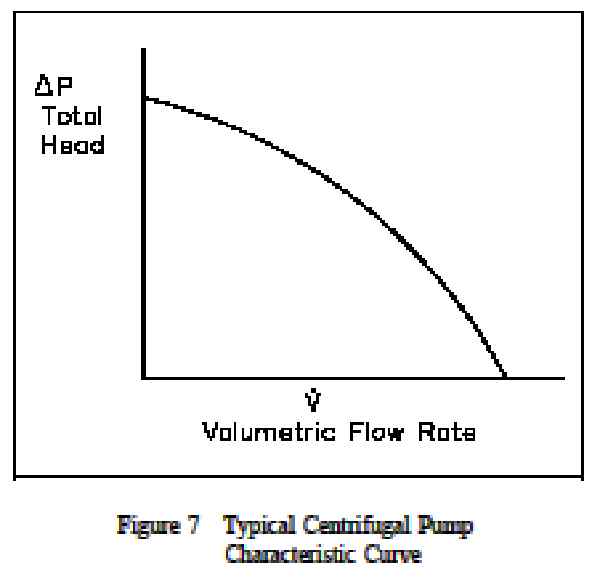
"Analysis of the relationship between the volumetric flow rate ( ) that a
centrifugal ˙V pump can maintain and the pressure differential across the
pump (DPpump) is based on various physical characteristics of the pump and
the system fluid. Variables evaluated by design engineers to determine this
relationship include the pump efficiency, the power supplied to the pump,
the rotational speed, the diameter of the impeller and blading, the fluid
density, and the fluid viscosity. The result of this complicated analysis
for a typical centrifugal pump operating at one particular speed is
illustrated by the graph below."
operat16.jpg
"Pump head, on the vertical axis, is the difference between system back
pressure and the inlet pressure of the pump (DPpump). Volumetric flow rate
(V ), on the horizontal axis, is the rate at which fluid is flowing through
the pump. The graph assumes one particular speed (N) for the pump impeller."
It is, for all practical reasons, a straight line reduction.
The bottom line is this doesn't really work. At best it is a wash.
I recommend two pass rads merely to get the in and out necks on the
same end of the rad.
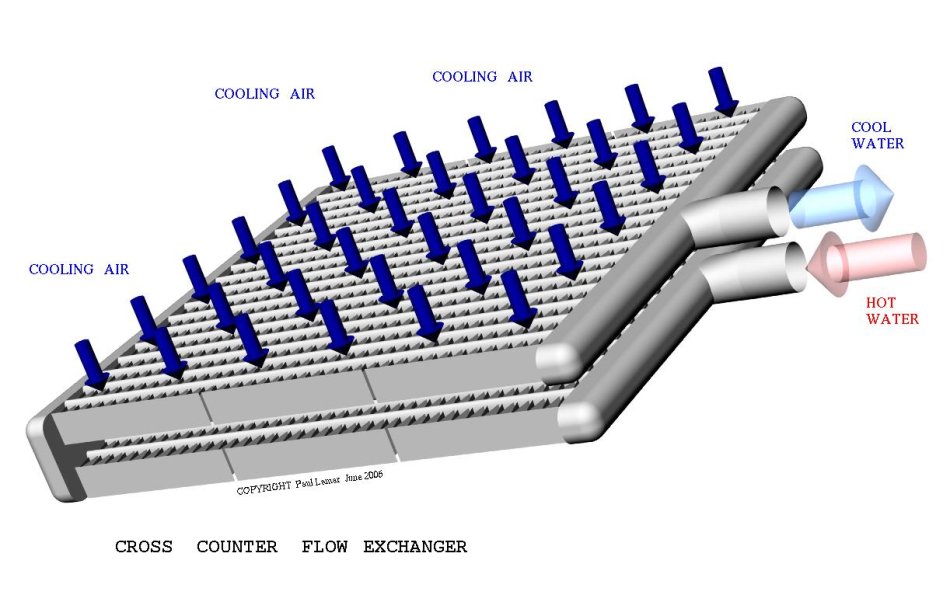
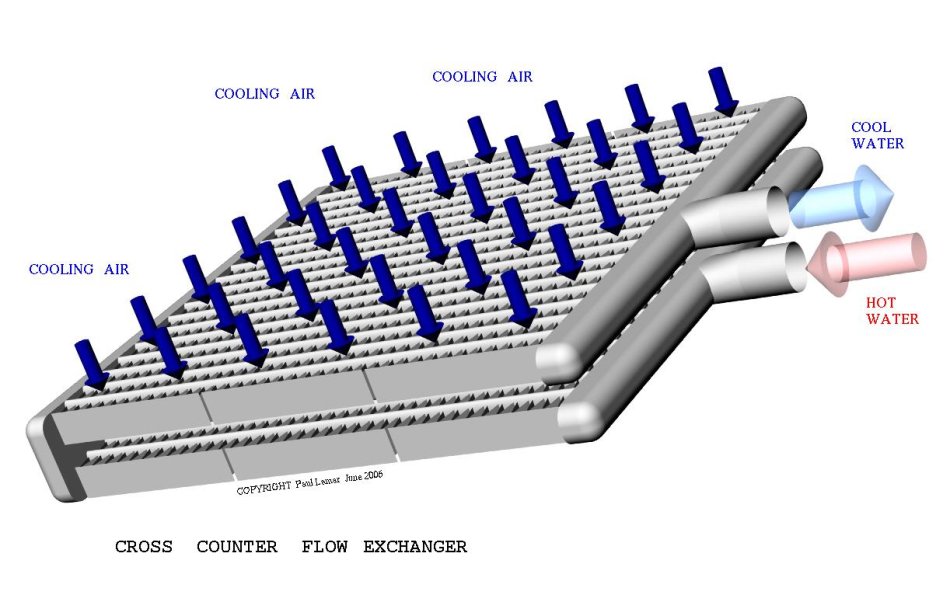
It is much better to build a cross counter flow rad as mentioned in
my book How to Cool Your Wankel.
Still on sale for $35 cash(free U.S. shipping)if I get your order this month.
Paul Lamar
--
The Rotary Engine News Letter. Powered by Linux.
ACRE NL web site.
http://www.rotaryeng.net
You Tube key word PaulLamar2
Copyright 1998-2012 All world wide rights reserved.