I had to go to the SF valley to check out a laser jet tube cutter
and MM welder and stopped off at a Pick a Part junkyard.
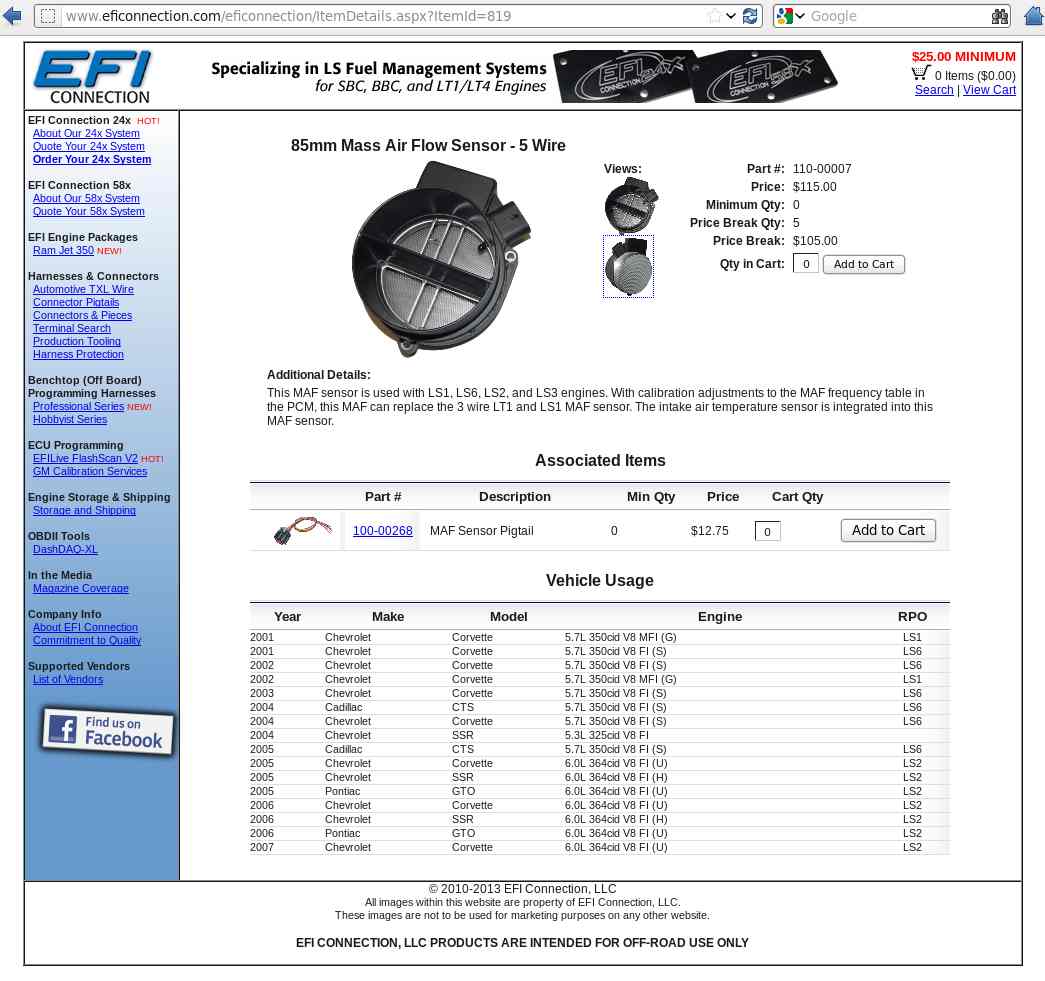
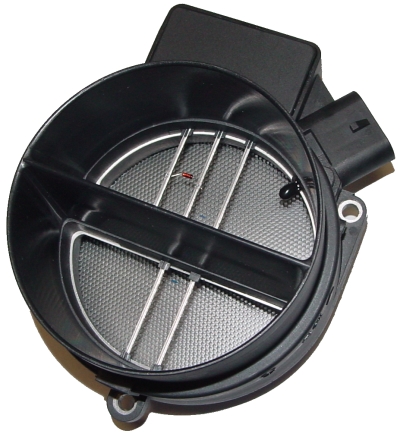
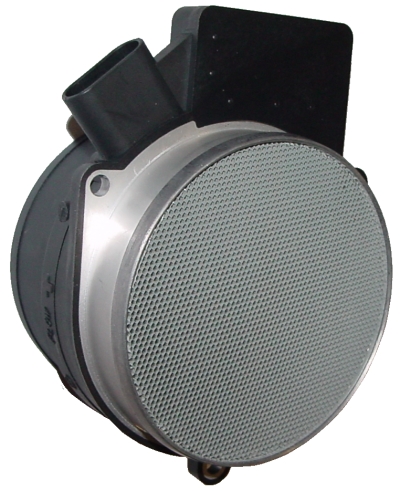
I found this GM LS1 mass airflow sensor for $45.
Retails for $399.95.
Took me five minutes to get it out of the wrecked Isusu truck.
All it took was 2 screw drivers a phillips and a straight :)
"Mass air induction systems measure airflow with an electronic "hot-wire"
type mass airflow sensor. The sensing element in the air intake
provides an
output voltage reading that is directly proportional to the amount of air
that is entering the engine. This airflow measurement reduces the
calculations required to control fuel and ignition spark advance. Mass
airflow sensors can react quickly and accurately to sudden changes in
airflow."
Usually it is 0 to 5 volts. I will use this with the Arduino program
and a slide throttle on the RV4.
They are easy to locate and mount as you put them upstream from
the slide throttle in 2.75 inch ID hose.
Paul Lamar
Hi Paul, The early types had a circuit that at switch off the wire
was heated to burn off any gunge sticking to the wire and cleaned up the
wire for next time engine was started. Hard to see the $400 value in
those things.
John Burey.
You can buy new ones made from plastic here for $100.
http://secure.ultracart.com/catalog/PSI/ACCESSORIES/MAF-Sensors/ACC-1004.html
Connectors called pig tails here:
http://secure.ultracart.com/catalog/PSI/PIGTAIL-EXTENSIONS/LS-Vortec-Pigtails/PIG-1019.html
While searching for a schematic for the LS1 MAF I ran across this explanation
of the advantages of putting the injectors at the upstream end of the
p-port runner tubes.
http://www.hotrod.com/techarticles/engine/hrdp_9812_10_common_efi_mistakes/viewall.html
"Carbureted and throttle-body fuel systems are considered wet flow. Port EFI
designs (an individual injector for each cylinder) are referred to as dry
flow. In a wet-flow system, a mixture of air and fuel coarses through the
intake-manifold runners; in port systems, the fuel is administered at the
end of the intake-manifold runner just prior to entry into the cylinder
head. The laws of physics dictate that for every 10 degrees Fahrenheit of
change in the temperature of the charge, there will be a corresponding
effect of 1 percent to the specific output of the engine-raising the charge
air temperature will decrease power; cooling it will have the opposite
effect. Wet-flow manifolds enjoy the advantage of cooler charge air
temperatures created by the vaporization of the fuel. When changing from a
liquid to a gaseous state, this transformation will consume some of the heat
from the intake tract. Dry-flow manifolds do not benefit from the latent
heat of vaporization."
"The results of this phenomenon cause fuel-injected engines to be affected
more by higher ambient temperatures and under hood heat."
"The best-running EFI cars breathe cold air from a ram-air kit."
-----------------------------------------------
Kevin's Arduino EFI code (attached) does not have a mass air flow sensor input.
It works like Tracy's code on intake manifold pressure and air temperature
correction I think. I suspect a mass air flow sensor would simplify
the code some what and most important the look up table.
In any event the 5 wire version of this mass air flow sensor has
a temp sensor for $2 more. A real bargain.
Paul Lamar
The Rotary Engine News Letter. Powered by Linux.
ACRE NL web site.
http://www.rotaryeng.net
You Tube
http://tinyurl.com/amz8apm
Copyright 1998-2013 All world wide rights reserved.