Delete the last program and replace it with
this. Debugged and much improved. The old one won't work
anyway.
I am getting a little practice with 2D arrays in QB64
I have decided to use a 10 by 10 array which is
a little larger than usual for an EFI system.
As I recall Megasquirt uses an 8 by 8.
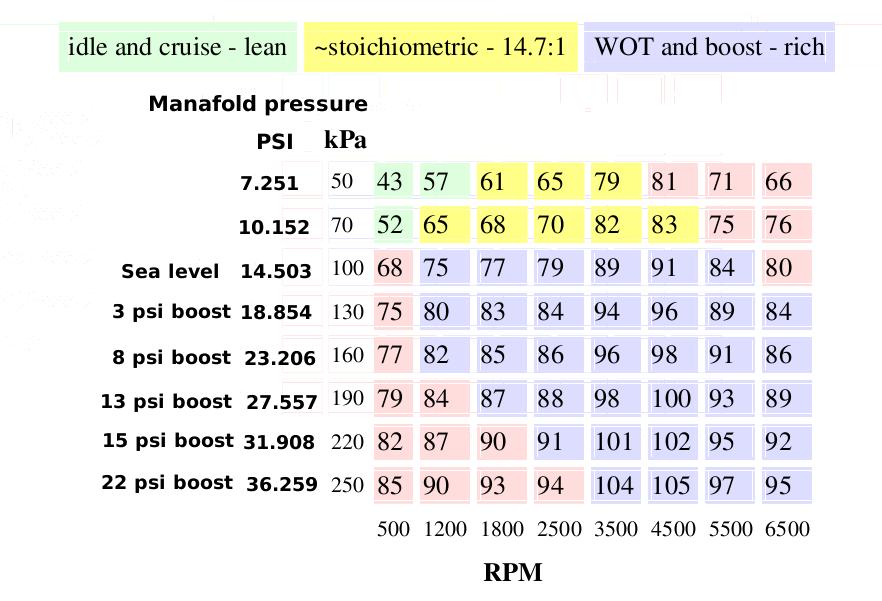
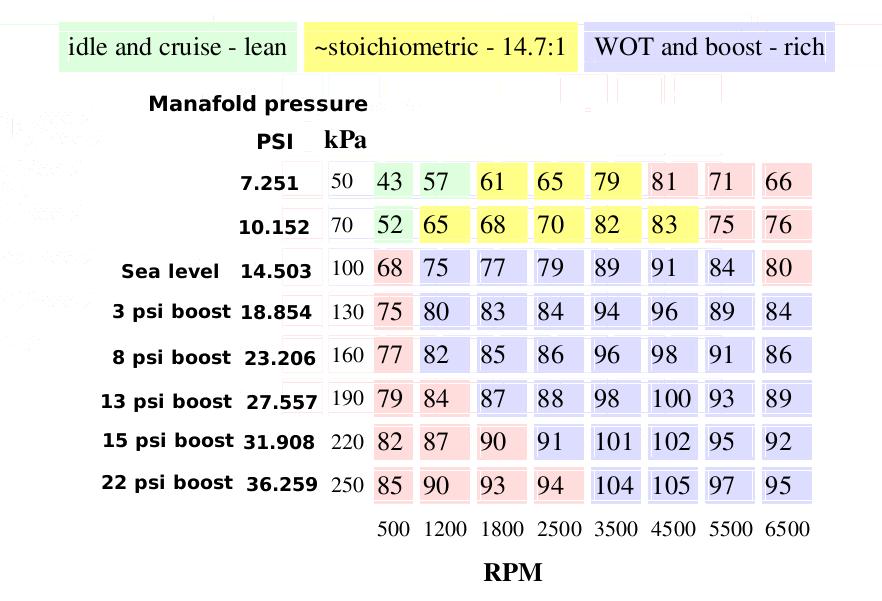
The array is a look up table. The x axis is the RPM
and the Y axis is the mass airflow.
Arrays have the form of A(xcoord,ycoord) in BASIC.
There will be a xcoord entry about every 75 RPM
and about every 0.5 Volts ycoord from the mass air flow
sensor. About 100 entries total It looks like this.
^ x x x x x x x x x x x x
M x x x x x x x x x x x x
A x x x x x x x x x x x x
F x x x x x x x x x x x x
^ x x x x x x x x x x x x
V x x x x x x x x x x x x
O x x x x x x x x x x x x
L x x x x x x x x x x x x
T x x x x x x x x x x x x
S x x x x x x x x x x x x
...... RPM >>>>>
x represents a mixture setting or pulse width for the injectors.
I wrote a program to initialize the array to 30
because it is rather tedious to type all that in by
hand. Simple QB64 program. The array will be adjusted
before I run the engine on it. The tuning procedure
is dump the array to a PC and load it into a spreadsheet
program. Edit as needed and ship it back through the
USB to the EFI computer. The next guy that builds
a EFI computer like this will have a head start.
Eventually we will accumulate a bunch of tables that people
can try when they are starting up for the first time.
CLS
OPEN "mix-tab.bas" FOR OUTPUT AS #1
FOR x = 1 TO 10
FOR y = 1 TO 10
y$ = STR$(y)
x$ = STR$(x)
n1 = 30
num$ = STR$(n1)
PRINT #1, "A(";
PRINT #1, x$;
PRINT #1, ",";
PRINT #1, y$;
PRINT #1, ") =";
PRINT #1, num$
NEXT y
NEXT x
CLOSE 1
END
Small sample of the output. 100 of these total.
A( 1, 1) = 30
A( 1, 2) = 30
A( 1, 3) = 30
A( 1, 4) = 30
A( 1, 5) = 30
A( 1, 6) = 30
A( 1, 7) = 30
A( 1, 8) = 30
A( 1, 9) = 30
A( 1, 10) = 30
A( 2, 1) = 30
A( 2, 2) = 30
A( 2, 3) = 30
A( 2, 4) = 30
This gets loaded into the program in the init area.
To read the array.
Inj-width = A(RPM,MAF)
Super simple. Temperature is compensated
automatically by hot wire mass airflow sensor.
Paul Lamar