The Piaggio Avanti is not a canard. The fore-wing provides lift and enables
the carry-through structure of the main wing to pass aft of the passenger
compartment. The fore-wing does not control pitch; it has a conventional
tail for that. Keep in mind that the Avanit has about as much main wing
area as a Cessna 172.
The Beech Starship is the orphan that is being bought back. It was almost
100 mph slower than the Avanti on vastly more power. Beech mangled the 85%
scale prototype up with a bulldozer in front of Rutan's Mojave hangar;
presumably they were upset with the program.
Canards have the built in weakness that the fore-plane must stall first.
This means that it must be more heavily loaded than the main wing, which
also means that the main wing never operates at it's ideal angle of attack
for lift at slow speeds, which means it must be much larger to achieve
acceptable landing speeds, or land dangerously fast. The Starship
incorporated a huge top surface reflex (ski-jump shape) to help kill the
pitching moment at high speed (read: drag) otherwise the forward canard
would have needed to be enlarged to control pitch at cruise (more drag) As
it was, I think the canard had a row of vortex generators. All of this
extra wing must be dragged along in cruise, which is why, hp per hp, any
given canard design will never be as fast and never land as slow as equally
well designed conventional aircraft.
http://gravityloss.wordpress.com/2009/12/04/starship-vs-avanti/
That being said, there IS a regime where canard aircraft operate more
efficiently (key word), but that tends to be a slower speed, like 1.3 x
stall speed (if I recall correctly). And on a looks basis only, I've always
been enamored by the Q-200.
Back to rotaries...
Chris Cosman
Good work and well put Chris. I learned a lot more about canards.
The Money spent on engineering school was not wasted :)
I am going to have to come up there and visit you guys when
you get a 1 rotor. We should have stopped on the way back from
the SCCA run offs in Elkhart Lake.
Paul Lamar
Thanks Paul. Just a "contact-intelligence" from hanging out with my genius
father over the years. See, homeschooling does work. :)
We may put together a cross country down to Flabob later this year. We'll
call if we do.
Chris Cosman
When you have a father like your father it certainly does.
Paul Lamar
I am deeply involved with canards. The involvement started about the
time Rutan released the Veriviggen(long before the VERI EZE). I can say
that his aircraft will not go into a flat stall or spin If several
conditions are met.
1. CG MUST be in the range that he requires.
2. Building the airframe MUST meet plans specifications.
After all he tested his prototypes at all CG's and attitudes
before releasing the plans.
3. The most common reason for problems with Rutan aircraft is putting a
larger engine than plans specs. moving the CG aft. There have been
several incidents of flat stall for this reason.
Not every one is a good builder and planes have been unsafe because of
poor construction, poor airfoil contour and even the airfoils not being
in the correct position on the fuselage.
4. Like all aircraft compromises were made for the intended use.
Because of this the canard as usually designed is not a slow landing
plane,but it sure goes fast for the horsepower.
chris smale
Any canard aircraft can be put into an unrecoverable stall/flat spin by
suddenly pulling up such that the aircraft gathers sufficient rotational
inertia to carry the rotation past the point where the main wing stalls
even after the canard is long past stall AOA. From that point on the
former pilot is now a passenger on the way to the crash.
Mark LaPierre
There are several approaches to designing a canard. The higher loading
of the canard is the poorest choice. At over the fence landing speeds if
the canard is slowed too much and stalls it will prevent the main wing stall
but not be able to recover enough lift to get the nose back up from a low
attitude.
The main wing has had it's angle of attack reduced by the nose
lowering, and while it doesn't enter a spin it is still producing reduced
lift. This design exhibits a porpoising action near stall AOA. Some other
canard designs mount the canard at a higher angle of attack so that it will
reach it's stall angle before the main wing gets to stall angle and lower
the nose. Still another approach is using a canard airfoil with a stall
angle of attack 3 to 4 degrees less than the main wing. Both of these
alternatives rely on angle of attack of the two wings allowing the main wing
to fly at a higher angle of attack and therefore slower at landing speeds.
A fourth but more difficult approach to implement is a full flying canard
which is adjusted for trim of CG location and a 15% of chord plain flap
acting as a trim tab on the canard. The design goal is to produce a mushing
rather than porpoising action to keep the main wing at a consistent AOA.
george grimes
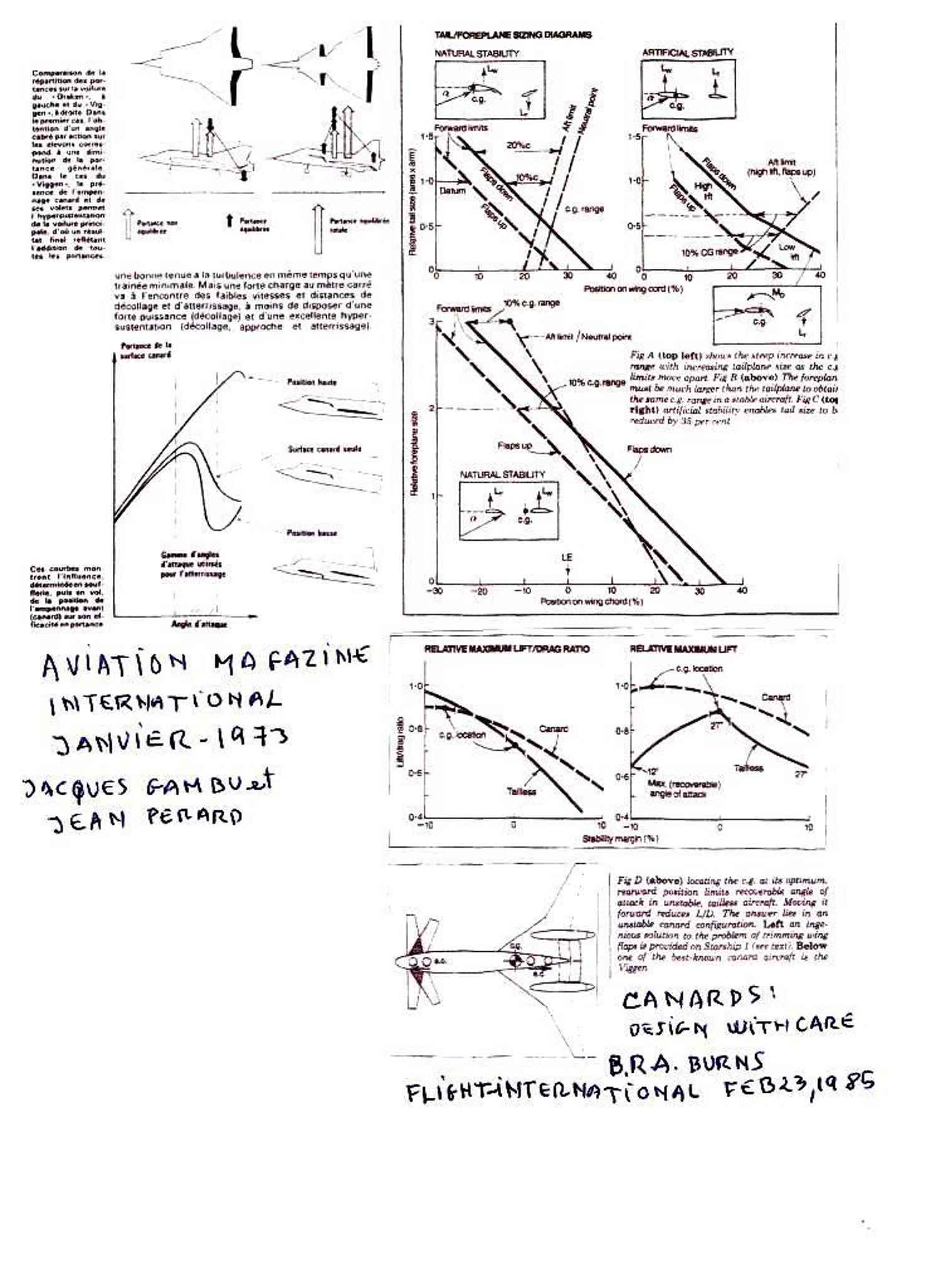
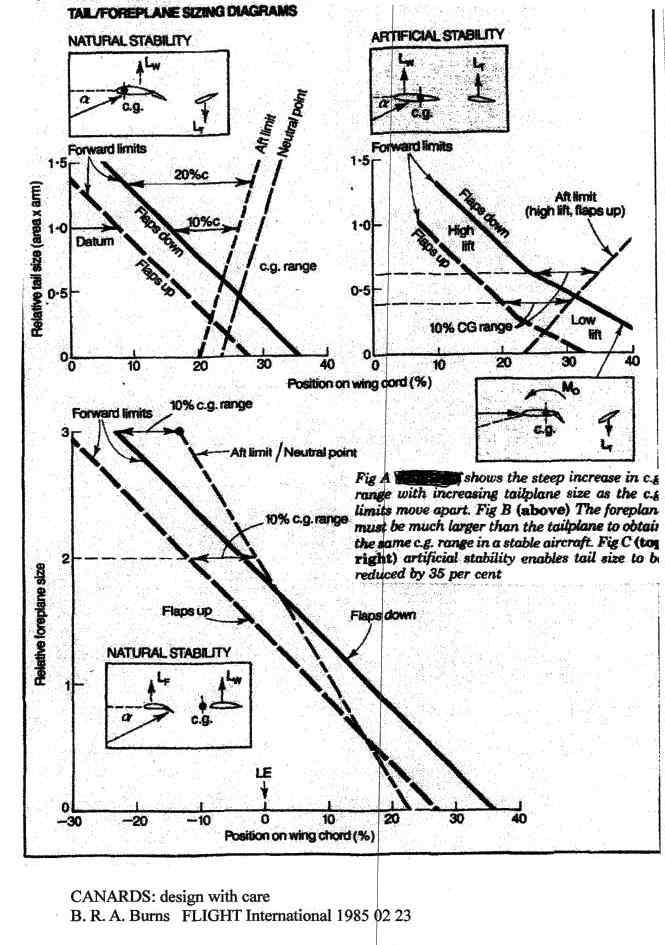
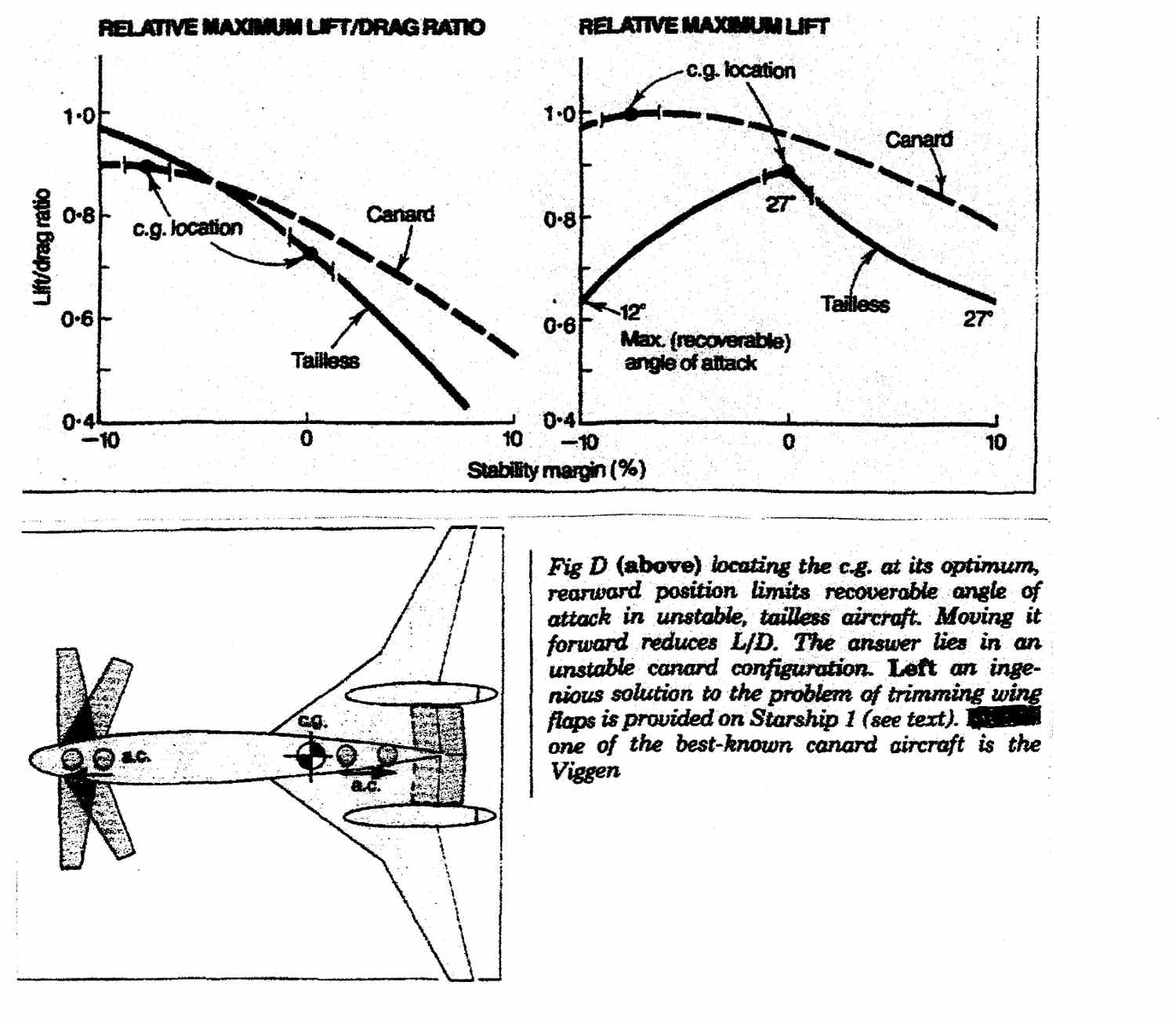
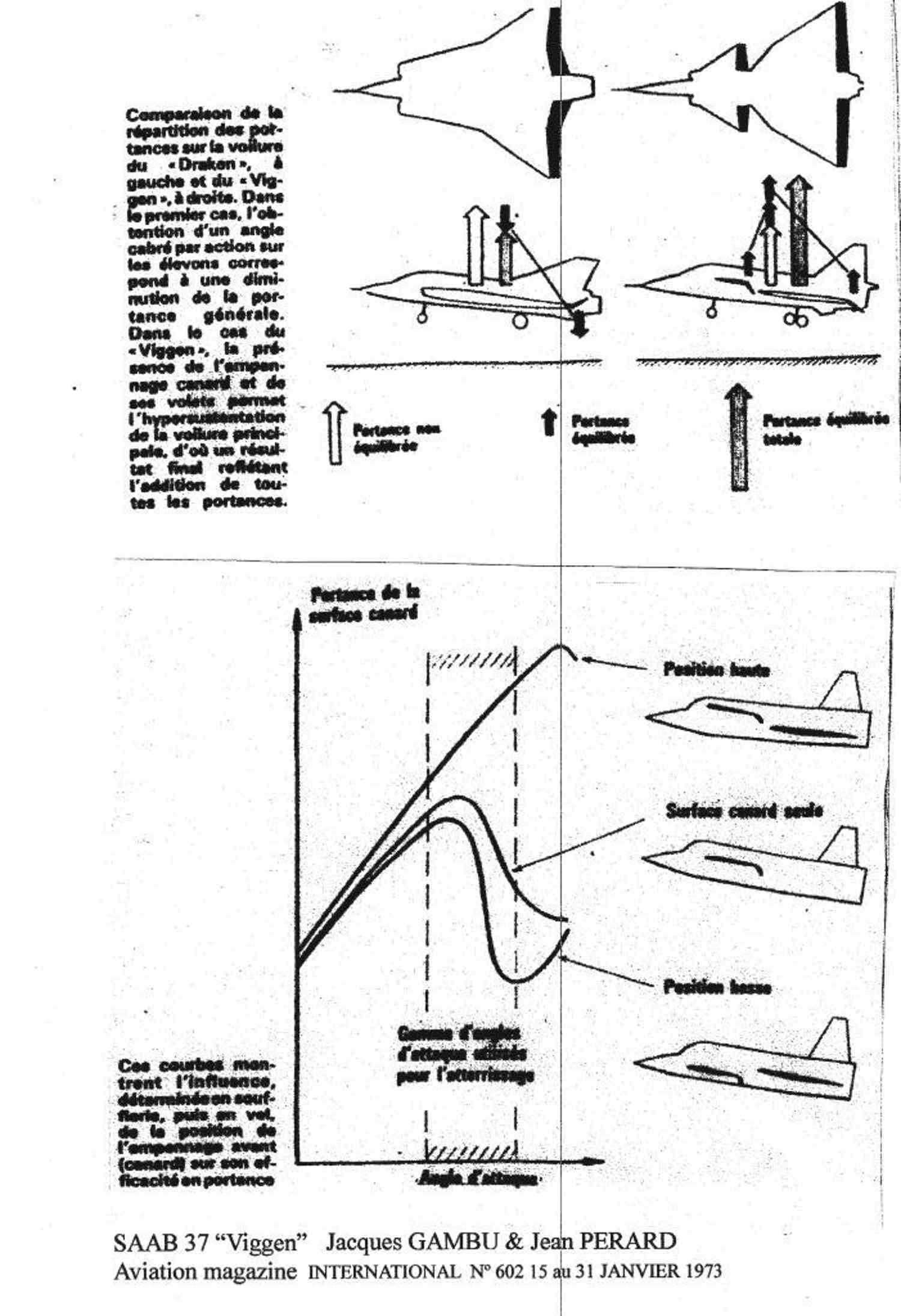
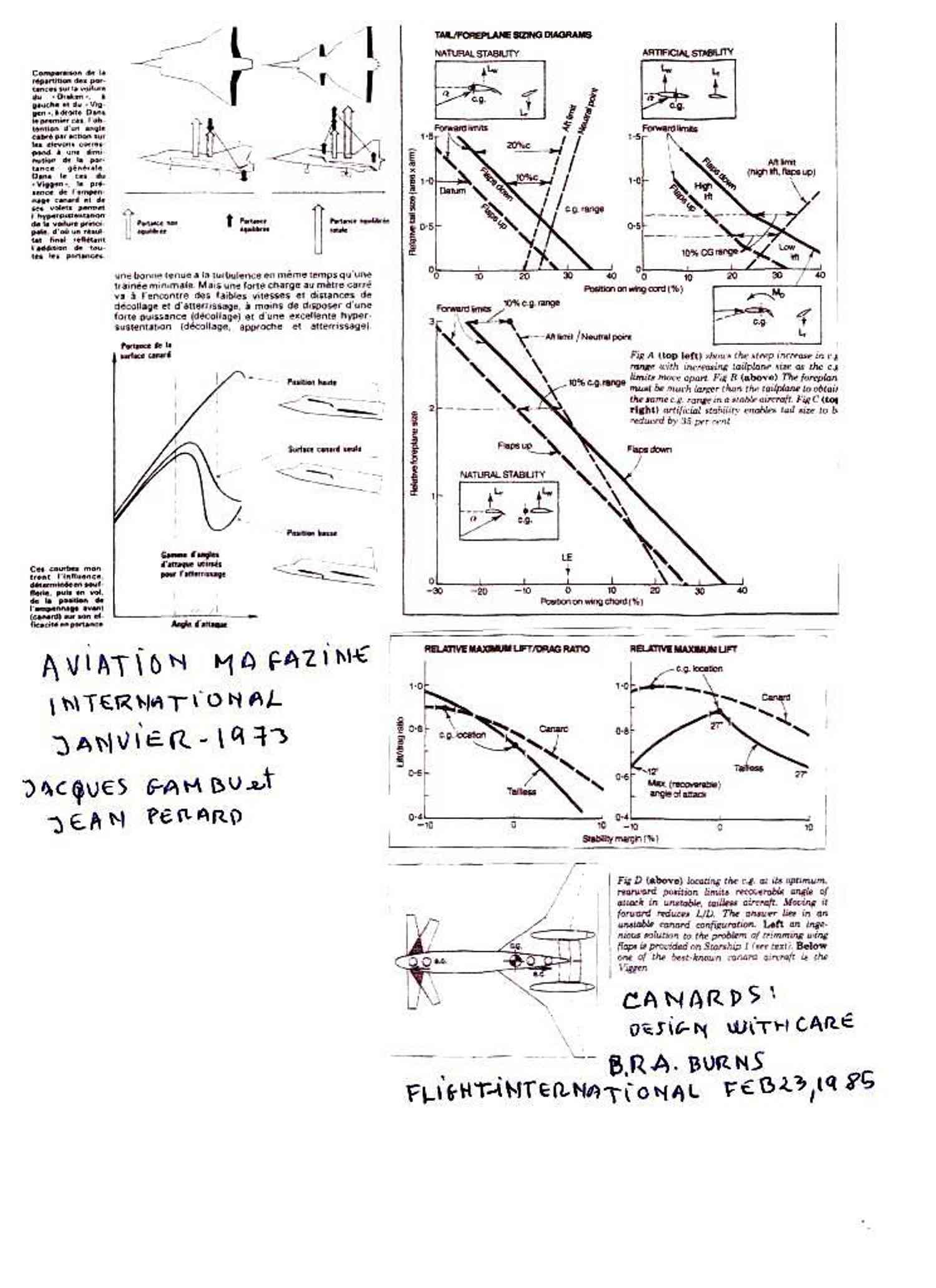
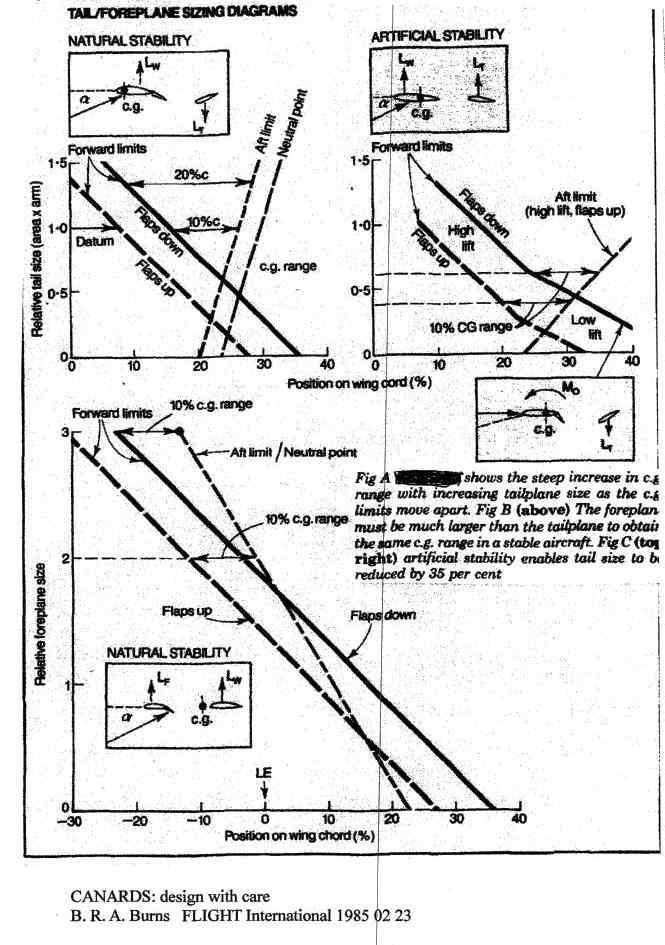
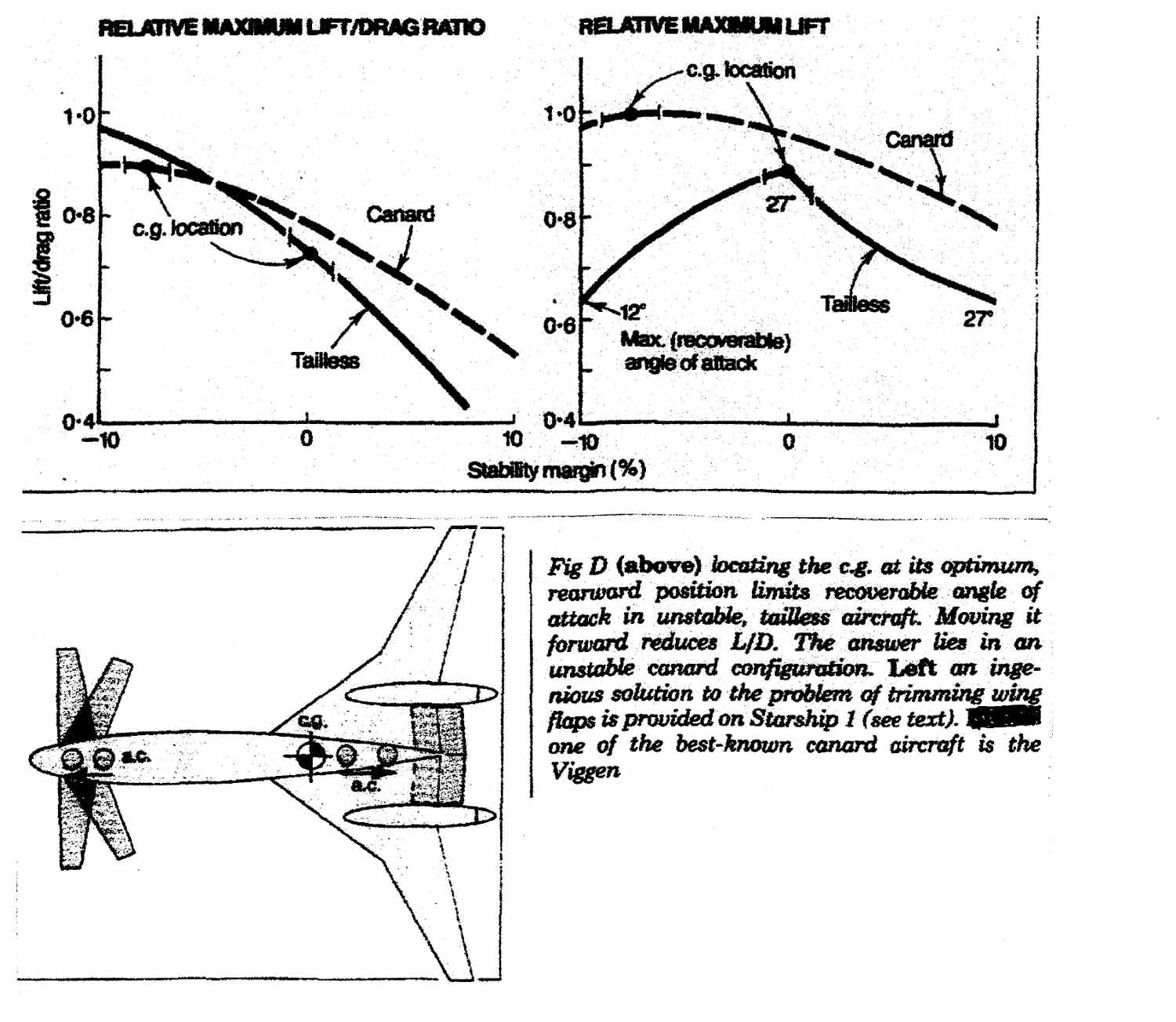
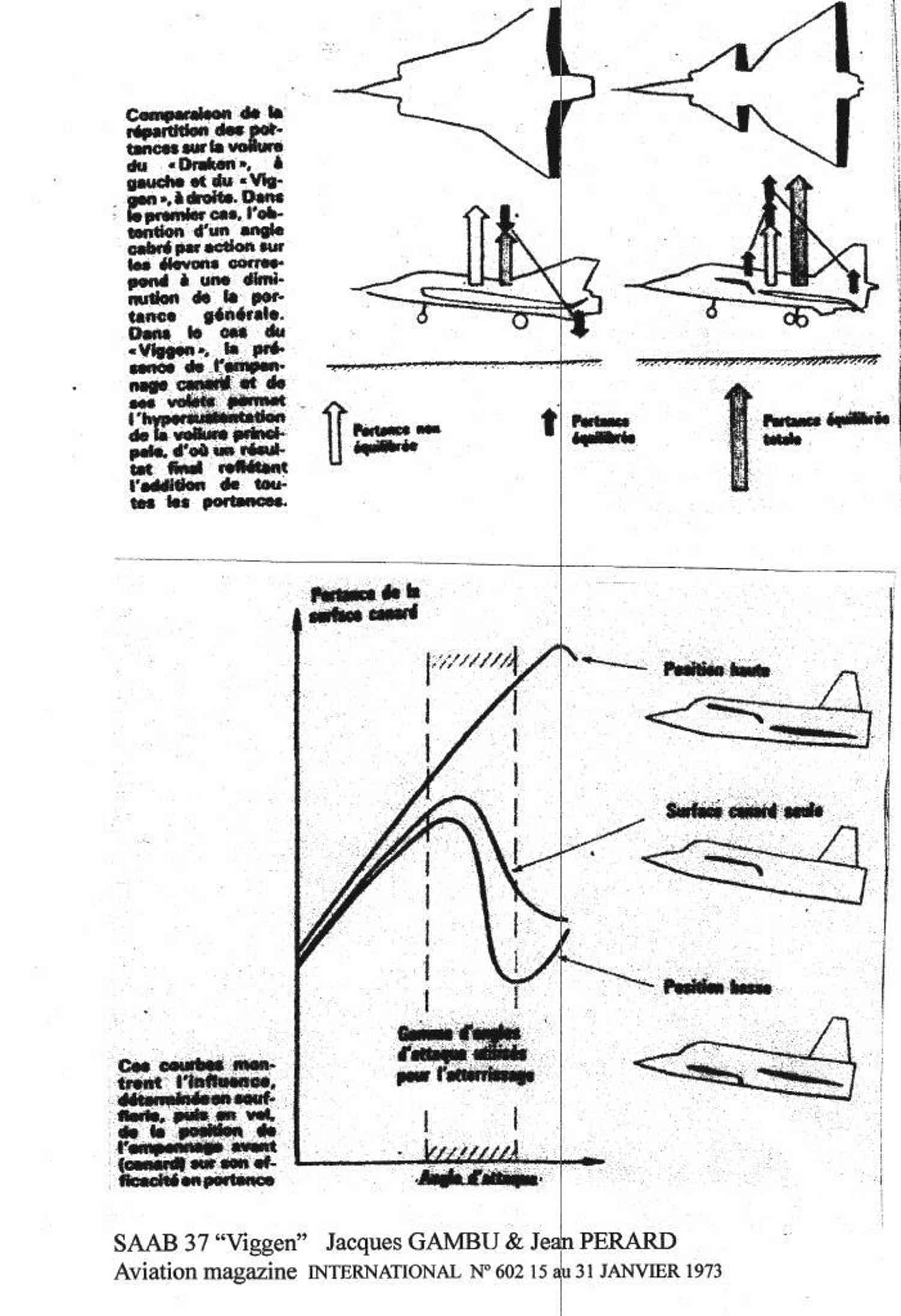
Hi!: I've just scanned my documents about canards, those by RBA Burns are well
known, and of open free access in the Flight International site, archive section,
but the other is from a french aviation magazine, and the cartoon showing different
results in TO/L conditions depending on the attack angle and the position of the
canard foreplane, above or below the main wing plane, may be not so known, as
I'm not aware of english language publications of these images.
Have a nice weekend, best regards, salut +
Jose Gros-Aymerich
E-28033 Madrid, Spain
--
The Rotary Engine News Letter. Powered by Linux.
ACRE NL web site.
http://www.rotaryeng.net
You Tube
http://tinyurl.com/amz8apm
Copyright 1998-2013 All world wide rights reserved.