I was reading the SDS EFI web site and notice they don't offer rotary
ignition support.
This is just an idea at this stage.
A simple ignition system using RX8 coils with a 2.5 ms
dwell time has a problem.
7000 RPM is 116.7 rev per second or 42,000 degrees per
second or one e-shaft degree in .02 ms.
1 ms is 1/1000 of a second.
So the ignition will be retarded 42,000 / 2.500 or
16.8 degrees. What is needed is advance at high RPM.
In the old days that was done by a distributor with mechanical and
vac advance.
That is for a real simple system that fires when the
CAS sends a trigger to the coil. A computer can fix this
but there may be a simpler way.
Hall Effect sensors are cheap and several can be used.
Lets say we have 4. The first one is used for 0 to 2000 RPM.
A small magnet would be mounted on the e-shaft pulley.
#1 0 to 2000 RPM 0 advance for good starting.
#2 2000 to 4000 14 degrees
#3 4000 to 6000 22 degrees
#4 6000 to 8000. 33 degrees
There is a device called called a data selector.
It is just a black box that can select one of these
HE sensors depending on RPM. Or the pilot can select one.
The black box can be controlled by a computer or an
analog to digital converter chip.
These charts are for cars but we have used a fixed advance
22 degrees BTC with good results.
If you set it at a greater number to compensate for the
coil 2.5 ms dwell that means you would have 16.8 +_22 which
might cause starting problems.
Just thinking out loud here.
Paul Lamar
Paul, This would be a backup for a Hall effect sensor failure where the
pilot could select one of the other timing points. Might need a toggle
switch to bypass the variable timing system and read only one at 22
degrees.
george grimes
Yes built in back up.
Paul Lamar
Paul,
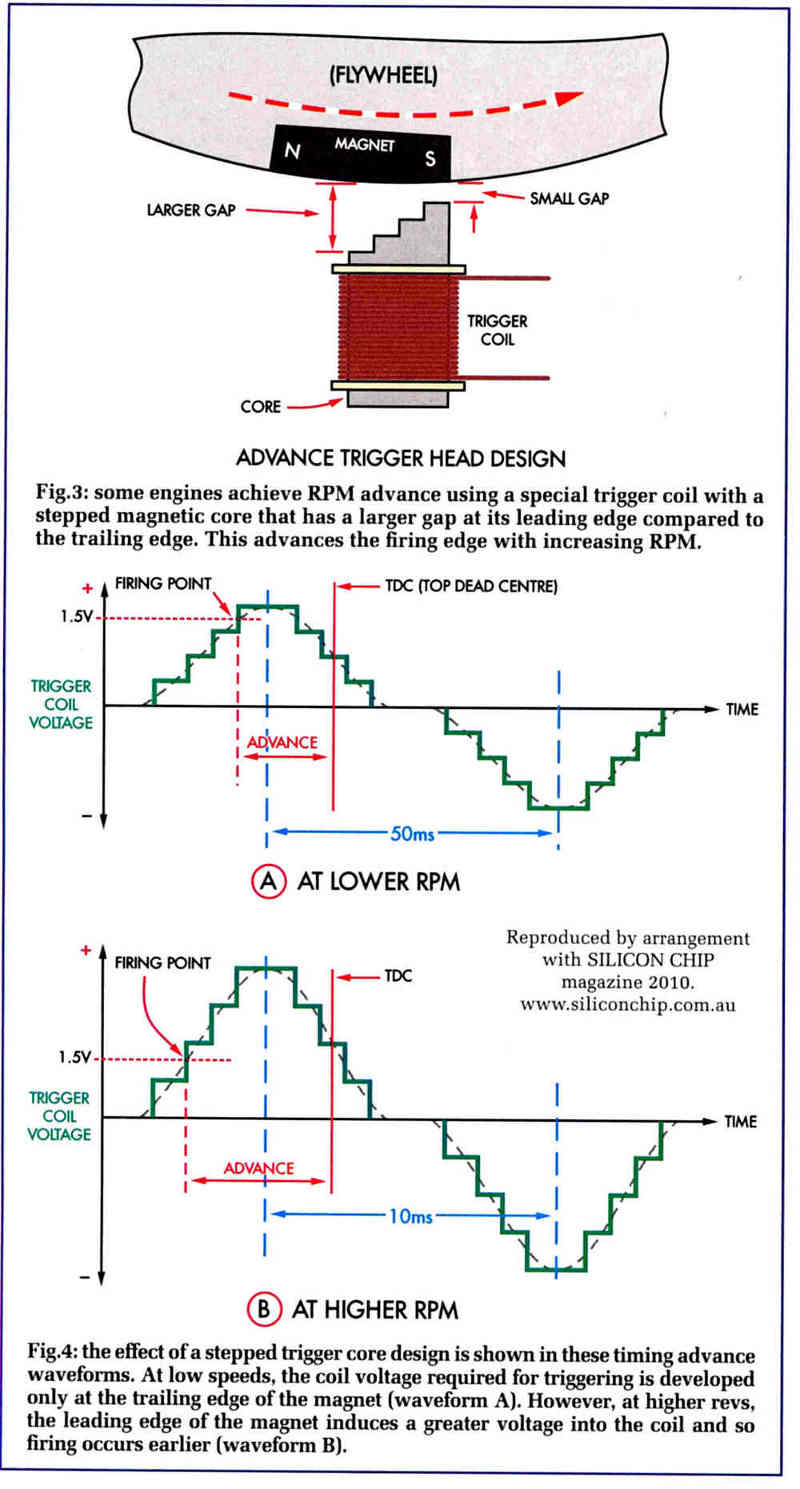
I have mentioned before that Kawasaki used a hall effect sensor to advance
the timing on their 2 cycles by running a permanent magnet stator with a
projection and gapping the hall effect sensor as wide as you could get it
to trigger. They got a thyristor that triggered at at about 50% of max
voltage and the increase in the sine wave amplitude with rpm would trigger
the ignition sooner. Very effective and no moving parts.
Bill Jepson
Yes I remember that. Only a few degrees.
We are talking 10 and 20 degree difference here.
Paul Lamar