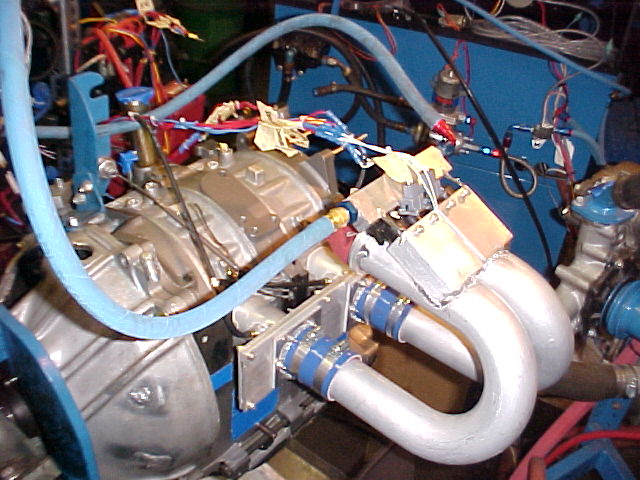
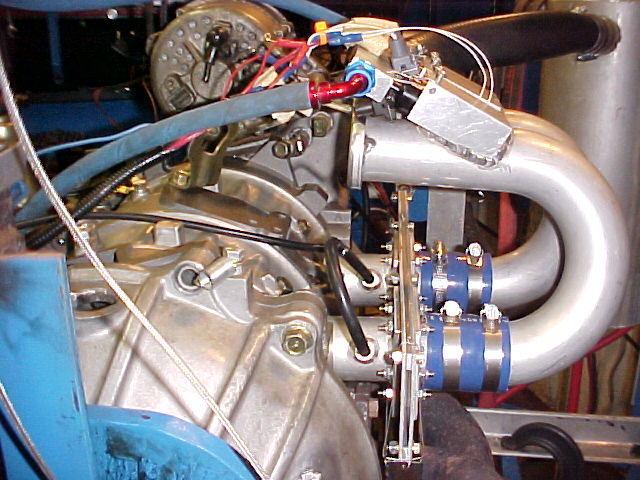
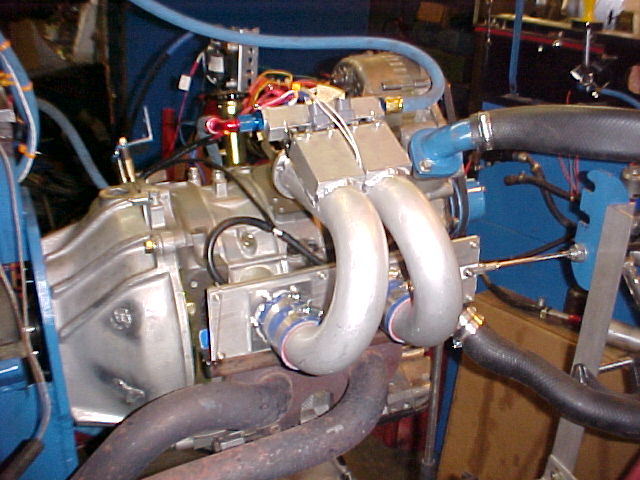
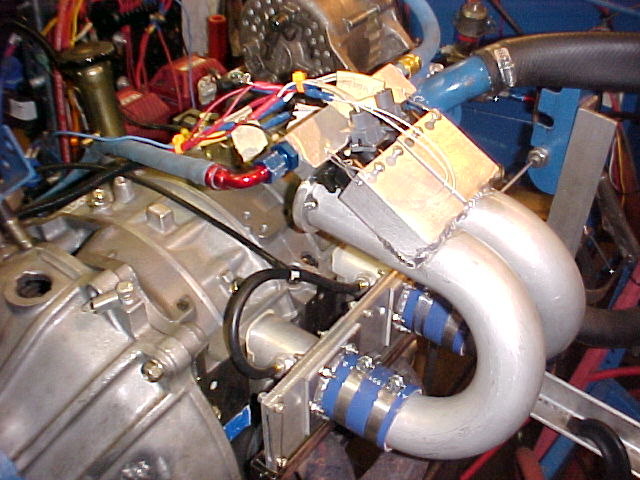
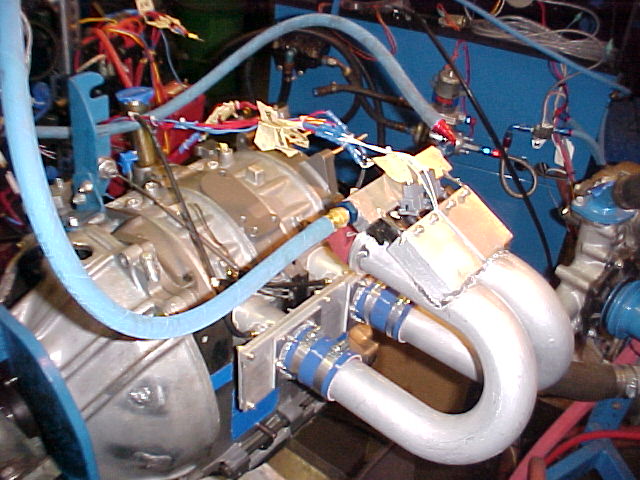
Alex and I visited Tracy today and the subject of muffler came up.
Here is some info on our coax muffler.
The best muffler for a rotary is 3 to 8 feet long about 4 to 5
inches in diameter. That gives the lowest aero drag for a given
silencing. Lowest frontal area. Mufflers work by the exhaust
gases rubbing on the metal surface losing kinetic energy to skin
friction and losing heat to the metal surfaces. The cooler the
gases in a pipe the lower the gas speed. When high speed gas
exits a pipe there is a sudden expansion that causes the noise.
The idea here is to cool the gases before they get to the end of
the inner pipe.
The inner tube is best done in .045 Inconnel but there is a
trade off with thickness. If you make the inner tube 2 inches
in diameter and use 321 SS make it .065 thick with a bunch of
holes drilled in it. The outer tube can be .030" thick 321 SS
as it will always run cooler. Also make the front of the
muffler look like this.
Don't drill any holes for the first 8 to 10 inches. The slip
stream will blow cooling air down between the coaxial tubes. At
the back end make the inner tube 6 inches shorter than the outer
tube. That will act as an ejector to draw cooling air between
the two tubes. Patent applied for:)
A 2 inch diameter SS tube .065 thick 72 inches long will weigh
about 8.8 pounds.
A 2 inch diameter SS tube .065 thick 72 inches long will weigh
about 8.8 pounds.
A 4 inch diameter SS tube .030 thick 72 inches long will weigh
about 7.50 pounds.
A 2.5 inch inner tube and a 5 and 1/2 inch outer tube may give a
little less back pressure for a weight trade off.
Tracy, if you get this reply with "OK".
Paul Lamar
==================================================
Here is the sound file.
BTW Tracy there is a period after .com on your email address on your web
site. If somebody cuts and paste that address to send an email some
email programs will barf on that.
tracy@rotaryaviation.com.
and
support@rotaryaviation.com.
Paul Lamar
Hi: very nice video and comments. May I have read that mufflers also
work bybreaking the waves, and are tuned to specific frequencies and
resonating frequencies?My brother Carlos, who is an aeronautical
engineer with a long time affection to2-stroke engines, sounds to me as
having bought some books on mufflers andexhaust pipes for 2-Stroke
engines long ago, when the dirty old oddities that are today 2-Stroke
engines were still in production.
There was also a pair of SAE Papers on the effect of intake and exhaust
piping and on numerical simulations, both by Mr. Ming-June Hsieh et al,
the first entitled:"The intake and exhaust pipe effect on a Rotary
Engine Performance", it failedto be available for bought at sae.org,
because the authors didn' get the Visa on timefor attending the meeting,
and as papers were not presented in the meeting, it were notavailable.
The documents about the Suzuki RE-5 said that a low pressure, low
resistance exhaust system is good for RCEs, but you're the ones who do
have the actual experience.
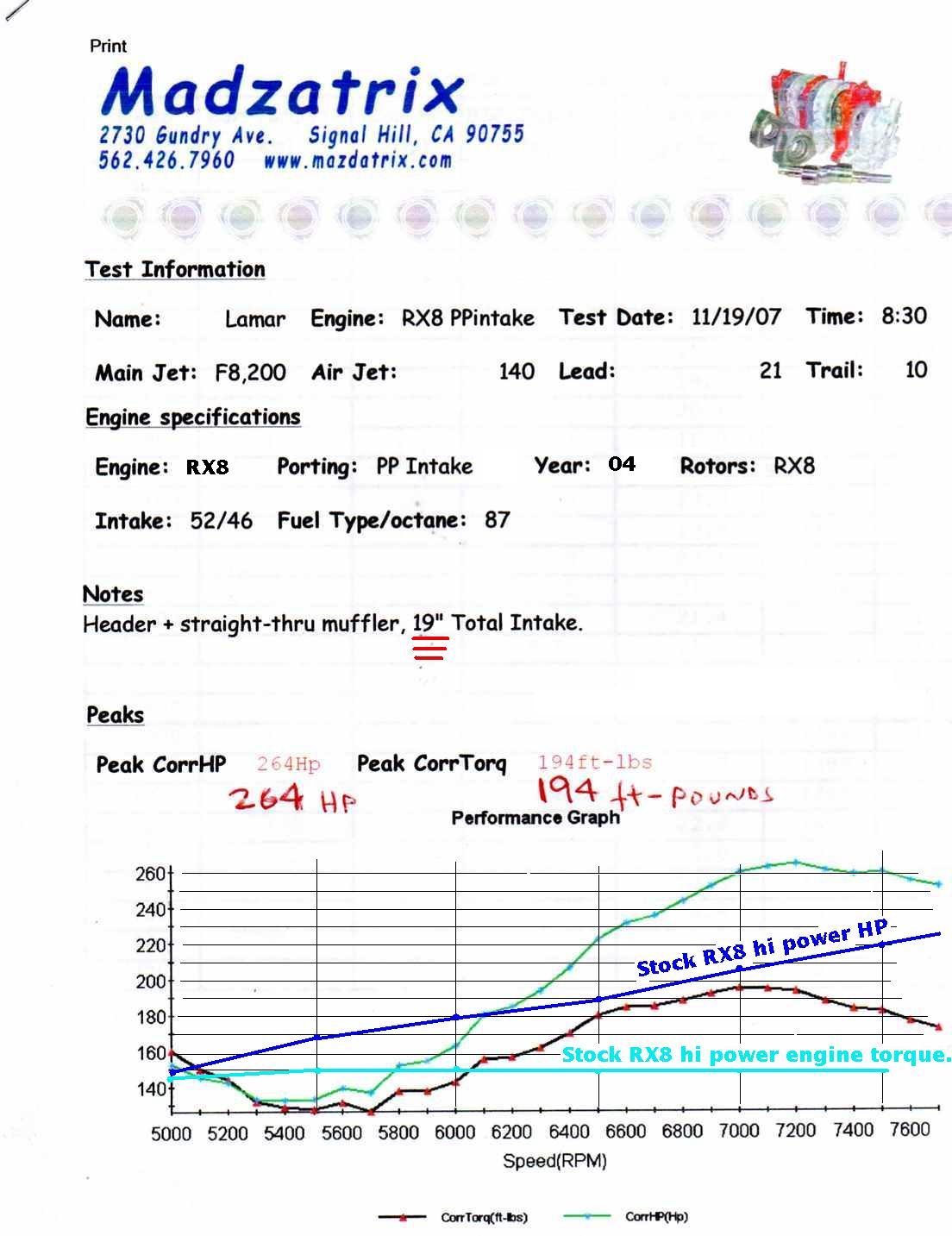
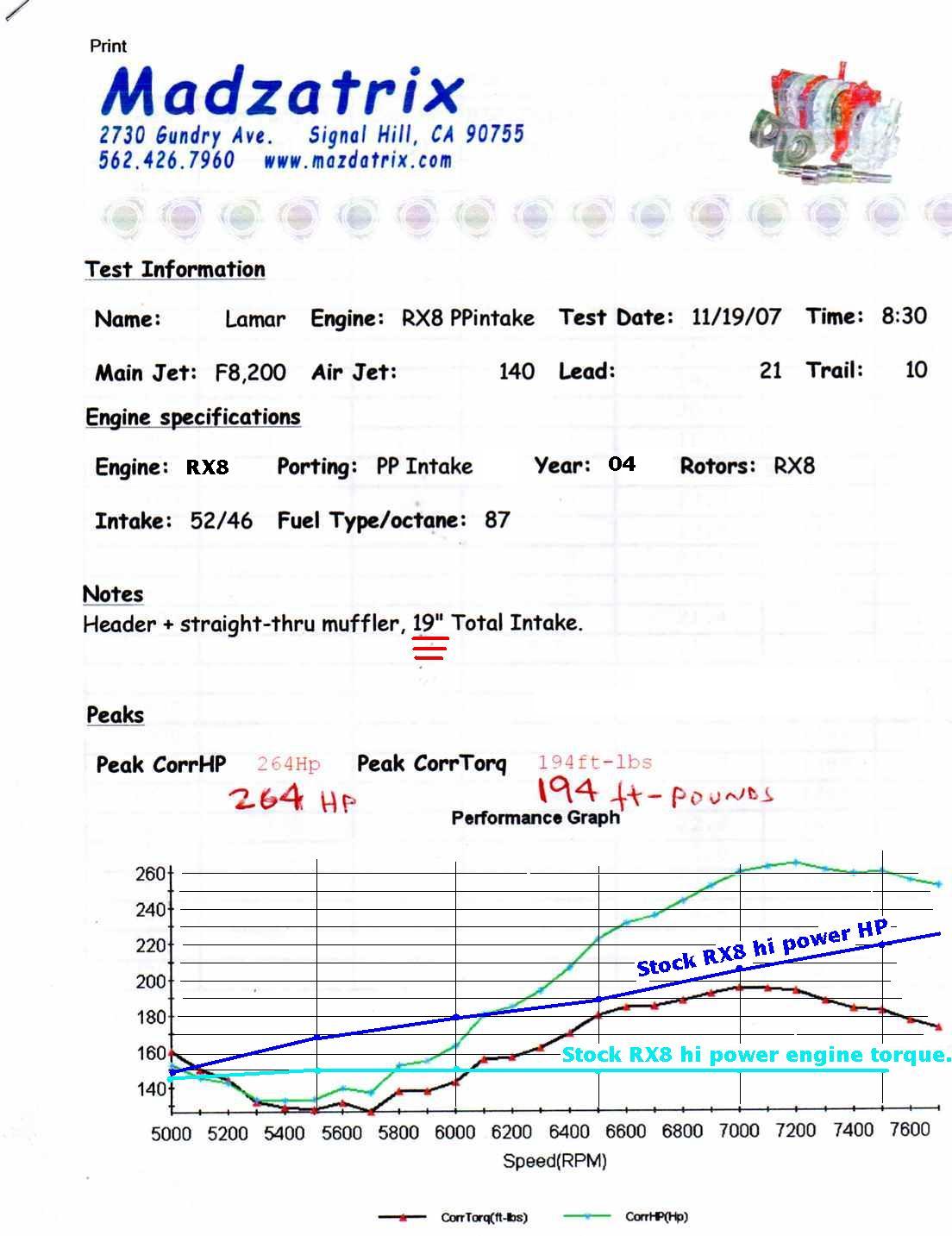
Do you have actual or real world data on the Rx-8 Renesis an author said
in this forum was going to test with a Peripheral Intake Port, while
preserving the Side Exhaust Ports?Paul Lamar's opinion on this seemed
very positive, and many people in the RCE car world would like knowing
more about this combination, peripheral intake-side exhaust.
Thanks, regards, salut +
Jose G A Madrid, Spain
We optimize the intake for 7500 RPM takeoff.
Here is a you tube video with about 82,000 hits.
http://www.youtube.com/watch?v=NKJ00JsnS8A
Paul Lamar